.avif)
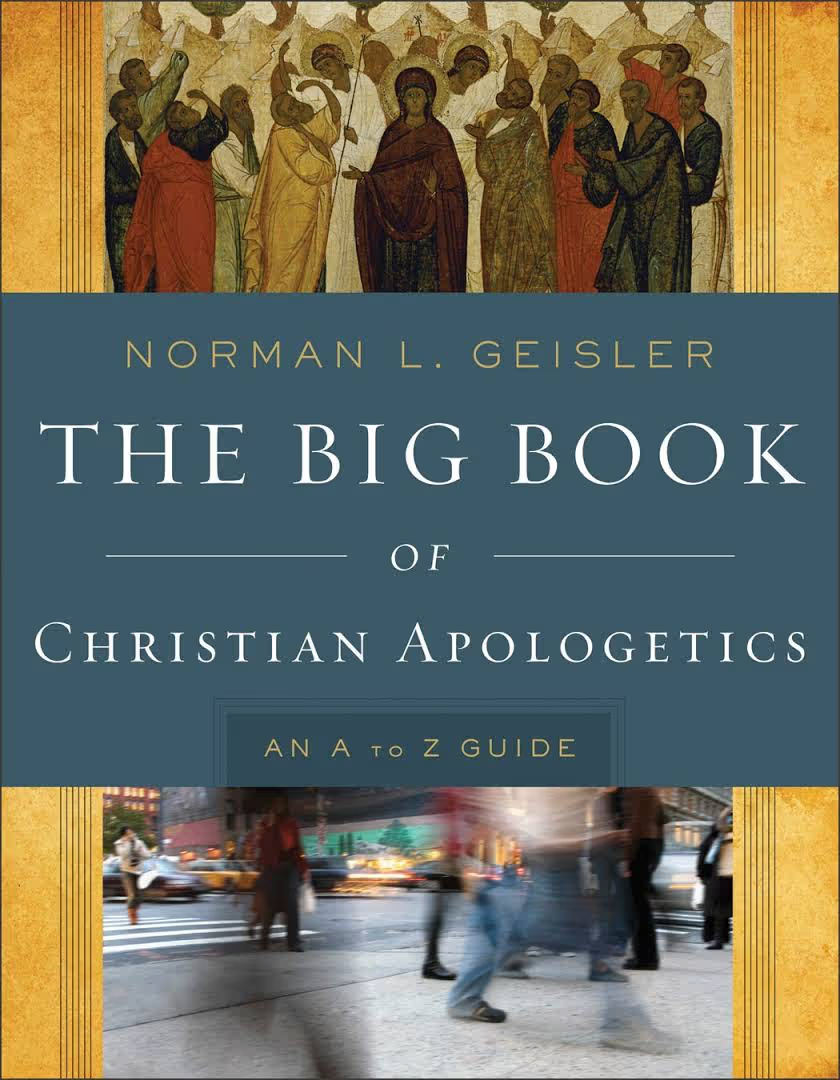
The Big Book of Christian Apologetics
A concise A-to-Z reference that distills Geisler’s larger Baker Encyclopedia of Christian Apologetics into brief, accessible entries for quick lookup. Topics span arguments for God’s existence, the reliability of Scripture, Jesus’ deity and resurrection, miracles, the problem of evil, ethics, world religions/cults, science-faith questions, and key philosophical terms and fallacies—each entry summarizing definitions, core arguments, and common objections with responses. Designed as a one-volume handbook for students, pastors, and lay readers, it reflects Geisler’s classical, philosophy-forward approach to defending Christianity.
The significance of even one fulfilled prophecy lies in its ability to serve as a divine signature, confirming the supernatural origin of the Bible. As Norman L. Geisler explains in The Big Book of Christian Apologetics, a single clear case of fulfilled prophecy can establish the credibility of the entire prophetic system. This is because prophetic predictions are often difficult to fulfill naturally, especially when they are specific and detailed.
When a prophecy is fulfilled precisely as predicted, it points to divine foreknowledge and power. Even if most predictions could be explained by natural means, the existence of just one genuine, fulfilled prophecy strongly supports the idea that Scripture is inspired by God. Therefore, critics must explain away all prophetic fulfillments to discredit the biblical prophetic record, which is a formidable challenge.
According to Norman L. Geisler in The Big Book of Christian Apologetics, it would require a supernatural power for Jesus to manipulate the numerous events necessary for the fulfillment of Old Testament prophecies. For example, he had no control over where he was born, how he was born of a virgin, when he would die, or his tribal lineage.
Furthermore, the specific reactions of people around him—such as John the Baptist heralding him, the reactions of his accusers, the soldiers casting lots for his garments, and the piercing of his side—were all beyond his control. The only way these could align perfectly is if Jesus possessed divine power, which aligns with the Christian understanding of his divine nature.
According to the principles discussed in Norman L. Geisler's The Big Book of Christian Apologetics, the mind cannot be fully reduced to material processes. While the brain and physical processes are involved in mental activity, consciousness, thoughts, and personal identity go beyond mere physical interactions.
The mind is capable of roaming beyond the physical universe, engaging in abstract thought, moral reasoning, and self-awareness. These qualities suggest that the mind is more than just a collection of neurons or electrons. Only a self-conscious being can truly possess genuine thoughts, and this points to a reality beyond material explanation.
The Bible clearly teaches that human beings are created by God. According to Genesis 1:27, humans are made in God's image. God is eternal, as stated in 1 Timothy 6:16, and all creation originates from Him, as affirmed in John 1:3 and Colossians 1:15–16.
Importantly, the Bible indicates that every human begins at conception (Psalm 139:13–16; Matthew 1:20). This means that our souls are created by God at the moment of conception, and there is no biblical support for the idea that souls preexist or reincarnate into new bodies.
The Bible teaches that upon death, the soul leaves the body and enters a disembodied state, where it awaits resurrection. The Apostle Paul expressed this hope when he said, “We are confident, I say, and would prefer to be away from the body and at home with the Lord” (2 Corinthians 5:8).
Paul also expressed a desire to be with Christ immediately after death (Philippians 1:23). The souls of martyrs and others who have died are conscious and present with God, as seen in Revelation 6:9 and Luke 23:43. Even Moses and Elijah, who lived centuries earlier, engaged in conversation during the Transfiguration (Matthew 17:3).
There is no biblical support for the idea that souls reincarnate into new bodies. Instead, Scripture teaches that the soul remains conscious in the spirit world until the resurrection.
The problem of evil, when viewed through the lens of reincarnation, suggests that suffering in this life results from evil committed in a previous life. But this leads to an infinite regress—an endless chain of past lives causing evil and suffering.
Since an infinite regress in time is impossible—because if there were infinitely many moments before today, then today would never arrive—this challenges the idea of endless previous lives. Therefore, reincarnation as traditionally understood cannot hold, because it relies on an infinite chain that cannot logically exist.
If there was a first life where evil originated due to free choices, then evil is rooted in individual free will, aligning with the biblical view that evil entered the world through free moral agency, such as Lucifer or Adam.
The view that redactors made deliberate and substantial content changes to prophetic writings is generally considered unacceptable within biblical theology. Scripture itself warns against adding to or taking away from God's Word.
Passages such as Deuteronomy 4:2, Proverbs 30:5–6, and Revelation 22:18–19 clearly instruct that God's revelation must remain unaltered. These warnings emphasize that no one should add to or subtract from God's spoken or written word.
Therefore, the idea of redactors intentionally changing the content of prophetic messages contradicts God's explicit commands and the integrity of Scripture.
Many religious traditions have their own views on what occurs after death and the ultimate spiritual goal. For example, Buddhists believe that at death, the unconscious soul (vinnana) continues, but the self—which includes intellect, emotions, and consciousness—is obliterated. The karma accumulated influences the cycle of rebirth called samsara. Buddhists interpret nirvana as the final state of liberation, attained through the grace of Buddha, where the cycle of rebirth ends.
Similarly, Jainism and Sikhism follow patterns akin to Hinduism, with Jainism emphasizing liberation through strict ethical conduct and Sikhism focusing on union with God through devotion. Despite differences, these traditions often see the cycle of rebirth as something to be transcended, aiming for a final state of spiritual union or liberation.
Хотите узнать больше? Задайте вопрос о вере
У вас есть вопросы, опасения или надежды? Чувствуете себя потерянным, обремененным или одиноким? «Задайте вопрос о вере» — это мягкое руководство, основанное на Священном Писании и мудрости Церкви. Найдите надежду и силу уже сегодня!

Нужна консультация или беседа со священником?
Напишите нам, и мы постараемся ответить на все ваши вопросы.

