.avif)
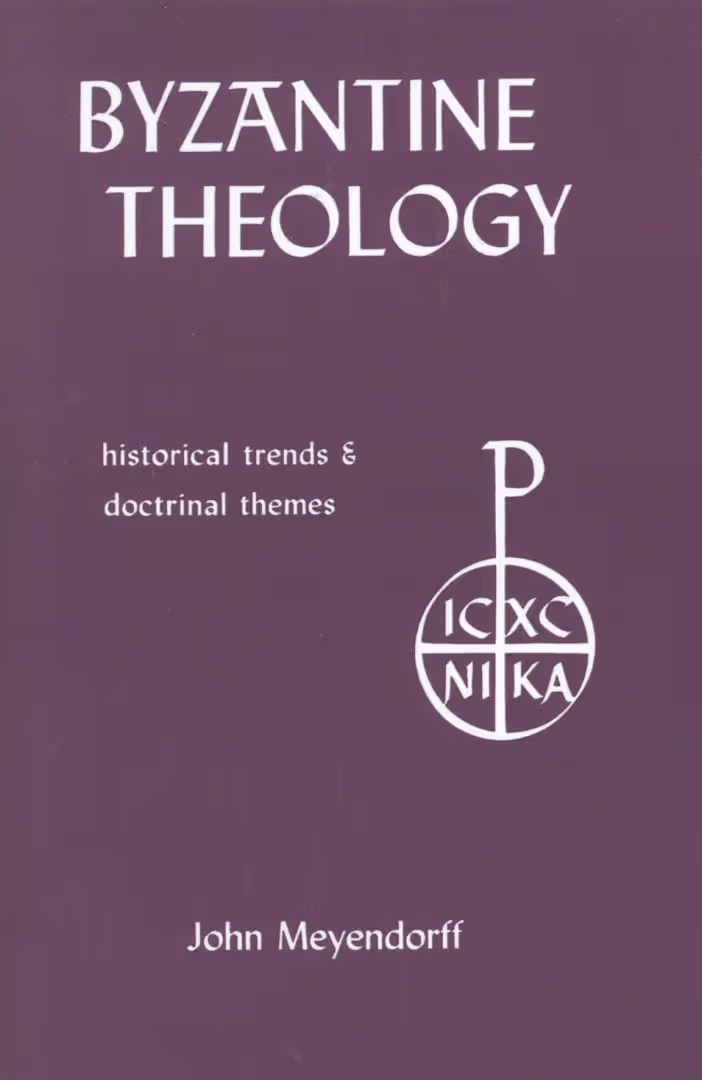
Byzantine Theology : Historical Trends and Doctrinal Themes
A classic, first-in-English synthesis of Byzantine Christian thought that traces its historical development and then presents key doctrinal themes—from the Trinity and Christology to Scripture–Tradition, icons, liturgy, and especially theosis and the spirituality of hesychasm/Palamas—showing how Eastern theology understands salvation as participation in God and how this vision endured and matured across centuries.
We chose it because it’s the most accessible, authoritative single-volume map of Orthodox theology’s history and core ideas—ideal for orienting seekers and students in the Find2God library.
The key marks of the true Church of God are unity, holiness, catholicity, and apostolicity. These marks are not merely human qualities but are divine signs given to a community through the Spirit of God.
Since the Eucharist is the central act of worship and the source of these marks, a local church where the divine liturgy is celebrated embodies these qualities. The Eucharist signifies the fullness of the Kingdom of God, which is anticipated in the liturgy. This fullness cannot be partial or divided; it is indivisible and divine, reflecting the unity of Christ's Body.
How do you experience the unity and holiness of your local church through the Eucharist?
The Latin West and Byzantine Christianity approached the Trinity with different emphases that shaped their theological expressions. The Latin tradition, especially since Augustine, focused on the unity of God's nature as the starting point of Trinitarian theology. They considered personality as a mode of nature, emphasizing the divine unity as the primary truth.
In contrast, Byzantine Christianity experienced the Trinity as a primary and concrete experience, emphasizing the distinct persons—Father, Son, and Holy Spirit—as revealed in salvation history. The unity of God's nature was an article of faith, coupled with the recognition of the absolute unknowability of divine essence. This experiential approach kept the focus on the divine persons as they are revealed through divine activity and salvation history.
How do you experience the presence of the divine in your own journey of faith?
The Filioque controversy, which involved the addition of the phrase and the Son to the Nicene Creed by the Western Church, became a significant point of contention. It symbolized deeper differences in understanding the nature of the Trinity and the relationship among the divine persons.
This theological disagreement contributed to the stiffening of positions and ultimately became one of the major causes of the Great Schism between East and West. The controversy highlighted the contrasting approaches: the East emphasizing the mystery and experiential knowledge of the Trinity, and the West emphasizing the unity of divine being as a starting point.
Have you ever encountered misunderstandings or disagreements that stem from differing perspectives on core beliefs?
Modern theology faces a crisis in explaining and justifying the being of God as a philosophically definable entity. This difficulty echoes the ancient debates, especially the challenge of articulating the divine mystery without reducing it to mere philosophical concepts.
The modern crisis, including ideas like the 'death of God,' prompts a return to an existential and experiential approach, emphasizing salvation history and personal encounter with the divine. As Karl Rahner suggests, without experiencing the Father, Son, and Spirit in salvation history, it becomes impossible to truly conceive of their distinct persons within the one God.
How do you find your own faith shaped by personal experience and salvation history?
In Byzantine theology, as outlined by Johannes Meyendorff in Byzantine Theology, Pentecost is not merely the incarnation of the Spirit, but the moment when the gifts of the Spirit are bestowed upon the apostles and the early Church.
The Spirit does not reveal His Person in the same way as the Son does through Jesus, nor does He en-hypostasize human nature as a whole. Instead, the Spirit communicates His uncreated grace to each individual person within the Body of Christ. This means that the new humanity is realized in the hypostasis of Christ, but it only receives the gifts of the Spirit.
The distinction between the Spirit's Person and His gifts becomes especially important in Byzantine theology, particularly during the controversies of the thirteenth and fourteenth centuries. Figures like Gregory of Cyprus and Gregory Palamas emphasized that at Pentecost, the apostles received the eternal gifts or energies of the Spirit, but there was no new hypostatic union between the Spirit and humanity.
Pentecost, therefore, signifies the outpouring of divine gifts that enable personal communion with God, emphasizing both the community’s spiritual structure and individual experience.
How do you personally experience the gifts of the Spirit in your faith life?
In Byzantine theology, as explained by Johannes Meyendorff in his work Byzantine Theology, the personal independence of the Spirit is deeply intertwined with the mystery of redemption. Redemption is understood as both a recapitulation of mankind in the divine-human hypostasis of Christ, the new Adam, and a personal encounter between each individual and God.
This means that while the unification of human nature is a divine gift freely given by God, the personal encounter with God depends on human freedom. Christ becomes the perfect image of humanity, and the Holy Spirit grants each person created in God's image the possibility of fulfilling that divine likeness. The Spirit, in this context, lends His hypostasis to human nature, and gives His divinity to individuals, enabling a personal relationship with God.
Divine grace and divine life are ultimately one reality, but because God is a Trinity, there is a necessary distinction: between the unapproachable divine Essence, the three hypostases (Persons), and the energy or grace through which God enters into communion with creatures.
How do you experience the personal encounter with God in your own faith journey?
Byzantine spirituality has traditionally not focused on developing a detailed, systematized code of Christian ethics. Instead, it emphasizes the pursuit of perfection and holiness, inspired by the mystical and eschatological nature of the faith. The Church's authority was often called upon to resolve specific issues, but the overarching spiritual call was to become saints and 'athletes of the faith.'
This approach is characterized by a maximalist vision—striving for the highest spiritual ideals—rather than legalistic rules. Byzantine Christians looked to the saints and monks as models of Christian behavior, especially through monastic literature, which reflects a profound quest for the Spirit. Hymns and writings, such as those of Symeon the New Theologian, express a deep longing for union with the Holy Spirit, emphasizing personal transformation over external moralism.
How does this focus on spiritual perfection influence your view of moral and ethical living?
The Holy Spirit is the divine source of the Church's 'apostolicity' since Pentecost, ensuring that the Church remains faithful to the original Gospel. Through the Spirit, the Church maintains its doctrinal integrity and spiritual vitality across generations. The various ministries within the Church, especially the episcopate (bishops), are instituted by the Spirit to preserve this continuity, structure the community, and safeguard its mission.
This divine guidance guarantees that the Church's teachings and sacraments remain authentic, effective, and true to Christ's message. It is through the Spirit's ongoing presence that the Church can adapt to new contexts while remaining rooted in divine truth.
Have you experienced the Spirit guiding your understanding or practice of faith?
Byzantine theology, as articulated by Basil and other church fathers, affirms that the Holy Spirit is inherently holy by nature. Unlike angels or other created beings, who receive sanctity as a gift or grace, the Spirit possesses sanctity essentially and eternally.
This divine sanctity is the foundation for all creation's sanctification. The Spirit is the ultimate source of holiness, and through His action, creation, angels, and humanity are sanctified. The Holy Spirit's role in salvation is to sanctify, creating a koinonia—a communion—between humans and God, and among believers themselves, forming a community of saints. This sanctification is a divine act that elevates and unites all in Christ.
Do you see God's holiness reflected in your daily life and the way you relate to others?
According to the patristic understanding presented in Byzantine Theology by Johannes Meyendorff, Christ's death as a human being involved the separation of His soul from His body. However, His divinity, the divine hypostasis of the Word, remained inseparable from both. This means that the divine hypostasis of Christ was never divided into two hypostases; instead, it remained one, unbroken, hypostatic reality.
Even at the moment of death, Christ's divine nature continued to unite His human body and soul through the single hypostasis of the Word. This profound unity underscores that Christ's divine hypostasis is ever one, and His human nature, though separated physically in death, remains hypostatically united through the divine Logos. This unity is the foundation of the Christian understanding of Christ's resurrection and victory over death.
How do you experience the unity of Christ's divine and human natures in your faith journey?
The liturgy of Holy Week, especially on Good Friday and Holy Saturday, vividly reflects the deep theological truths about Christ's hypostatic union and His triumph over death. On Good Friday, as Christ gives up His spirit, the hymns begin to proclaim His divine nature, emphasizing that His divine hypostasis remains united with His human body even in death.
During Holy Saturday, the liturgy celebrates the hidden yet decisive victory: 'Though the temple of Thy body was destroyed in the hour of the passion, yet even then one was the hypostasis of Thy Divinity and Thy flesh.' This affirms that Christ's divine hypostasis was never broken, even in death, and that His death was a participation in the divine life.
This liturgical rhythm underscores the core Christian message: God Himself tasted death hypostatically in Christ, and through this, death was defeated. It is a profound act of divine love and power that continues to be celebrated in the Church's worship.
How does participating in these liturgical mysteries deepen your understanding of Christ's victory?
Willst du mehr wissen? Frage Gottes Wort!
Hast du Fragen, Sorgen oder Hoffnungen? Fühlst du dich verloren, belastet oder allein? „Frage Gottes Wort“ bietet dir sanfte Führung, die in der Heiligen Schrift und der Weisheit der Kirche verwurzelt ist. Finde heute Hoffnung und Kraft!

Benötigst du Beratung oder ein Gespräch mit einem Priester?
Schreibe uns und wir werden versuchen, alle deine Fragen zu beantworten.

