.avif)
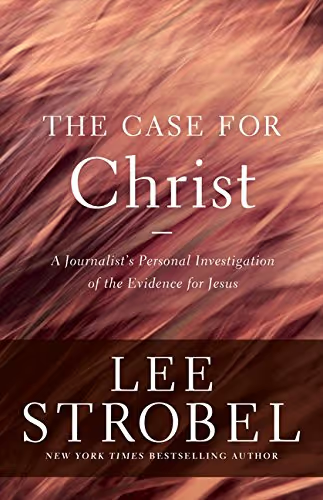
The Case for Christ: A Journalists Personal Investigation of the Evidence for Jesus
A former Chicago Tribune legal editor investigates Christianity’s core claims by cross-examining a dozen scholars on the historical Jesus: the reliability of the Gospels and extra-biblical sources, archaeological and textual evidence, medical details of the crucifixion, and the historical case for the Resurrection—an A-to-Z journalistic inquiry first published in 1998 and reissued in an updated/expanded edition (Zondervan, 2016).
We chose it because its interview-driven, accessible format lets skeptics and seekers weigh primary historical questions with clear expert testimony in one readable volume.
Воскресение служит окончательным подтверждением божественной власти Иисуса, поскольку оно показывает, что власть Бога над смертью реальна и активна. Воскресение Иисуса из мертвых подтвердило его притязания на звание Сына Божьего и подтвердило его учения.
Это событие предвещает будущее воскресение всех верующих, вселяет надежду и уверенность в том, что смерть — это еще не конец. Это чудо подтверждает личность Иисуса как воплощенного Бога и подчеркивает истинность его послания.
Испытывали ли вы надежду и уверенность, которые дает вам вера в воскресение Иисуса?
The missing body of Jesus is central because it supports the claim that Jesus rose from the dead, which is the cornerstone of Christian belief. If Jesus' body was truly absent from the tomb, it confirms the resurrection, demonstrating that Jesus overcame death and is indeed alive.
The resurrection is not just a miraculous event; it is the ultimate validation of Jesus' divine identity and his teachings. As the apostle Paul emphasized in 1 Corinthians 15:17, 'If Christ has not been raised, your faith is futile; you are still in your sins.' This underscores how crucial the empty tomb is to the foundation of Christianity.
How do you personally experience the significance of Jesus' resurrection in your faith journey?
The healing miracles of Jesus, such as the instant healing of ten lepers and the healing of a man with a shriveled hand, are powerful evidence against the idea that hypnosis was responsible. These healings occurred instantaneously and completely, with no suggestion or trance involved.
For example, the ten lepers were healed immediately upon Jesus' command, and the healing was visible and undeniable. Hypnosis, on the other hand, typically involves a trance state that does not produce permanent or complete physical healing. Additionally, the Gospel accounts include detailed descriptions of what Jesus said and did, and they do not portray him as using hypnotic techniques.
How might these miracles influence your understanding of divine power and authority?
The Gospel accounts provide detailed descriptions of Jesus' words and actions, yet they never depict him as engaging in hypnotic techniques or suggesting trance states to his followers. Instead, they portray Jesus performing miracles through divine authority, emphasizing his role as the Son of God.
This absence of any indication of hypnosis supports the view that his miracles were genuine acts of divine power, not psychological tricks. The consistency and detail in the Gospel narratives reinforce their credibility and suggest that these events were extraordinary and rooted in divine intervention.
In what ways do you see divine power at work in the world around you?
The miracle of turning water into wine, as recorded in the Gospel of John, is unique because Jesus did not directly address the guests or instruct the servants about the transformation. Instead, he simply told the servants to fill the jars with water, and then the water was miraculously turned into wine. The master of the banquet, who tasted the wine, recognized it as such without any prior knowledge or suggestion.
This event demonstrates an instantaneous and complete transformation that surpasses what hypnosis can achieve. Hypnosis might influence perceptions or cause temporary changes, but it cannot produce a genuine, spontaneous miracle like this, which involves a supernatural act of creation.
Have you ever experienced or witnessed something that you could only attribute to divine power?
Some skeptics have proposed that the disciples might have been hypnotized into believing the tomb was empty, or that Jesus himself could have used hypnosis to appear to his followers after his resurrection. They suggest that these experiences could be explained as psychological phenomena rather than actual miracles.
However, this explanation faces significant challenges. For example, the resurrection involved multiple witnesses, including skeptics like Thomas, who refused to believe until he saw and touched Jesus' wounds. Hypnosis cannot produce such tangible, verifiable experiences. Moreover, the empty tomb cannot be explained away by hypnosis, as the authorities at the time would have simply produced Jesus' body if it had been in the tomb. The fact that they did not indicates that the tomb was genuinely empty, which aligns with the biblical account of the resurrection.
How do you experience the possibility of divine intervention beyond psychological explanations?
The Gospel of John is supported by numerous historical and textual evidences that affirm its accuracy and authorship. Scholars point to its consistent theological perspective and detailed eyewitness accounts, which align with other historical sources. The dating of John’s Gospel, generally placed around the late first century, further supports its authenticity as a firsthand account of Jesus' life and teachings.
Additionally, the Gospel's unique perspective and detailed descriptions provide a rich, reliable narrative that has been preserved through ancient manuscripts. The careful preservation and the early references to John’s Gospel bolster its credibility as an authoritative record of Christ’s ministry.
How do you experience the reliability of the Gospel of John in your own faith journey?
The title 'Son of Man' emphasizes Jesus' identification with humanity, highlighting His role as the divine Savior who entered into human history. It reflects His humility and His mission to serve as the Redeemer for all people.
This designation also connects Jesus to Old Testament prophecies, especially in Daniel, where the 'Son of Man' is given authority and eternal dominion by God. It underscores His dual nature—fully divine and fully human—and His role in God's plan for salvation.
How does understanding Jesus as the 'Son of Man' influence your view of His empathy and authority?
The writings of early church fathers and creeds, such as the Nicene Creed, serve to preserve and affirm core Christian doctrines about Jesus’ divine nature, His incarnation, death, and resurrection. These early statements of faith were formulated to combat false teachings and heresies, ensuring that the essential truths about Jesus remained consistent throughout history.
They reflect the collective understanding and theological reflection of the early Christian community, emphasizing Jesus’ deity, His obedience to the Father, and His role as Savior. These creeds and writings provide a historical and theological foundation that continues to guide Christian faith and doctrine today.
How do you find these ancient statements of faith meaningful in your personal spiritual journey?
Paul and Peter are pivotal witnesses in the Christian faith, each providing unique perspectives on Jesus' life, death, and resurrection. Paul, in particular, offers a theological witness that emphasizes Jesus' purpose as the Messiah and Son of God, and his writings help shape early Christian doctrine. Peter, as one of Jesus' closest disciples, provides eyewitness testimony of Jesus' earthly ministry and resurrection.
Their testimonies are foundational because they connect the historical Jesus to the divine purpose of salvation. Paul’s letters and Peter’s accounts serve as crucial evidence that affirm Jesus’ identity and mission, reinforcing the truth of the Gospel message. These witnesses help us understand that Jesus’ life was not only a historical event but also a divine act of love and redemption.
How do you experience the testimony of those who have encountered Jesus firsthand in your own faith journey?
Jesus’ miracles are central to understanding His divine authority and identity as the Son of God. They serve as signs that affirm His deity, demonstrating His power over nature, illness, and even death. For instance, miracles such as healing the sick, calming storms, and raising the dead are recorded in the Gospels and are seen as evidence of His divine nature.
Furthermore, miracles confirm the truth of His teachings and His mission to bring salvation. They also inspire faith among believers, showing that Jesus is not merely a moral teacher but the divine Savior who has power over all creation. These acts of divine intervention are foundational to Christian belief in Jesus as the Messiah.
How do you experience the presence of divine power in your own life or faith practice?
The resurrection of Jesus is the cornerstone of Christian faith, and in The Case for Christ, Lee Strobel examines the evidence that supports this miraculous event. Scholars and historians analyze eyewitness testimonies, the empty tomb, and the transformation of Jesus’ followers after his death.
Many argue that the resurrection is the best explanation for the rapid growth of Christianity and the unwavering conviction of the disciples. While it is a supernatural event, the historical evidence presented suggests that it is a credible and pivotal moment in history that affirms Jesus’ divine identity.
How open are you to considering extraordinary events as possible historical realities?
Yes, there are several non-Christian sources that mention Jesus, providing external validation of his historical existence. Roman historians like Tacitus and Jewish historians such as Josephus refer to Jesus as a real person who lived in first-century Palestine. These writings, though not as detailed as the biblical accounts, affirm that Jesus was a significant figure whose life and death left a mark on history.
Such corroboration from outside sources strengthens the case that Jesus was a historical individual, not merely a myth or legend. It invites us to consider the historical context in which he lived and the impact he had on those around him.
Have you explored how historical records outside religious texts can influence your understanding of history?
The reliability of the New Testament is a central question in understanding the historical Jesus. In The Case for Christ, Lee Strobel investigates this by consulting experts who analyze the manuscripts, textual consistency, and historical context of the biblical texts. They affirm that the New Testament documents are among the most well-preserved ancient writings, with thousands of copies and fragments that help verify their accuracy.
Scholars also examine the archaeological discoveries and non-Christian sources that corroborate many details of Jesus’ life and ministry. This evidence suggests that the New Testament is a trustworthy record, providing a solid foundation for faith and historical inquiry.
Have you ever considered how ancient manuscripts are preserved and verified over centuries?
The Gospels are remarkably reliable as historical documents, especially considering their age and the context in which they were written. Scholars have examined their manuscripts, consistency, and archaeological evidence to assess their accuracy.
For instance, the preservation of the Gospels through numerous manuscripts, such as the papyrus and parchment copies, shows careful transmission over centuries. The consistency among the Synoptic Gospels—Matthew, Mark, and Luke—supports their reliability, as does their alignment with historical facts and archaeological findings.
Moreover, the Gospels were written by eyewitnesses or close associates of eyewitnesses, which lends credibility to their accounts. While some variations exist, these do not undermine the core message or historical core of the narratives.
How do you personally approach the historical reliability of the biblical texts in your faith journey?
Хотите узнать больше? Задайте вопрос о вере
У вас есть вопросы, опасения или надежды? Чувствуете себя потерянным, обремененным или одиноким? «Задайте вопрос о вере» — это мягкое руководство, основанное на Священном Писании и мудрости Церкви. Найдите надежду и силу уже сегодня!

Нужна консультация или беседа со священником?
Напишите нам, и мы постараемся ответить на все ваши вопросы.

