.avif)
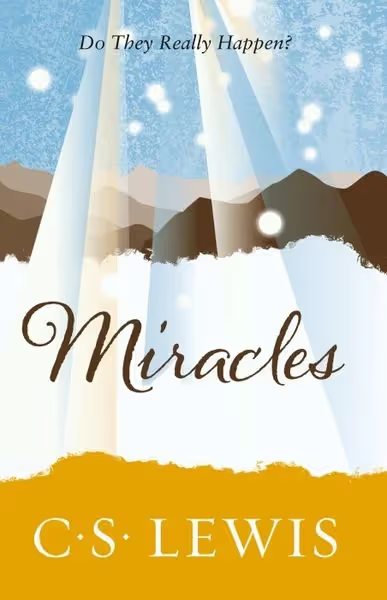
Miracles
Lewis argues that before debating whether any miracle happened, we must first ask whether miracles are even possible, contrasting naturalism (a closed system of cause-and-effect) with supernaturalism (reality open to transcendent causation). He develops the famous “argument from reason”: if strict naturalism were true, our reasoning would be the product of nonrational causes and therefore unreliable—undermining science and knowledge itself. Miracles, he contends, don’t violate laws of nature but are additions from outside the system that nature then integrates (e.g., the Incarnation and Resurrection, his “Grand Miracle,” as the key that makes sense of other miracles). First published in 1947 and revised in 1960 to sharpen the philosophical case, the book remains a classic, accessible defense of miracle-possibility grounded in coherent theism.
We chose it because it gives seekers a lucid, philosophically rigorous framework for why belief in miracles—and especially the Incarnation—makes rational sense today.
Yes, some truths are so clear that they resemble tautologies—statements that are true by definition or logical necessity. For example, to a perfect mathematician, the statement 9 × 7 = 63 is a tautology because it is an obvious consequence of arithmetic.
However, to a child learning multiplication or someone unfamiliar with the system, it is not immediately obvious. To fully grasp such truths, one must have insight into the entire system—like understanding the interconnectedness of nature or the divine order.
In the divine realm, the statement God is love might be a tautology for the seraphim—beings who see God's nature directly—yet it remains a profound truth for us humans, who are still learning to perceive divine love fully.
How do you see the relationship between understanding complex truths and divine revelation?
In Miracles, C.S. Lewis explains that even when we believe an event has been 'decided' in the divine plan—meaning it was determined 'before all worlds'—our prayers still play a vital role.
Lewis suggests that prayer can influence the process leading to an event. It may be a cause that God takes into account when bringing about the outcome. Therefore, our prayers are not futile; they are part of the divine orchestration.
He further clarifies that the event's occurrence is connected to causes that include our prayers. If we cease praying, we might inadvertently remove a contributing cause. Conversely, beginning to pray can introduce a new cause that influences the outcome.
This understanding affirms the importance of persistent prayer, knowing that it can shape the course of events within God's providential plan, even when those events seem predetermined.
How does this perspective encourage you to approach prayer in your daily life?
This is a profound question addressed by C.S. Lewis in Miracles. He suggests that when we ask whether an event is an answer to prayer, we are often trying to determine if God caused it directly or if it simply happened as part of the natural order.
Lewis explains that every event in the world is both a natural cause and a providential act. Just as in Shakespeare's Hamlet, where Ophelia's death results from both the natural breaking of a branch and Shakespeare's poetic purpose, real-world events are similarly both caused by natural laws and guided by divine providence.
Importantly, Lewis emphasizes that providence and natural causation are not mutually exclusive but are intertwined. All events are part of God's providential plan, and natural causes are the channels through which divine purpose unfolds.
This perspective invites us to see the world as a harmonious interplay of natural laws and divine sovereignty, where every event is ultimately under God's loving control.
How does this view influence the way you interpret the events in your life?
Lewis uses the analogy of a novelist to illustrate God's omniscience and providence. Just as a novelist foresees and plans every twist and turn in his story, God, in His omniscience, knows and has planned every detail of creation.
In the analogy, the novelist carefully arranges events—such as a character’s death or a moral lesson—so that the story unfolds with purpose. Similarly, God, knowing all future events, orchestrates the universe so that everything serves a divine purpose.
This analogy helps us understand that God's foreknowledge does not negate free will but is part of a divine plan that encompasses all of history and every individual life.
How might this perspective influence the way you view the events in your own life?
Yes, according to Lewis's explanation in Miracles, if we accept that God directs every atom and event in the universe, then everything is indeed predetermined in the divine plan.
However, this does not diminish human responsibility or the meaningfulness of our choices. Instead, it reveals that God's sovereignty is so comprehensive that it includes the natural laws and the unfolding of history itself. The events we see—like the weather at Dunkirk—are part of this divine orchestration, serving purposes that may be beyond our full understanding.
This view encourages us to trust in God's wisdom and goodness, knowing that even the seemingly random or tragic events are woven into His divine purpose.
Have you ever experienced a situation where something that seemed accidental turned out to have a deeper purpose?
Lewis explains that God's creation of natural laws does not mean He is absent from the ongoing life of the universe. Instead, these laws are the framework within which God's providence operates. They are like the rules of a game, which God set in place at creation.
When a miracle occurs, it is not because God is breaking these laws but because He is acting within His created order in a way that is extraordinary from our perspective. The natural laws are reliable because they reflect God's consistent will, but God's omnipotence allows Him to act beyond or within these laws when necessary.
This understanding helps us see that miracles are not violations of nature but divine acts that are fully compatible with God's sovereignty and His ongoing relationship with creation.
Can you think of a time when a seemingly impossible event felt like a divine intervention?
In the context of Christian thought, miracles are extraordinary events that are not caused by the natural laws of the universe—they are acts of divine intervention that stand outside the ordinary course of nature.
Natural events, on the other hand, are those that occur within the framework of natural laws and are part of the universe's regular functioning.
Some people speak of certain events as 'providential' or 'special providences,' which implies that these events are somehow guided or favored by God's divine plan without necessarily being miraculous. For example, the weather that allowed the rescue at Dunkirk might be seen as 'providential'—not miraculous, but still part of God's care.
The challenge lies in understanding whether such events are simply natural occurrences or if they are special acts of divine guidance. If an event was inevitable given the universe's natural history, it cannot be called 'specially' providential unless we see it as part of God's purposeful design.
How do you interpret the idea of divine guidance in everyday events in your life?
The references to early Christian creeds and theologians like Athanasius, Chrysostom, and others serve to ground the discussion of miracles in the rich tradition of Christian faith.
These sources affirm core doctrines about God's nature, His incarnation, and His sovereignty over creation. For example, the Athanasius De Incarnatione emphasizes Christ's divine and human nature, which is central to understanding the miracle of the Incarnation.
By citing these authorities, Lewis highlights that belief in miracles is not a modern invention but a longstanding part of Christian orthodoxy. It shows that miracles are deeply woven into the fabric of Christian theology and Scripture.
Do you find that understanding the historical and theological foundations of miracles strengthens your faith?
In Christian theology, the term 'spiritual' refers to the life that arises within rational beings when they voluntarily surrender to Divine grace and become children of God through Christ. This spiritual life is a gift from God that transforms and elevates us, aligning us with His divine purpose.
It is in this sense, and only in this sense, that 'spiritual' is always good. This goodness stems from its divine origin and its role in restoring and revitalizing our true nature as God's children. When we embrace this spiritual life, we participate in God's divine life, which is inherently good and life-giving.
How do you experience the presence of this divine life in your daily walk with God?
The 'spiritual life' or 'supernatural life' refers to the divine life that is given to a rational creature when they voluntarily surrender themselves to Christ. This life is absolutely supernatural because it is not merely a result of creation but a gift from God that elevates and transforms the soul.
Devotional writers often use terms like Zoë to describe this divine life, emphasizing that it is a life rooted in God's eternal nature. It is accessible to every rational being through faith and surrender, and it signifies a deep union with God that surpasses mere natural existence.
Have you experienced moments where you felt a deeper connection with God's divine life?

Do you want to know More? Ask God’s Word!
Do you have questions, worries, or hopes? Feeling lost, burdened, or alone? "Ask God’s Word" brings you gentle guidance rooted in Scripture and the wisdom of the Church. Find hope and strength today!

Need a consultation or conversation with a priest?
Write to us and we will try to answer all your questions.

