.avif)
Spiritual Foundations
Orthodox assistance and support in difficult life situations, spiritual guidance, and the opportunity to ask questions about faith and the meaning of life.

Life can be difficult. Sooner or later, we all face seasons that leave us asking the big questions: Why is this happening to me? Where can I find true, lasting happiness? How do I stay strong when everything around me is changing? Orthodox Christianity is not just an ancient tradition or a set of rituals. It is a living encounter with God, Who brings comfort, Helps us through life's difficulties, and Gives us a firm foundation, peace, and joy that do not depend on external circumstances.
it's a living faith that offers real answers, brings comfort, hope, and introduces a person to the authentic communion of the one true Church
Seeking Light in the Shadows:
Grief, Loss, and the Power of Hope
Orthodoxy provides a framework for understanding loss, offering comfort through prayer, services, and the support of the community.

The Sacrament of Holy Unction
In the Orthodox Church, there is a special sacrament for the sick — the Anointing of the Sick. Through the prayers of priests and anointing with holy oil, a person receives God's grace to strengthen their soul and body. ‘Is anyone among you sick? Let him call for the elders of the church, and let them pray over him, anointing him with oil in the name of the Lord. And the prayer of faith will save the sick, and the Lord will raise him up; and if he has committed sins, he will be forgiven’ (James 5:14–15). The Lord provides what is truly beneficial: healing, relief from illness, or inner peace to endure it.
Prayer during illness
Illness is a time of special closeness to God. A person can pray in their own words and with church prayers. The Church also commemorates the sick daily during the Liturgy. Scripture says, ‘The Lord will sustain him on his sickbed’ (Psalm 40:4). Even in weakness, a person is not alone — God is near. Prayer strengthens the heart, heals, brings comfort, and helps us not to lose hope.
The Holy Scriptures & the saints: a source of strength
In moments of weakness, the words of Scripture are especially comforting. The psalmist says, ‘The Lord is my shepherd; I shall not want’ (Psalm 22:1). These words remind us that we are not alone in difficult situations. God is near, even when the body weakens. He remains close — like a Shepherd who guides, supports, and protects.
The Church preserves the memory of saints who endured illness with faith and courage. Many ascetics and righteous people themselves went through physical suffering, but did not lose their inner peace. Their lives show that illness can weaken the body, but it cannot deprive a person of dignity, hope and spiritual strength.
When a person combines their weakness with prayer and trust in God, a special strength is born in their heart — quiet, deep and real. It is faith that gives this strength.
Support from the church community
A Christian should not remain alone. A priest can visit the sick at home or in hospital and bring them Communion. Believers help through prayer and action.
‘If one member suffers, all suffer together’ (1 Cor. 12:26). The Church is a living family where pain is shared and hope is strengthened.
Prayer for the deceased
The Church does not cease to love a person after their death. We commemorate the departed in our personal prayers, at memorial services and at the Divine Liturgy.
The Orthodox faith teaches that the prayers of the living benefit the soul of the deceased. We ask God to forgive their sins and grant them light, peace and rest. By God's mercy, the prayer of the Church can ease a person's fate after death and support them as they await the universal resurrection.
Scripture calls prayer for the dead a pious act: “It is a holy and pious thought to pray for the dead, that they may be freed from sin” (2 Macc. 12:45). In the New Testament, the Apostle Paul prays for Onesiphorus, asking for mercy for him from the Lord: ‘May the Lord grant him to find mercy from the Lord on that day’ (2 Tim. 1:18).
Prayer for the departed strengthens love, comforts the living, and roots our sorrow in the hope of Christ's Resurrection.
Comfort in the Sacraments
In grief, it is especially important not to withdraw into oneself. A person can bring their pain to Christ in the Sacrament of Confession and Holy Communion.
Confession is not a conversation about the past, but an encounter with God's mercy. Scripture says, ‘If we confess our sins, He is faithful and just to forgive us our sins and to cleanse us from all unrighteousness’ (1 John 1:9). Through repentance, the heart is freed from its burden and begins to breathe with hope.
Holy Communion is a union with Christ Himself, Who comforts and strengthens a person from within. The Lord said: “I am the bread of life... whoever eats My flesh and drinks My blood has eternal life” (John 6:48, 54). Communion does not erase the memory of a loved one, but gives strength to live on without falling into despair.
Through the Sacraments, the Lord restores peace to the heart, which cannot be found in words alone.
Holy Scripture — Words of comfort
When a person experiences loss, words often prove powerless. But Scripture speaks a language that touches the heart. The psalmist reminds us: “The Lord is my shepherd; I shall not want... Even though I walk through the valley of the shadow of death, I will fear no evil, for You are with me” (Ps. 22:1, 4). Christ Himself addresses everyone who mourns: “Come to Me, all you who labour and are heavy laden, and I will give you rest” (Matt. 11:28).
These words are not a poetic image, but a living promise. God does not require people to hide their tears and be ashamed of their weakness. He invites us to come to Him precisely with our pain, problems, and confusion.
Christ also says, “I am the resurrection and the life. He who believes in Me, though he may die, he shall live” (John 11:25).
Therefore, Christian sorrow is not hopelessness. The pain remains real, but it is illuminated by hope. The words of Scripture help us not to drown in despair and remind us that death does not have the last word, because the last word belongs to God.
Support in the church parish
A grieving person should not be left alone. In the Orthodox Church, grief is not experienced in isolation — it is shared. Parishioners pray for the deceased, commemorate them at the Liturgy, attend the funeral service, and support the family with words and deeds. The priest prays, talks, comforts, and helps them to cope with their loss and not withdraw into despair. The Apostle Paul writes: “If one member suffers, all suffer together” (1 Cor. 12:26). This is not a beautiful image, but the reality of church life. When a person comes to church in times of grief, they hear the prayers of the whole community. Their tears become part of the common prayer. Their pain does not go unanswered.
Support can be simple and very earthly: help in organising the funeral, a meal after the funeral service, visits to the home, a warm silent presence nearby. But through this simple care, God's grace works — the heart gradually ceases to feel abandoned.
The church reminds us that love is stronger than death. And even after separation, we remain united in Christ — in prayer, memory, and hope for a meeting in the resurrection.
Offering Your Pain to God
Suffering becomes destructive when a person is left alone with it. But when pain is brought to God, it ceases to be meaningless. The Apostle Peter writes: “Cast all your anxiety on him because he cares for you” (1 Peter 5:7). Turning to God is not a sign of weakness, but an acquisition of inner strength. Even a short prayer, “Lord Jesus Christ, have mercy on me,” becomes an act of trust and a path to success.
Meaning begins when a person stops struggling alone and opens their heart to God. Then suffering ceases to be chaos and becomes a path: through it, a person learns trust, frees themselves from false supports, understands themselves and others more deeply, and becomes capable of compassion and mature love. The pain does not disappear instantly, but it ceases to be empty — it becomes a step towards inner growth and closeness to God.
Suffering as a path to purification
The Orthodox faith does not claim that God desires suffering for human beings. But it teaches that God can transform even difficult circumstances. The Apostle Paul says, “All things work together for good to those who love God” (Romans 8:28). This does not mean that suffering itself is good. But God is able to use trials to purify the heart of pride, bitterness, and illusions, and to teach patience, love, and compassion. The Epistle to the Hebrews says, “No discipline seems pleasant at the time, but painful. Later on, however, it produces a harvest of righteousness and peace for those who have been trained by it” (Hebrews 12:11).
The meaning of suffering is not immediately apparent, but over time a person can see that it is precisely through difficult periods that their heart has become more responsive, gentler and more alive.
The Cross of Christ — The Centre of Meaning
When someone asks, ‘Why me?’ it is important to remember the main thing: God does not watch our pain from the sidelines. Jesus Christ Himself experienced injustice, betrayal, physical pain, and death. He knows what fear, tears, and loneliness are. That is why Christianity does not speak of a distant God, but of a God who understands.
The Apostle Paul conveys the words of Christ: “My strength is made perfect in weakness” (2 Cor. 12:9). This means that it is precisely in difficult moments that a person can discover in themselves a depth of faith and inner strength that they did not know before.
Christ went through death and rose again. Therefore, suffering is not a dead end. It can become a transition to a new life, to a more mature view of the world, to liberation from bitterness and to true inner peace.
The meaning is not in the pain itself. The meaning is that God is able to lead a person through it to the light.
Suffering does not destroy love
Suffering can cause a person to withdraw into themselves—or, conversely, teach them to love more deeply. The Apostle Paul says, “Suffering produces perseverance; perseverance, character; and character, hope” (Romans 5:3–4). When a person goes through difficulties with faith, they become better able to understand others, show mercy and offer support.
Suffering does not become good in itself. But if a person does not shut themselves off in despair but turns to God, it can change them internally: teach them to appreciate life, to truly love, to forgive, to understand the pain of others, and to seek not the temporary but the eternal. Then what they have experienced does not destroy them but makes them deeper, wiser, and closer to God.
Prayer during the workday
Work is often rushed and stressful. But even in the office, workshop, or behind the wheel, a person can remain with God. The Apostle Paul says, “Whatever you do, work at it with all your heart, as working for the Lord, not for human masters” (Colossians 3:23).Morning and evening prayers help to maintain inner peace.The Jesus Prayer — “Lord Jesus Christ, have mercy on me” — can be heard in your heart even in the midst of your work.This does not make work easier instantly, but it changes your attitude towards it: work ceases to be only a source of stress and becomes part of Christian life, ultimately leading to professional success.
Integrity under pressure
The workplace often presents us with a choice: compromise our conscience or remain true to our beliefs. Scripture asks, “What good is it for someone to gain the whole world, yet forfeit their soul?” (Mark 8:36). Christians are called to be honest—without aggression, but firm in their convictions. This may not be easy, but a clear conscience brings more peace than temporary gain. God sees a person's labour and faithfulness, even if those around them do not appreciate it, and will surely reward them.
Your job does not equal your value.
The modern world measures a person by their success. But Christianity says otherwise. “Do not worry about your life, what you will eat or drink...” (Matthew 6:25). Work is important, but it does not determine a person's value. A person is valuable because they are created by God.
Therefore, it is important to maintain a balance: work conscientiously, but do not sacrifice your family, health, and spiritual life for the sake of an endless race. The Lord's Day reminds us that life is more than work.
Support and wise counsel
Sometimes difficulties at work require not only patience, but also a solution: changing jobs, talking to management, taking a step into the unknown.
“Without counsel, plans fail, but with many advisers they succeed” (Proverbs 20:18). A priest, a spiritually mature person, or members of the congregation can help you see the situation soberly and calmly.
A Christian is not obliged to endure humiliation in silence, but is called to seek a way with reason, prayer, and peace in his heart.
Love is a choice, not just a feeling
Family life goes through different stages: joy, fatigue, conflicts. Christianity reminds us that love is not only an emotion, but also a willingness to care for another person. The Apostle Paul writes: “Love is patient, love is kind… it does not seek its own” (1 Cor. 13:4–5).
The meaning of family is not in perfection, but in faithfulness, mutual respect, and complementing one another.
Forgiveness as a path to peace
Without forgiveness, families fall apart. Christ teaches, ‘If you forgive others their trespasses, your heavenly Father will also forgive you’ (Matthew 6:14). Forgiveness does not justify evil, but it frees the heart from bitterness. It restores dialogue and gives a chance to start over.
Family prayer
Praying together — even briefly — strengthens relationships. When spouses and children pray together, a special peace comes into the home. “For where two or three are gathered together in my name, there am I in the midst of them” (Matthew 18:20).
God’s presence in the family makes it stronger than any temporary difficulties.
When things get tough, seek help
Sometimes problems require support: conversations with a priest, spiritual psychologist, family council, or a sober view from the outside.
“Bear one another's burdens” (Gal. 6:2)
Asking for help is not a weakness.
Preserving your family is more important than your pride.
Anxiety & Fear
When your heart is heavy with anxiety, start with something simple: ‘Lord, You are with me, help me.’
Scripture says, ‘The Lord is my light and my salvation; whom shall I fear?’ (Psalm 26:1).
Prayer, reading psalms (for example, 26 or 90), a quiet walk, talking to a priest or spiritual psychologist can help you gradually regain your inner balance. Anxiety does not disappear instantly, but it loses its power when a person is no longer alone with it.
Anger & Resentment
Resentment can live in the heart for years and destroy inner peace. Christ says, ‘Forgive, and you will be forgiven’ (Luke 6:37).
Forgiveness is not an excuse for evil or a denial of justice. It is the liberation of your own heart from constant inner tension.
Tell God in confession what caused you pain. Ask for the strength to forgive — even if the path to complete restoration of trust will be gradual. Peace begins within.
Shame & Guilt
Shame whispers, ‘You are incorrigible.’ The Gospel says otherwise: ‘If we confess our sins, He will forgive us our sins’ (1 John 1:9).
In the Sacrament of Confession, a person is not humiliated, but restored. God does not destroy human dignity — He restores it.
After repentance, it is important to take concrete steps toward correction. Grace does not work abstractly, but in real life.
Despair & Depression
Sometimes your inner state becomes difficult: insomnia, apathy, feelings of hopelessness. At such moments, it is especially important not to isolate yourself. ‘Come to Me, all you who labour and are heavy laden, and I will give you rest’ (Matthew 11:28), says Christ.
Talk to someone you trust. Consult a priest. If necessary, consult a doctor or specialist. This is not a weakness of faith, but concern for the life that God has given you.
If a person feels that their life is in danger, they should seek help immediately. Life is a gift from God, and it must be cherished.
If you find it difficult to cope on your own, if you don't know where to start, or simply don't want to go down this path alone, seek support. Here you can ask questions and get answers.
Find answers to life’s deepest questions
The Holy Bible presents a cohesive narrative of God's loving plan for humanity, unfolding through the interconnected books of Holy Scripture.
Christianity is more than a religion - it’s a journey of faith, hope, and love. Discover its core beliefs, the life of Jesus Christ, and the teachings that have transformed millions of lives. This section also delves into the history of Christianity, its role in shaping civilizations, and its relevance in today’s modern world.
There is one true Church founded by Jesus Christ, built on Christ the cornerstone and the apostles (Eph 2:20) to carry His truth and grace. The Orthodox Church preserves this apostolic faith in her worship, sacraments, and life. “You are Peter, and on this rock I will build my church” (Matthew 16:18).
Science does not prove the existence of God directly, but it points to rational grounds for belief: the orderliness and fine-tuning of the universe, the origin of the laws of nature and human consciousness are difficult to explain without an intelligent First Cause.
God did not create suffering. It is a consequence of falling away from Him. The Lord does not forcibly remove suffering, as He respects human freedom and even uses pain as a path to healing, maturity, and encountering Him; at the same time, He Himself shared in human suffering through His death on the cross, rather than remaining aloof. “All things work together for good to those who love God” (Romans 8:28).
After death, a person does not disappear or dissolve into nothingness: the soul leaves the boundaries of this world and enters into God's reality, where perfect life is revealed; there are no wars, violence, diseases, fear, grief, or loss there, because all these things belong to the temporary, earthly world. Orthodox Christianity says that it is better there than here — not as an escape from earthly life, but as a transition to its fullness, where love, peace and life can no longer be taken away.
Orthodoxy is the true Church founded by Jesus Christ, preserving the original faith and teachings of the apostles. It follows ancient creeds and traditions, maintaining unity in doctrine, worship, and sacraments. The Orthodox Church guards God's truth faithfully throughout history as the pure body of Christ.
We need the Church because it brings God's grace through sacraments, teaches God's truth, and unites believers. It supports your faith journey and continues Christ’s work on earth. “Where two or three are gathered in my name, there am I among them” (Matthew 18:20).
Living as a Christian today means following Jesus' teachings with faith, love, and courage amid modern challenges. It calls for prayer, reading God's Word, participating in the Church, and showing compassion to others. Christians are called to be salt and light - standing firm in truth while loving their neighbors. This transforms not only individual lives but also society. “You are the light of the world” (Matthew 5:14).
Deep Dives: Wisdom from the Heart of Christianity
Here, you'll find articles and resources that explore the deeper teachings of Orthodoxy. We'll feature insights from priests, theologians, and spiritual leaders, offering practical wisdom for everyday life.
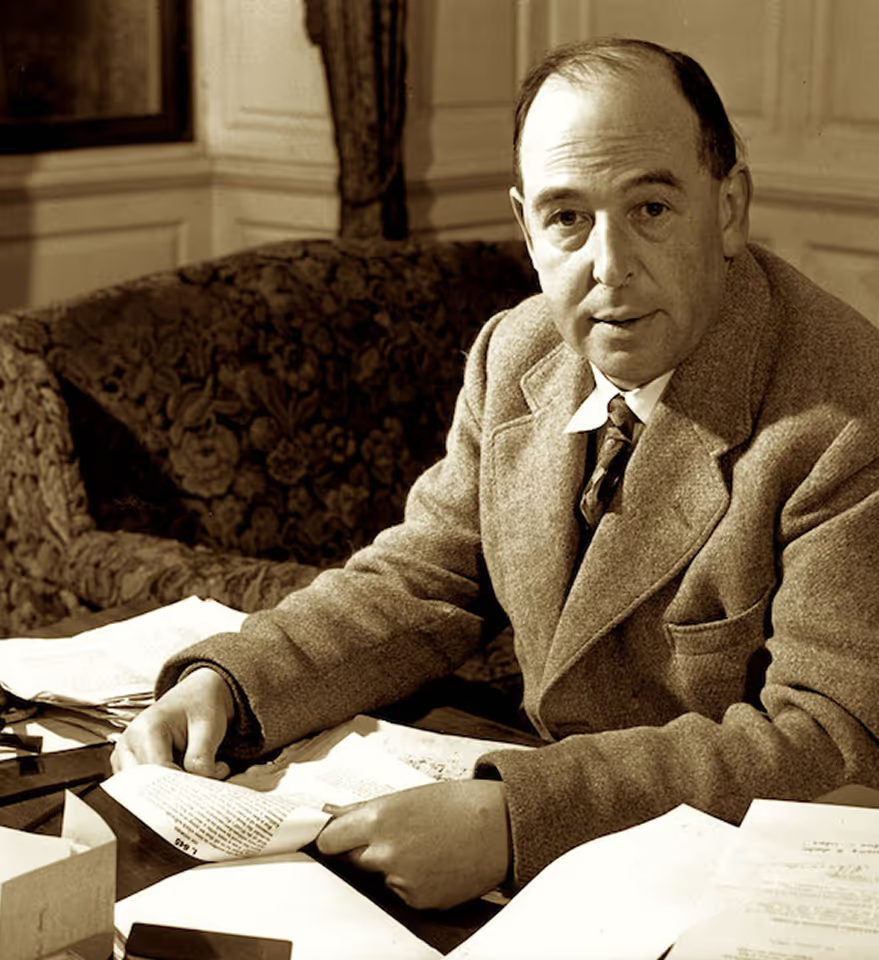
C.S. Lewis - A Voice of Reason and Faith
Lewis, an Anglican, wasn't just a believer; he was a brilliant defender of the Christian faith. His works bridge the gap between faith and reason, making them timeless resources for those exploring spiritual questions."
Here, you'll find articles and resources that explore the deeper teachings of Orthodoxy. We'll feature insights from priests, theologians, and spiritual leaders, offering practical wisdom for everyday life.
C.S. Lewis - A Voice of Reason and Faith
Lewis, an Anglican, wasn't just a believer; he was a brilliant defender of the Christian faith. His works bridge the gap between faith and reason, making them timeless resources for those exploring spiritual questions."
Here, you'll find articles and resources that explore the deeper teachings of Orthodoxy. We'll feature insights from priests, theologians, and spiritual leaders, offering practical wisdom for everyday life.
C.S. Lewis - A Voice of Reason and Faith
Lewis, an Anglican, wasn't just a believer; he was a brilliant defender of the Christian faith. His works bridge the gap between faith and reason, making them timeless resources for those exploring spiritual questions."
Here, you'll find articles and resources that explore the deeper teachings of Orthodoxy. We'll feature insights from priests, theologians, and spiritual leaders, offering practical wisdom for everyday life.
C.S. Lewis - A Voice of Reason and Faith
Lewis, an Anglican, wasn't just a believer; he was a brilliant defender of the Christian faith. His works bridge the gap between faith and reason, making them timeless resources for those exploring spiritual questions."
Here, you'll find articles and resources that explore the deeper teachings of Orthodoxy. We'll feature insights from priests, theologians, and spiritual leaders, offering practical wisdom for everyday life.
C.S. Lewis - A Voice of Reason and Faith
Lewis, an Anglican, wasn't just a believer; he was a brilliant defender of the Christian faith. His works bridge the gap between faith and reason, making them timeless resources for those exploring spiritual questions."
Wisdom of the Holy Fathers
What to read to strengthen your faith? Recommendations from priests and experienced readers.
What is the Prayer to St Anthony for Lost Things?
15
min read
October 9, 2026

How to Pray to God: Christian Guide and Insights
17
min read
October 7, 2026

How to Begin a Prayer: Start with Confidence
17
min read
October 5, 2026

How Do I Pray in Tongues? Discover Orthodox Insights
15
min read
October 4, 2026
Do you want to know More? Ask God’s Word!
Do you have questions, worries, or hopes? Feeling lost, burdened, or alone? "Ask God’s Word" brings you gentle guidance rooted in Scripture and the wisdom of the Church. Find hope and strength today!

Need a consultation or conversation with a priest?
Write to us and we will try to answer all your questions.

