Monastery of Saint Job of Pochayev (Russian Orthodox - ROCOR)
Munich-Obermenzing, Germany
From Ladomirová to Munich.
The present Munich monastery traces back to the Monastery of St. Job of Pochaev founded in Ladomirová (Eastern Slovakia) in 1923 by Archimandrite Vitaly (Maksimenko). The brotherhood operated a major printing press and publishing house, shaping the literature of the Russian Orthodox Church Outside Russia (e.g., Pravoslavnaja Rus’, Pravoslavnyj Put’, Pravoslavnyj Kalendar’). In 1944/45, before the advance of the Red Army, the community was evacuated; the group grew to 49 monks, some passing through Geneva into Germany. The Ladomirová monastery was closed in 1946.
A new start in Obermenzing (1946).
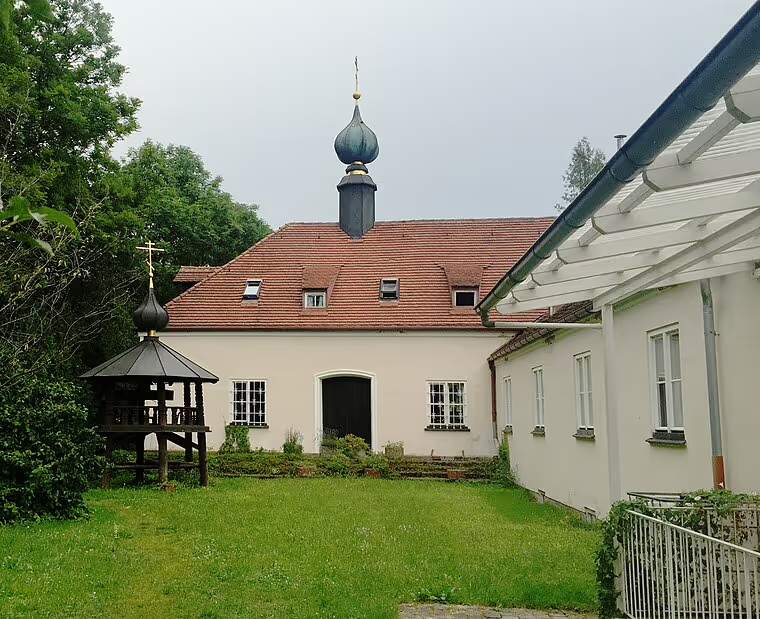
At the initiative of Archimandrite Job (Leontyev) and with the help of the US military government, the brotherhood found premises in Munich-Obermenzing. Within a short time they built cells, a refectory, and the Church of St. Job, consecrated on August 28/September 10, 1946. The iconostasis was painted in old-Russian style by Hieromonk Kiprian; frescoes adorn the walls. The small church remains an art-historical gem. By late 1947 the community numbered 32 brethren (some lay). Political insecurity and economic hardship soon led to the emigration of many monks—notably to Holy Trinity Monastery, Jordanville (USA), as well as to Palestine, France, England, Canada, and South America, where new monasteries were founded.
1950s–1970s.
Despite poverty, the monks offered social aid (free meals, clothing) and revived printing: until 1977 some 200 titles (Russian/Church Slavonic) were produced. The monastery ran priest-training courses (e.g., under Archpriest Vasilij Vinogradov) and multi-day meetings for Orthodox Germans, later seminars in Frankfurt and Munich. From 1966–1980 Bishop (later Archbishop) Nathanael headed the monastery; until 1981 it was stauropegial (directly under the ROCOR First Hierarch), thereafter under the German Diocese.
Renewal according to Athonite rule (from 1980).
With Bishop (now Archbishop) Mark, the community undertook a thorough renovation and adopted Athonite rule: a new entrance with tower and crosses, a larger onion dome, and modernization of the press. A basement candle-works has since supplied diocesan needs and supports the monastery financially. Guest rooms were added, annual youth seminars (1982–1994) held, and an individualized priest-formation established, through which over a dozen clergy were ordained in the 1980s. The monastery became a bridge between the émigré community and faithful from Russia, Belarus, and Ukraine.
Today.
The brotherhood continues with publishing, candle-making, incense production, silversmithing, beekeeping, as well as religious education and adult catechesis. Through its printing and educational work, the monastery has become a spiritual center for Orthodox Christians and seekers in Germany and for the Russian diaspora of Western Europe.
Täglicher Gottesdienst: Orthros (Matutin), 6.00 Uhr; Vesper, 18.00 Uhr
Göttliche Liturgie: Täglich (soweit Zelebrant verfügbar); sonntags und an Feiertagen um 9.00 Uhr
Besichtigungen und Gruppenbesuche: nach Vereinbarung
.avif)