.avif)
How to Pray the Divine Mercy Chaplet: A Guide
Every guide to how to pray the divine mercy chaplet will hand you the words. Almost none of them will tell you what to do when you say "Jesus, I trust in You" and, well, you don't. Not really. Not that day.

What Do You Do When "I Trust in You" Feels Like a Lie? A Pastoral Word on How to Pray the Divine Mercy Chaplet
Every guide to how to pray the divine mercy chaplet will hand you the words. Almost none of them will tell you what to do when you say "Jesus, I trust in You" and, well, you don't. Not really. Not that day.
In my years of serving as an Orthodox priest since 2013, I have found that questions about the Divine Mercy Chaplet often come from sincere people who love Christ and want to know how that devotion fits, or does not fit, within Orthodox life. Sometimes they're catechumens with a rosary still tucked in a coat pocket. Sometimes they're simply curious about how to pray the divine mercy chaplet. Either way, I've noticed something the instructional pages never mention: people aren't only asking for a prayer script. They're asking where mercy actually lives.
So let's start there instead of with beads and bullet points.
Quick Answer: The Divine Mercy Chaplet is prayed on a standard rosary with a fixed sequence of prayers recalling Christ's Passion, but it's a Roman Catholic devotion rather than part of Orthodox worship, and Orthodox Christians find their own ancient path into divine mercy through the Jesus Prayer, Psalm 50(51), confession, and the Divine Liturgy.
In This Article:
- What Do You Do When "I Trust in You" Feels Like a Lie? A Pastoral Word on How to Pray the Divine Mercy Chaplet
- What Is the Divine Mercy Chaplet, Really, and How to Pray the Divine Mercy Chaplet?
- How Do You Actually Pray the Divine Mercy Chaplet Step by Step?
- Where Does Orthodoxy Actually Find Divine Mercy?
- Why Does Orthodoxy Turn to the Jesus Prayer Instead?
- If You Love the Divine Mercy Chaplet and Are Exploring Orthodoxy, What Now?
- How Does This Compare Across Christian Traditions?
- Father Victor's Perspective: Mercy Is More Than a Formula
- Common Misconceptions About the Divine Mercy Chaplet and Orthodoxy
TL;DR — Key Takeaways
- The Chaplet is prayed on five decades of a rosary using set prayers about Christ's Passion, but it comes from 20th-century Roman Catholic devotion, not Orthodox tradition.
- Orthodoxy doesn't reject the theme of mercy. It just carries that theme differently, mainly through the Jesus Prayer and the sacramental life.
- If you're moving toward Orthodoxy and love this Chaplet, no priest worth his collar will shame you for it. Guidance, not panic, is the Orthodox way.
- The real spiritual work was never memorizing the words. It's learning to pray for trust even in the middle of doubting it.
What Is the Divine Mercy Chaplet, Really, and How to Pray the Divine Mercy Chaplet?
The Chaplet came to the Church through St. Faustina Kowalska, a Polish nun of the twentieth century, who recorded visions of Christ asking for a devotion centered on His mercy. Pope John Paul II canonized her in 2000, and that same year the Feast of Divine Mercy was extended to the whole Roman Catholic Church, according to Vatican records from that canonization. It's a young devotion, historically speaking. Younger than most people assume.
The prayers themselves lean heavily on Christ's Passion. "Eternal Father, I offer You the Body and Blood, Soul and Divinity of Your dearly beloved Son..." That's real theology, real Christocentric language. I won't pretend otherwise. For people searching for how to pray the divine mercy chaplet, that theological seriousness is part of why the devotion resonates so deeply.
A Roman Catholic Devotion, Not an Orthodox Service
Here's the plain fact: the Divine Mercy Chaplet has never been part of Orthodox liturgical or private prayer tradition. It developed after the schism between East and West, shaped by a specific private revelation received by a specific Roman Catholic nun. Orthodoxy treats private revelation, meaning any spiritual message or vision claimed by an individual outside what the whole Church has received in Christ, with real caution. Not hostility. Caution.
That doesn't make St. Faustina's experience meaningless to Catholics who hold it dear. But it does mean Orthodox Christians don't build their prayer rule around it. The Divine Mercy Chaplet is a Roman Catholic devotion, not an official Orthodox prayer, even though its central themes of Christ's Passion and divine mercy are profoundly Christian.
How Do You Actually Pray the Divine Mercy Chaplet Step by Step?
I'll describe this clearly, because seekers deserve a straight answer. But I want to say up front: this description is informative, not a suggestion for Orthodox prayer life. Think of it as understanding a neighbor's house, not moving in. If you're simply trying to learn how to pray the divine mercy chaplet, here's the standard Roman Catholic pattern.

The Basic Bead-by-Bead Structure
- Begin with the Sign of the Cross, then pray the Apostles' Creed.
- On the first large bead, pray the Our Father.
- On the next three small beads, pray the Hail Mary.
- On the following bead: "O Blood and Water, which gushed forth from the Heart of Jesus as a fountain of Mercy for us, I trust in You."
- On each large bead of the five decades: "Eternal Father, I offer You the Body and Blood, Soul and Divinity of Your dearly beloved Son, our Lord Jesus Christ, in atonement for our sins and those of the whole world."
- On each of the ten small beads: "For the sake of His sorrowful Passion, have mercy on us and on the whole world."
You repeat that pattern across all five decades. Then, to close, the prayer "Holy God, Holy Mighty One, Holy Immortal One, have mercy on us and on the whole world" is prayed three times, often followed by "Jesus, I trust in You," also said three times, according to Catholic instructional guides such as the USCCB prayer page. Some people looking up how to pray the divine mercy chaplet also search for a Divine Mercy Chaplet PDF, a Chaplet of Divine Mercy prayer download, or even a free printable Divine Mercy Chaplet to keep with their prayer book.
If you want to see the devotion prayed aloud from start to finish, this video walks through it clearly and reverently.
[YOUTUBE_VIDEO]
Worth noting: this is a Roman Catholic resource, useful for understanding the practice, not an Orthodox liturgical text. For readers wanting another visual guide on how to pray the divine mercy chaplet, this additional video guide may also be helpful, and some Catholics discuss practical questions about the devotion in this Catholic discussion thread.
Do You Use a Rosary for the Divine Mercy Chaplet?
Yes. The Chaplet is designed for a standard five-decade Catholic rosary. And this is exactly where Orthodox seekers often get tangled up, because Orthodoxy doesn't use a rosary at all. We use a prayer rope, called a chotki in Slavic practice or komvoskini in Greek, usually with 33, 50, or 100 knots. No decades. No Hail Marys counted off. Just one repeated cry, over and over: "Lord Jesus Christ, Son of God, have mercy on me, a sinner." If you're comparing how to pray the divine mercy chaplet with Orthodox practice, that's one of the clearest differences.
How Many Times Should You Pray It?
Catholic guidance generally leaves this open. Once daily, several times, or as part of a nine-day novena before Divine Mercy Sunday. There's no single mandated number.
From where I stand as an Orthodox priest, I'd gently redirect the question. Orthodoxy doesn't measure mercy in repetitions of a specific chaplet. What we ask instead is: does this prayer draw you into a stable rule of prayer, blessed by a priest or spiritual father, that includes morning and evening prayers, the Jesus Prayer, and the services of the Church? That's the real question. Not "how many times," but "toward what."
Why Is It Often Prayed at 3 PM?
Catholic tradition ties the Chaplet to 3:00 PM, the traditional hour of Christ's death on the Cross, sometimes called the Hour of Great Mercy. It's a beautiful instinct, remembering the Crucifixion at the hour it happened. Many also call this the 3 O clock Divine Mercy prayer, though the heart of the matter is still Christ's mercy, not the mechanics of the clock.
Orthodoxy shares that instinct too, honestly. We remember Christ's death constantly, in every Divine Liturgy, in every service of Holy Week. But we wouldn't say mercy is somehow locked to a clock. God's mercy isn't a vending machine that only dispenses at 3 PM. It's good to remember Christ's death at any hour, including 3 PM, but we trust in Christ Himself rather than treating time as a spiritual formula. Related: How to Pray the Divine Mercy Chaplet Prayer & More.
Where Does Orthodoxy Actually Find Divine Mercy?
So if not the Chaplet, then where? Fair question.

Scripture grounds everything here. As Hebrews reminds us, we're invited to "come boldly to the throne of grace, that we may obtain mercy and find grace to help in time of need" (Hebrews 4:16). Mercy isn't something we manufacture through correct wording. It's received through Christ our High Priest, who intercedes for us continually.
And St. Paul writes that "God demonstrates His own love toward us, in that while we were still sinners, Christ died for us" (Romans 5:8). Mercy flows from the Cross, always. Ephesians tells us God, "being rich in mercy," made us alive together with Christ even when we were dead in sin (Ephesians 2:4-5). That's not a devotional theme. That's the Gospel itself.
Mercy in Scripture
Christ's own parable of the Pharisee and the tax collector shapes Orthodox prayer more than almost any other passage. The tax collector, standing far off, wouldn't even lift his eyes to heaven, but beat his chest and said, "God, be merciful to me a sinner!" (Luke 18:13). And Christ says this man, not the Pharisee, went home justified. That single cry, "have mercy on me, a sinner," became the seed of the Jesus Prayer itself. Not a coincidence.
The repentant thief crucified beside Christ gives us another pattern, one I return to often when I sit with families near the end of a loved one's life. "Lord, remember me when You come into Your kingdom," he says, and Christ answers, "Today you will be with Me in Paradise" (Luke 23:42-43). Mercy at the very last hour. No formula required. Just a turning of the heart.
Mercy in the Divine Liturgy and Confession
Here's something I wish more articles about this topic understood: in an Orthodox service, you'll hear "Lord, have mercy" dozens of times. Dozens. It's not decoration. It's the heartbeat of our worship.
Fr. Alexander Schmemann, the Orthodox liturgical theologian, taught that the experience of God's mercy is given above all in the Eucharist, where Christ's sacrifice is made present and the faithful receive life. Not symbolically. Actually. And confession, that quiet, sometimes terrifying, sometimes deeply freeing conversation with a priest, is where mercy becomes personal, specific, and healing rather than theoretical.
Psalm 50, known in Western numbering as Psalm 51, gets prayed constantly in Orthodox life, at Matins, in personal prayer rules, whispered by monks a thousand times over centuries. "Have mercy upon me, O God, according to Your lovingkindness" (Psalm 51:1). If you're looking for an Orthodox parallel to repetitive mercy prayer, this psalm is closer to home than any chaplet. Readers who want to go deeper into this Orthodox pattern may also find help in our guide to the Jesus Prayer and our introduction to an Orthodox prayer rule.
Why Does Orthodoxy Turn to the Jesus Prayer Instead?
As St. John Cassian explains in Conference 10, a brief repeated prayer can accompany the Christian in every circumstance, whether at work, at rest, or in danger. That teaching comes from the fourth and fifth centuries. Long, long before any modern chaplet existed.
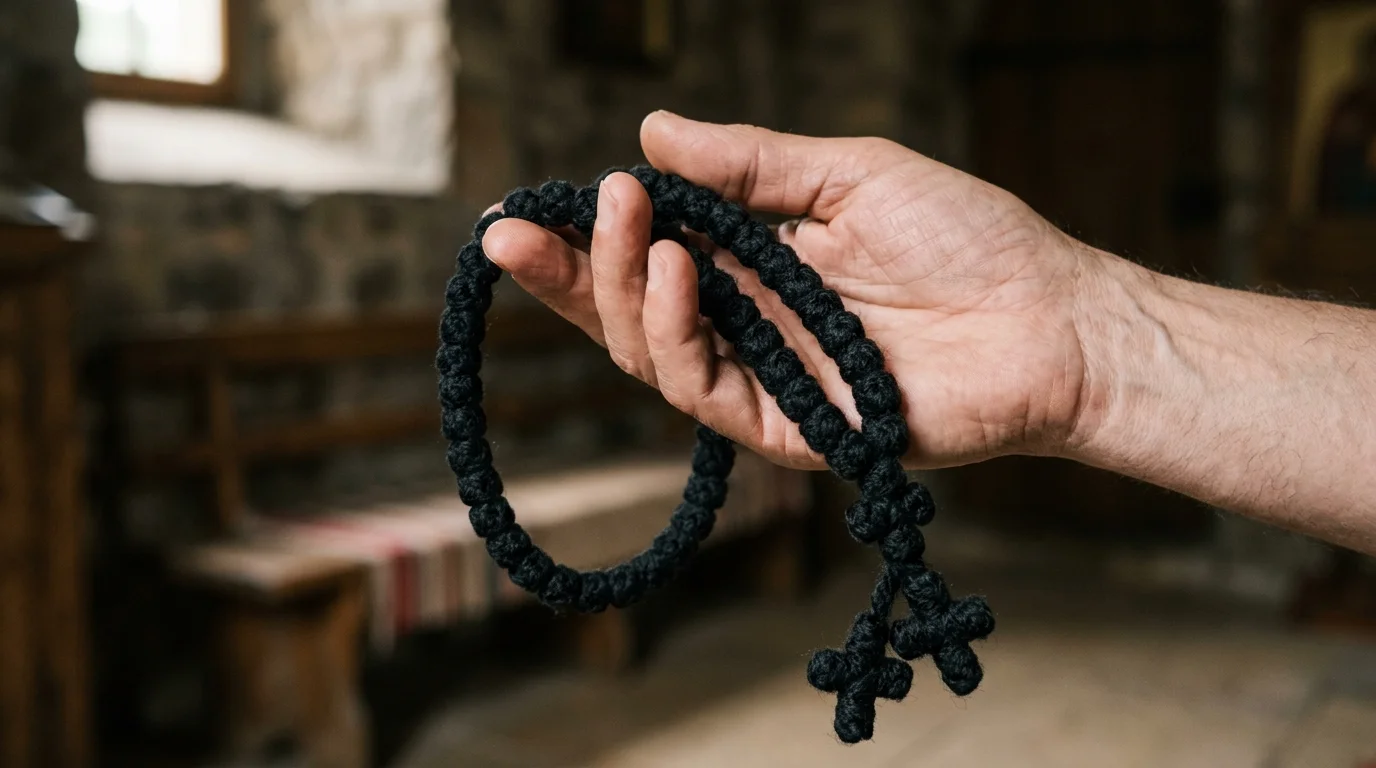
The Jesus Prayer itself, "Lord Jesus Christ, Son of God, have mercy on me, a sinner," is short enough to carry anywhere. In traffic. At a hospital bedside. Half-asleep at 3 AM when anxiety won't let you rest. I've prayed it in all those places myself.
Why Orthodox Christians Use a Prayer Rope
The prayer rope helps the mind stay anchored while the heart repeats this one cry. Each knot marks a repetition, nothing more mystical than that, though over years it becomes something like a second heartbeat. St. Gregory the Theologian says in Oration 27 that the remembrance of God should become as constant as breathing. That's the goal. Not perfection of wording. Just constancy.
How to Begin a Simple Jesus Prayer Rule
If you want to start, keep it modest. Genuinely modest.
- Get a simple 33 or 50-knot prayer rope, widely available through Orthodox monasteries and church bookstores.
- Set aside five or ten minutes, morning or evening, and pray the Jesus Prayer slowly, one knot at a time.
- Don't rush toward some emotional payoff. Some days it will feel dry. That's fine. That's normal, actually.
- Speak with a priest about your rule before adding length or frequency. This isn't bureaucracy. It's wisdom from centuries of monastic experience.
Different jurisdictions and spiritual fathers recommend different lengths and frequencies here, and that's fine. The principle stays the same even when the practical numbers vary. If your earlier prayer life included learning how to pray the divine mercy chaplet, this simpler Orthodox rhythm can still feel familiar in its steady appeal for mercy.
If You Love the Divine Mercy Chaplet and Are Exploring Orthodoxy, What Now?
Let me tell you about someone I met a while back. A catechumen, Catholic background, kept a rosary in her coat pocket and had prayed the Divine Mercy Chaplet every day for years. She came to me almost bracing for bad news. "Father, if I become Orthodox, do I have to stop praying this immediately?"
I didn't answer with a hard no or a hard yes. I told her the Chaplet is a Roman Catholic devotion, not part of the Orthodox rule of prayer, but that nobody should shame her for having learned to trust Christ's mercy through it. And honestly? That trust is the point, no matter which tradition taught it to her first. What we worked on together was building an Orthodox prayer rule instead, morning and evening prayers, the Jesus Prayer, real participation in the Liturgy, under the guidance of her priest. See also: Prayer of the Heart: An Orthodox Christian Guide to....
Months later she told me something that stuck with me: Orthodoxy wasn't taking mercy away from her. It was drawing her further into it.
A Gentle Transition, Not a Spiritual Panic
Some priests advise stopping old devotions fairly quickly. Others allow a slower, more gradual transition. That's a difference in pastoral method, not doctrine, and both approaches come from love, not legalism. If you're in this position, talk to your priest. Actually talk to him, don't just guess at what Orthodoxy expects.
The Church is not trying to punish your past. She's teaching you how to pray from within her own life and rhythm. That takes time. It took me time too, coming from a Catholic upbringing myself, learning to let go of certain devotional habits while keeping the love of Christ that had formed them in the first place. If your search began with how to pray the divine mercy chaplet, let it also open into the wider question of how the Orthodox Church teaches a soul to live in mercy.
How Does This Compare Across Christian Traditions?
People sometimes ask me why Orthodox and Catholic Christians can share the exact same Trisagion prayer, "Holy God, Holy Mighty, Holy Immortal," and still not share the same chaplet. Fair question. Sharing one ancient prayer text doesn't mean sharing the same devotional framework. In Orthodoxy, the Trisagion belongs to the Church's liturgical life first. In the Chaplet, it's folded into a distinct, later devotional structure.

How Christians Approach the Divine Mercy Chaplet and Mercy Prayer
[COMPARISON_TABLE]
There are roughly 260 million Orthodox Christians worldwide, according to Pew Research Center (2017), and about 77% of adults in majority-Orthodox countries say religion is very important to them. In Greece, 55% pray daily. Structured, repeated prayer clearly hasn't gone out of style in Orthodox life. It never really left.
Father Victor's Perspective: Mercy Is More Than a Formula
When I studied theology at LMU Munich and later accompanied seekers in parish life, I saw that many people aren't really asking only for instructions. They're asking where mercy is actually found in the life of the Church. That's the deeper question hiding under "how do I say this prayer correctly."
Here's what I've come to believe, after years of sitting across from people wrestling with exactly this. The deepest Orthodox response to the Divine Mercy Chaplet isn't a simple yes or no. It's a re-centering question: does this prayer lead someone more deeply into repentance, into the Eucharist, into obedience, into the communal worship of the Church? Or does it stay isolated, a private ritual disconnected from the wider life of grace?
I'll say something else, and I say this having studied both theology and psychology. In Orthodox thought, mercy isn't primarily a legal transaction secured by the correct formula. It's the healing energy of God drawing a wounded person into communion. That's the doctrine of theosis, our participation in God's own life by grace, and it reframes everything. Mercy heals. It doesn't just pardon. That's why the Jesus Prayer and the sacraments work together rather than competing for our attention.
And here's my honest take on the contrarian question nobody wants to sit with: what happens when you say "I trust in You" and you don't? I've felt that. I don't fully understand why some days faith feels solid as stone and other days it feels like sand slipping through fingers, but I've seen this pattern hold true again and again. The prayer isn't measuring whether you feel trust. It's training you toward trust, the way lifting weights trains muscle you don't yet have. St. Isaac the Syrian teaches in the Ascetical Homilies that human sin is like a handful of sand before the sea of God's mercy. That sea doesn't care whether you feel confident wading into it. It's simply there, vast, waiting.
For seekers attached to the Divine Mercy Chaplet, I think the real bridge into Orthodoxy is the shared language of mercy itself. But the destination is different. Not a devotion built around one private revelation, but a whole life centered on the liturgical revelation of Christ within His Church. That's not a downgrade. If anything, it's wider, older, and quieter than any single chaplet could be. So if your first question was how to pray the divine mercy chaplet, my hope is that the deeper answer leads you beyond technique and into the living mercy of Christ in the Church.
Common Misconceptions About the Divine Mercy Chaplet and Orthodoxy
"The Chaplet is basically Orthodox because it talks about Christ's Passion and uses the Trisagion." Not quite. The Chaplet is a Roman Catholic devotion tied to St. Faustina Kowalska. Orthodoxy deeply affirms God's mercy and Christ's Passion, but it doesn't recognize this particular chaplet as part of its prayer tradition. Shared language doesn't mean shared devotional framework.
"Becoming Orthodox means instantly rejecting every Western devotion I ever loved." This one causes real anxiety, and I understand why. But Orthodoxy calls for discernment and patience, not panic. A priest can walk you gradually toward an Orthodox prayer rule. The Church isn't punishing your past. Related: What Does the Bible Say About Prayer? Discover Now.
"Orthodox Christians care less about mercy because they focus more on fasting and rules." I hear this more than you'd think. Mercy is everywhere in Orthodox life: in "Lord, have mercy," in confession, in the Eucharist, in prayers for the sick and dying. Orthodox asceticism isn't the opposite of mercy. It's how we cooperate with God's healing mercy.
"A prayer said at 3 PM carries special spiritual power tied to that exact hour." It's good to remember Christ's death at 3 PM, or any hour. But Orthodoxy doesn't treat mercy as locked to a schedule. Trust Christ Himself, not the clock.
"If a prayer sounds theologically sound, it needs no further discernment." Orthodoxy actually evaluates devotions by origin, use, and spiritual fruit, not just wording. Orthodoxy asks not only what a prayer says, but how it forms the soul.
"If I stop the Chaplet for the Jesus Prayer, I might lose God's mercy or protection." This fear comes up more often than I'd like. God's mercy isn't a reward for choosing the correctly branded devotion. God isn't withdrawing His love because you're learning to pray in the tradition of the Church you're entering.
Frequently Asked Questions
How to pray the Chaplet of Divine Mercy step by step?
You begin with the Sign of the Cross and the Apostles' Creed, then pray the Our Father and three Hail Marys, followed by "O Blood and Water..." Then, on the large beads across five decades, you pray "Eternal Father, I offer You the Body and Blood, Soul and Divinity of Your dearly beloved Son...," and on each small bead, "For the sake of His sorrowful Passion, have mercy on us and on the whole world." You close with the Trisagion prayed three times.
This is standard Roman Catholic practice, worth understanding if you're exploring the faith or came from that background. Orthodox Christians instead turn toward the Jesus Prayer and the Church's liturgical services as their normative path into mercy.
How many times should I pray the Divine Mercy Chaplet?
Catholic guidance leaves this flexible, once daily, several times, or as part of a nine-day novena before Divine Mercy Sunday.
Orthodoxy doesn't set a rule for this Chaplet since it isn't part of Orthodox prayer life. If you're building a rule of prayer, the better question is how a stable daily rhythm, blessed by your priest, shapes your whole life rather than counting repetitions of any single prayer.
What are the words to the Divine Mercy Chaplet?
The core repeated lines are "Eternal Father, I offer You the Body and Blood, Soul and Divinity of Your dearly beloved Son, our Lord Jesus Christ, in atonement for our sins and those of the whole world," on the large beads, and "For the sake of His sorrowful Passion, have mercy on us and on the whole world," on the small beads, closing with "Holy God, Holy Mighty One, Holy Immortal One, have mercy on us and on the whole world."
These words are Roman Catholic in origin. The Orthodox equivalent, in spirit if not in form, is the Jesus Prayer: "Lord Jesus Christ, Son of God, have mercy on me, a sinner."
Do you use a rosary for the Divine Mercy Chaplet?
Yes, it's prayed on a standard five-decade Catholic rosary.
Orthodox Christians use a prayer rope instead, called a chotki or komvoskini, typically with 33, 50, or 100 knots, for praying the Jesus Prayer rather than a rosary-based devotion.
About the Author
Father Victor Meshko is an Orthodox priest of the Russian Orthodox Church Abroad (ROCA), serving at the Cathedral of the Holy New Martyrs and Confessors of Russia in Munich since his ordination in 2013. He holds multiple degrees in theology, including a Diplom in Theology and PhD studies at LMU Munich's Institute for Orthodox Theology, as well as theological training from Carpathian University and the Uzhhorod Ukrainian Theological Academy. He is also the author of the published book 'Erzbischof Filaret (Gumilevskij) von Černigov und Nežin' and brings together Orthodox scholarship, pastoral care, liturgical experience, and a background in psychology in his writing for Find to God.
Researched and written by Father Victor Meshko. AI tools were used during the research process; theological review and final approval were provided by Father Victor Meshko in accordance with EU AI Act transparency expectations.
<table class="seo-table comparison-table"><caption>How Christians Approach the Divine Mercy Chaplet and Mercy Prayer</caption><thead><tr><th>Aspect</th><th>Orthodox</th><th>Catholic</th><th>Protestant</th></tr></thead><tbody><tr><td>Origin of the devotion</td><td>Not an Orthodox devotion; Orthodoxy has the Jesus Prayer and liturgical petitions for mercy</td><td>A 20th-century devotion linked to St. Faustina and officially promoted in Roman Catholic life</td><td>Usually not part of mainstream Protestant devotion, though some individuals may use it</td></tr><tr><td>Primary prayer tool</td><td>Prayer rope (chotki/komvoskini)</td><td>Rosary beads</td><td>Often no beads, though some traditions use prayer beads</td></tr><tr><td>Main mercy practice</td><td>Jesus Prayer, Psalm 50(51), Divine Liturgy, confession, repeated 'Lord, have mercy'</td><td>Divine Mercy Chaplet, confession, Eucharist, Divine Mercy Sunday</td><td>Personal prayer, psalms, spontaneous prayer for mercy</td></tr><tr><td>View of private revelation</td><td>Approached with caution and discernment; not foundational for common prayer</td><td>St. Faustina's revelations accepted within Catholic devotional life</td><td>Varies widely; often not central or not officially received</td></tr><tr><td>What is distinctive</td><td>Mercy is experienced sacramentally and liturgically as healing communion with Christ</td><td>Mercy is strongly expressed through a specific chaplet and devotional framework</td><td>Mercy is often emphasized in preaching and personal prayer rather than fixed chaplet forms</td></tr></tbody></table>


Help us bring the christian faith to modern seekers worldwide.
Godfinder relies on generous souls to sustain our multilingual platform, develop new tools like the Magic Cube, and support struggling believers. If our work has touched your heart, consider contributing to our nonprofit partner

Do you want to know More? Ask God’s Word!
Do you have questions, worries, or hopes? Feeling lost, burdened, or alone? “Ask God’s Word” brings you gentle guidance rooted in Scripture and the wisdom of the Church. Find hope and strength today!
