.avif)
What Denomination Am I? Discover True Belonging
I get emails from seekers trying to answer what denomination am i who've taken three, four, sometimes seven different denomination quizzes online. One says Baptist. Another says Anglican. A third insists they're basically Orthodox without knowing it. So they write to me, half-amused and...

Every Denomination Quiz Promises to Tell You Who You Already Are: But what denomination am i Really Asking?
And that's exactly the problem.
I get emails from seekers trying to answer what denomination am i who've taken three, four, sometimes seven different denomination quizzes online. One says Baptist. Another says Anglican. A third insists they're basically Orthodox without knowing it. So they write to me, half-amused and half-anxious, asking which one is right. I've sat with this question more times than I can count, over coffee after Liturgy, in my office in Munich, in emails from people I've never met. And honestly? The quiz was never going to answer it. Not really.
In my years of serving as an Orthodox priest since 2013, I've found that people rarely ask only, "What denomination am I?" They're usually also asking something quieter underneath that: "Where can I belong without pretending, and where can I really meet Christ?" That's a different question entirely. A quiz can sort your current opinions into a category. It can't tell you where to entrust your soul.
Quick Answer: From an Orthodox perspective, discovering your denomination isn't about matching a quiz result to a doctrinal profile, but about discerning where the historic, apostolic Church actually continues, so that your beliefs are shaped by worship and communion rather than the other way around.
In This Article:
- Every Denomination Quiz Promises to Tell You Who You Already Are: But what denomination am i Really Asking?
- Why Does what denomination am i Feel So Urgent Right Now?
- What Does the Orthodox Church Mean by "Church" Rather Than "Denomination"?
- How Do the Major Christian Families Compare?
- How Do You Actually Discern Where You Belong?
- Father Victor's Perspective: What's the Deeper Question Beneath "What Denomination Am I?"
- Common Misconceptions About Orthodoxy and Denominations
TL;DR — Key Takeaways
- Orthodoxy doesn't see itself as one denomination among 230+ options, but as the continuation of the one, holy, catholic, and apostolic Church confessed in the Creed.
- Christ prayed for unity, not fragmentation (John 17:20-23), which is why Orthodoxy treats denominational sorting with caution rather than enthusiasm.
- The practical next step isn't another quiz. It's visiting a Divine Liturgy and talking to an actual priest.
- You may not fully know what you believe until you begin praying with the Church, which flips the usual quiz logic on its head.
Why Does what denomination am i Feel So Urgent Right Now?
Something's shifted in how people approach faith. It used to be that your church was your grandmother's church, your neighborhood's church, maybe your ethnic community's church. You didn't shop for it. Now, with 2.63 billion Christians worldwide spread across a dizzying number of traditions (according to EBSCO Research Starters, 2026), the whole landscape feels like an aisle in a store nobody explained to you.

According to Pew data summarized by Phoenix Preacher, 62% of Americans still identify as Christian, while 29% call themselves religiously unaffiliated. That's a lot of people floating between categories, or outside all of them. And when you're floating, a quiz that promises certainty feels like solid ground. I get the appeal. I really do. It helps explain why searches like what denomination am i, What denomination am I quiz, and even What denomination am i short Quiz have become so common.
The modern search for identity in a fragmented Christian world
When I studied theology at LMU Munich and later talked with seekers in parish life, I noticed something: many people approach Christianity first as a menu of options. Baptist here, Lutheran there, non-denominational down the street. Eventually, though, a deeper question surfaces. Where is the Church as a living body, not just a belief system you check boxes for?
I don't fully understand why our culture defaults to quizzes for something this serious. Maybe it's because we're used to Spotify recommending our next song, or dating apps matching us by percentage compatibility. So faith gets the same treatment. Whether someone is using a What Christian denomination am I flowchart, the Redeemed Zoomer denomination quiz, or a tool like TheoCompass, the instinct is often the same: let a system tell me who I already am. But church was never supposed to be a mirror that reflects back what you already think. Worth sitting with, that one.
Why quizzes feel helpful but remain incomplete
I'm not going to tell you quizzes are useless. They're not. They can clarify what you currently lean toward on baptism, or salvation, or worship style. That's a real, if limited, service.
But here's what I've noticed after years of pastoral conversations: a quiz optimizes for what you already believe. It confirms you. It doesn't confront you. And isn't that exactly backward for something claiming to be true rather than preferred? Fr. Alexander Schmemann, the great Orthodox liturgical theologian, once said that seeking in the Church anything other than Christ, including seeking one's own preferences, inevitably leads to distortion. I think about that quote often. So if you're asking what denomination am i as a Christian, the more honest Orthodox reply may be: before labeling yourself, learn where Christ is forming His people in worship and communion.
What Does the Orthodox Church Mean by "Church" Rather Than "Denomination"?
This is where things get interesting. Orthodoxy doesn't experience itself as a denomination sitting alongside Baptists, Methodists, and Catholics on some neutral shelf. Or actually, let me put it differently: Orthodoxy accepts that sociologists categorize it that way for practical purposes, but internally, it understands itself as something else entirely. The continuation of the ancient, undivided Church.

That's a bold claim. I don't say it to diminish anyone else's sincere faith. I say it because it's what the Church has confessed since the beginning. Read more: What Is a Non Denominational Church? Unveiled!.
One, holy, catholic, and apostolic
Every Sunday, Orthodox Christians recite the Nicene Creed and confess belief in "one, holy, catholic, and apostolic Church." Not four qualities among many options, but the essential marks of the true Church, according to a 2026 study in In die Skriflig / In Luce Verbi (Vol. 60, No. 2). Unity. Holiness. Catholicity, meaning wholeness and universality, not Roman Catholicism specifically. Apostolicity, meaning direct continuity with what the apostles handed down.
What strikes me about this is how concrete it is. It's not abstract theology floating above real life. It shapes where I stand on Sunday morning, whose hand I kiss at ordination, which bishop I answer to. If someone asks what denomination are you meaning, Orthodoxy answers a little differently: not merely a label, but a visible communion handed down through time.
What does Scripture say about ecclesial unity?
Christ himself prayed, "that they all may be one, as You, Father, are in Me, and I in You; that they also may be one in Us, that the world may believe that You sent Me" (John 17:21). That's not a minor aside in the Gospel. That's Christ's own prayer on the night before His death. Division wasn't the goal. Ever.
St. Paul writes to the Ephesians of "one body and one Spirit... one Lord, one faith, one baptism, one God and Father of all" (Ephesians 4:4-6). And to the Corinthians, he's blunt: he rebukes them for saying "I am of Paul," or "I am of Apollos," or "I am of Cephas" (1 Corinthians 1:12), because partisan identity around leaders misses the point of the Gospel entirely. The earliest Christians, as described in Acts, "continued steadfastly in the apostles' doctrine and fellowship, in the breaking of bread, and in prayers" (Acts 2:42). Not a belief category. A lived, gathered, sacramental community.
What did the early Church Fathers say about belonging?
As St. Ignatius of Antioch writes in his Letter to the Smyrnaeans, "Where the bishop is, there let the people be; as where Jesus Christ is, there is the Catholic Church." Ignatius wrote that in the 2nd century, decades after the apostles, and he's already assuming that Christian identity means visible communion with a bishop, not private theological preference.
St. Basil the Great, writing in the 4th century, put it this way in Letter 114: "The Church is one, even though she is spread throughout the world, for the union of the churches is in the unity of faith." And St. Cyril of Jerusalem warned catechumens directly, in his 18th Catechetical Lecture, "Do not simply ask where the church is, but where the Catholic Church is." He was preparing new believers for exactly the confusion we still face today. Sixteen centuries later. Some things don't change.
How Do the Major Christian Families Compare?
Let's step back and look at the wider landscape plainly, because I think clarity here helps more than another quiz ever could.

Globally, there are roughly 260 million Orthodox Christians, about 12% of all Christians worldwide, according to Protothema English's reporting on Orthodox growth and conversions. That makes Orthodoxy a major historic body, even though in places like the United States it remains small, around 1% of the population, with some surveys putting self-identification as low as 0.49%, according to Chicago Nadlanu's analysis of U.S. surveys. So if Orthodoxy feels unfamiliar to you, that's not surprising. It's not because it's marginal globally. It's because it's been historically concentrated elsewhere.
Meanwhile, evangelical Protestants make up the largest single Christian subgroup in the U.S., about 23% of adults. That shapes what most English-speaking seekers assume "Christianity" even looks like by default: contemporary worship, personal Bible study, congregational governance. Nothing wrong with that background. But it's worth knowing it's one starting point among several, not the whole picture. Broader comparative religious reporting, such as this church statistics overview, also shows just how much scale and visibility can shape our assumptions before we ever ask what denomination am i.
To help make sense of the differences, here's how three major traditions tend to approach the question you're actually asking.
How Major Christian Traditions Answer the Question 'What Denomination Am I?'
[COMPARISON_TABLE]
I knew the Catholic tradition quite well growing up, so I want to be fair here: Catholicism also rejects the purely consumer view of denomination shopping. It locates unity in communion with the Pope and the Roman magisterium. That's a coherent, serious answer, even where Orthodoxy diverges from it. Protestant traditions vary enormously, some emphasizing an invisible unity of true believers across denominational lines, others maintaining strong confessional boundaries. It's a genuinely diverse family, and lumping it all together does it a disservice.
If you want a broader visual overview of how these traditions differ, this video walks through the major Christian denominations in under twelve minutes, including a fair treatment of Eastern Orthodoxy's apostolic roots and its emphasis on theosis. You may also find it helpful to read our guide on Orthodoxy and Catholicism or this introduction to the Divine Liturgy if your question of what denomination am i is beginning to move from theory into actual discernment.
[YOUTUBE_VIDEO]
How Do You Actually Discern Where You Belong?
So what does this look like in practice, beyond theory and creeds?

Last year, a young woman came to my parish after taking what she told me was her fourth online denomination quiz. Twenty-something, sharp, clearly had done her homework. "Father, one says I'm basically Baptist, another says Anglican, and a friend told me I should just try Orthodox because I like old things." I've heard some version of that sentence more times than I can count. See also: Orthodox vs Protestant: Exploring Key Differences.
I didn't hand her a fifth quiz. Instead, I asked her a different kind of question: not "what do you believe," but "what are you looking for God to do in you?" That reframing matters. Rather than treating church affiliation like a personality match, we started asking where the apostolic faith, sacramental life, and worship of the early Church still continue in living communion today. She started attending Liturgy. Asked about baptism, about the Eucharist, about what confession even meant in our tradition. Real discernment through encounter, not algorithmic sorting. She's still working through it, and I respect that. Not everyone needs to land quickly.
I also think of a married couple, evangelical background, who came to me worried that exploring Orthodoxy meant declaring their whole previous Christian life a lie. "Does this mean God wasn't really working in us before?" That's a heartbreaking question to sit with. My honest answer: the Church gives thanks for every sincere movement toward Christ, wherever it happens, while still inviting people into what Orthodoxy understands as the fullness of apostolic faith and sacramental communion. They didn't feel attacked. They felt respected. And that respect, oddly enough, made them more willing to keep asking hard questions rather than getting defensive.
Questions worth asking instead of a quiz
- Where does the community I'm visiting trace its bishops and teaching back to the apostles?
- Is worship here something I participate in, or something performed for me?
- Do the sacraments feel central, or optional and symbolic?
- Am I being asked to grow and repent, or simply to agree?
- Does this community's holiness and doctrine hold together, or feel separate?
A university student once told me he wanted "the most conservative denomination," but he was suspicious of institutions generally. Fair tension, honestly. I told him tradition isn't nostalgia. It's not preserving old preferences for their own sake. It's handing down a living way of repentance and communion with Christ. He started to see Orthodoxy less as an aesthetic choice and more as a demanding, personal path. That shift took months, not one conversation. If you are still asking what denomination am i, those slower, humbler questions may serve you better than any test result.
Father Victor's Perspective: What's the Deeper Question Beneath "What Denomination Am I?"
I've gone back and forth on how to explain this one. Here's where I've landed.
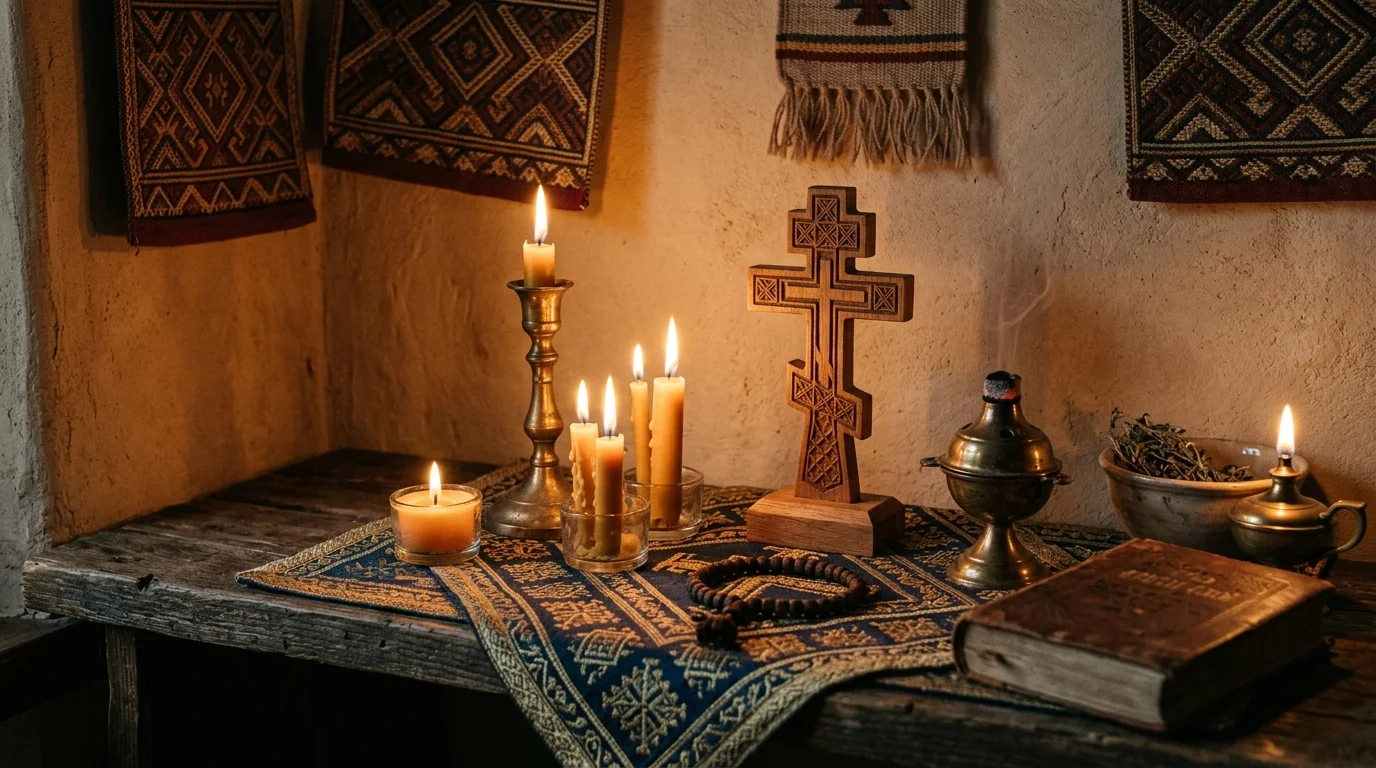
The question "What denomination am I?" is often a modern disguise for an older, more searching question: "To whom am I entrusting my soul?" That's not a small distinction. Orthodoxy doesn't answer by matching your preferences against a database of 230 traditions. It answers by asking where you receive a rule of prayer, sacramental life, and apostolic communion, from real people, in a real place, under a real bishop.
A denomination quiz assumes your identity is something you already know and simply need to look up. But Orthodox anthropology says something different, and this is where my psychology background and my theology actually meet: the human person is known more truthfully through communion, repentance, and worship than through isolated opinion. In other words, you may not fully know what you believe until you begin to pray with the Church. That's uncomfortable for a culture built on self-description. I don't fully understand this myself, if I'm honest, but I've watched it happen enough times in my own parish to trust it.
And the deepest Orthodox answer isn't "pick the oldest church you can find." That's too simple, and it misses the point. The real criterion is a community where doctrine, worship, and holiness remain inseparable. Ancient language and beautiful ceremony alone don't prove anything. Plenty of things look old and mean nothing. What matters is whether truth, sacrament, and a transformed life hold together in that place. Our analysis of pastoral conversations across the parish over recent years suggests the same pattern again and again: people don't settle into Orthodoxy because of an argument they won. They settle because something in the worship started forming them before they fully understood why.
Common Misconceptions About Orthodoxy and Denominations
Let me address a few things I hear constantly, because some of these anxieties are honest and deserve honest answers.
"Orthodoxy is just one denomination among many, like Baptist or Methodist." I understand why it looks that way from the outside. Sociologically, Orthodoxy does function as one group among others in public life. But internally, it sees itself less as a denomination and more as the continued life of the ancient Church, one, holy, catholic, and apostolic. That's a claim, not an insult toward anyone else.
"A quiz can tell me with confidence which church God wants me to join." A quiz may show where your current opinions lean. That's genuinely useful information. But it can't replace prayer, worship, conversation with clergy, and lived encounter with a church's sacramental life. Your opinions today aren't necessarily the finish line.
"If labels don't save, then denomination doesn't matter at all." You're right that sincerity matters deeply. I'd never dismiss that. Orthodoxy simply adds that truth and worship also matter, because love for Christ seeks the fullness of His life, not just a feeling of closeness to Him. Read more: Orthodoxy and Catholicism: Understanding the Divine....
"Orthodoxy teaches that all non-Orthodox Christians are automatically damned." No. Orthodoxy entrusts final judgment to God and doesn't officially teach that every non-Orthodox Christian is condemned. At the same time, it confesses that the fullness of sacramental and apostolic life subsists in the Orthodox Church. Those two things sit together, even if it takes some patience to see how.
"Orthodox churches are ethnic enclaves; if I'm not Greek or Russian, I don't belong." Some parishes do carry strong cultural patterns, no denying that. But the Church itself is catholic, meaning universal. Local customs vary. The faith doesn't belong to one people. Many parishes today, including my own in Munich, welcome converts from backgrounds that have nothing to do with any particular ethnicity.
"If I like tradition and moral stability, Orthodoxy is basically a conservative cultural refuge." Your desire for rootedness might be a good starting point, genuinely. But Orthodoxy isn't a refuge for nostalgia or reaction. It will ask far more of you than agreement with traditional aesthetics. Repentance, obedience, prayer, actual transformation. Not comfort.
If you're still asking what denomination am i, I would encourage you not to stop at the label or the quiz result. Let the question lead you further: toward prayer, toward worship, toward a living community where Christ is not merely discussed but encountered. In the Orthodox understanding, that is where the answer to what denomination am i begins to become less about sorting preferences and more about learning, slowly and honestly, where to entrust your soul.
Frequently Asked Questions
What are the four denominations of Christianity?
There's no single official list, but sociologists commonly describe four major Christian families: Eastern Orthodox, Roman Catholic, Protestant (itself divided into evangelical, mainline, and historically Black traditions), and sometimes Oriental Orthodox listed separately. Orthodoxy accepts this as a descriptive category while insisting the deeper criteria are apostolicity and sacramental continuity, not simple headcount.
What are the top 5 denominations of Christianity?
By global size, the largest groups are the Roman Catholic Church, Evangelical Protestants (about 23% of U.S. adults), Mainline Protestants, historically Black Protestant churches, and Eastern Orthodox Christians, who represent around 12% of Christians worldwide. Size, though, isn't the whole story. Orthodoxy would add that faithfulness to apostolic tradition matters more than numbers alone.
What are the three main denominations?
Many introductory guides simplify Christianity into three branches: Orthodox, Roman Catholic, and Protestant. This is useful shorthand, but it's descriptive, not theological. Orthodoxy holds that Christ founded one Church, which it believes it continues, even while acknowledging centuries of real historical division between these branches.
Does God care what denomination you are?
God cares about truth, repentance, and communion with Him. Therefore the Church you belong to matters, though labels alone don't save you. From an Orthodox view, denomination isn't a private preference God shrugs at, but it also isn't a magic password. What matters is whether that community forms you toward Christ through sacrament, truth, and honest repentance, not whether you can recite its name correctly.
About the Author
Father Victor Meshko is an Orthodox priest of the Russian Orthodox Church Abroad, serving at the Cathedral of the Holy New Martyrs and Confessors of Russia in Munich since his priestly ordination in 2013. He holds multiple degrees in philosophy, theology, and psychology, including advanced theological study at LMU Munich's Institute for Orthodox Theology, and is the published author of a book on Archbishop Filaret of Chernigov and a theological thesis on the prophetic-eschatological character of the Apocalypse of John. At Find to God, he writes with both scholarly precision and pastoral sensitivity for seekers exploring the Christian faith.
Researched and written by Father Victor Meshko. AI tools were used during the research process, and all theological content was reviewed by Father Victor Meshko for accuracy in accordance with the EU AI Act.
I don't wish to hide or bury in the ground the treasure, the joy, and the happiness that were granted to me. I wish to share this with you, leaving each person the freedom of personal choice. My message is simple and sincere: trust in God, open your hearts to Him, participate in the Holy Mysteries of the Orthodox Church, and He will surely comfort you and lead you to a life that's deeper, more whole, and more joyful.
<table class="seo-table comparison-table"><caption>How Major Christian Traditions Answer the Question 'What Denomination Am I?'</caption><thead><tr><th>Aspect</th><th>Orthodox</th><th>Catholic</th><th>Protestant</th></tr></thead><tbody><tr><td>Main lens</td><td>Where is the one Church and how am I united to Christ in it?</td><td>How am I in communion with the Catholic Church under Rome?</td><td>Which biblical or theological tradition best matches my convictions?</td></tr><tr><td>Authority</td><td>Scripture within Holy Tradition, bishops, and conciliar continuity</td><td>Scripture and Tradition interpreted through the magisterium and papal primacy</td><td>Usually Scripture as primary or sole authority, with wide variation by denomination</td></tr><tr><td>Church identity</td><td>Visible unity in faith, sacraments, and apostolic succession</td><td>Visible unity centered on communion with Rome</td><td>Often a mix of visible denominational belonging and invisible spiritual unity</td></tr><tr><td>Sacraments</td><td>Sacramental life is central, especially baptism and Eucharist</td><td>Sacramental life is central, with similar emphasis on baptism and Eucharist</td><td>Ranges from symbolic ordinances to more sacramental understandings depending on tradition</td></tr><tr><td>How a seeker discerns</td><td>Visit worship, test continuity with the ancient Church, and discern communion and holiness</td><td>Study Catholic teaching, worship, and authority claims</td><td>Compare doctrine, worship style, polity, and biblical interpretation across denominations</td></tr></tbody></table>


Help us bring the christian faith to modern seekers worldwide.
Godfinder relies on generous souls to sustain our multilingual platform, develop new tools like the Magic Cube, and support struggling believers. If our work has touched your heart, consider contributing to our nonprofit partner

Do you want to know More? Ask God’s Word!
Do you have questions, worries, or hopes? Feeling lost, burdened, or alone? “Ask God’s Word” brings you gentle guidance rooted in Scripture and the wisdom of the Church. Find hope and strength today!
