.avif)
What Do Greek Orthodox Believe? Discover Their Faith
Ask ten Greek Orthodox Christians what they believe. You'll get ten different answers. I'm not exaggerating — I've watched this exact question unfold at coffee hour after Liturgy more times than I can count. Someone wondering what do greek orthodox believe will hear one person talk about theosis...

Ask Ten Greek Orthodox Christians What They Believe
Ask ten Greek Orthodox Christians what they believe. You'll get ten different answers. I'm not exaggerating — I've watched this exact question unfold at coffee hour after Liturgy more times than I can count. Someone wondering what do greek orthodox believe will hear one person talk about theosis and the Fathers with real precision. Then the next person just shrugs. "I light a candle, I cross myself, I believe in God." Simple as that.
Here's what surprised me when I first started pastoral ministry, back before I really understood my own tradition from the inside: according to Orthodox theology itself, that's not a crisis. That's actually kind of the point.
In my years of serving as an Orthodox priest since 2013, I've found that many English-speaking seekers ask not only what Greek Orthodox believe, but whether Orthodoxy is truly Christian in the fullest sense. Fair question. It deserves more than a dismissive answer, and I've never been able to give one. Honestly, a lot of the confusion around what do greek orthodox believe comes down to one habit — trying to pull doctrine apart from worship, as if they were two separate things. Orthodoxy has never worked that way. It never will.
Most articles online miss this entirely: Orthodox belief gets learned first through worship, long before anyone grasps it conceptually. In parish life, seekers come to understand the Trinity, Christ, Mary, salvation, and the Church not through definitions alone but through hymns, feast days, confession, fasting seasons, and the Eucharistic life of the community. Doctrine on paper is one thing. Doctrine breathed in incense and sung in Greek or Slavonic or English — that's something else entirely.
Quick Answer: Greek Orthodox Christians believe in one God in three Persons, confess Jesus Christ as fully God and fully man, and understand salvation as theosis, a lifelong process of union with God by grace, lived out through Scripture, Holy Tradition, and the sacramental life of the Church.
In This Article:
- Ask Ten Greek Orthodox Christians What They Believe
- Is Greek Orthodoxy Different from Christianity?
- What Are the Core Beliefs of Greek Orthodox Christians?
- How Do Scripture and Holy Tradition Work Together?
- What Do Greek Orthodox Believe About Salvation?
- What Do Greek Orthodox Believe About the Church, Mary, Icons, and the Sacraments?
- What Do Greek Orthodox Believe Happens After Death?
- Father Victor's Perspective: Why Orthodox Belief Is Meant to Be Lived
- Common Misconceptions About Greek Orthodox Beliefs
TL;DR — Key Takeaways
- Greek Orthodoxy isn't a separate religion from Christianity. It's an ancient Christian tradition within the Eastern Orthodox Church.
- Greek Orthodox believe in the Holy Trinity, the full divinity and humanity of Christ, and salvation as theosis (union with God).
- Scripture is read within Holy Tradition, the living memory of the Church, not against it.
- The word "Greek" mostly points to liturgical and cultural heritage, not a separate set of doctrines.
Is Greek Orthodoxy Different from Christianity?
No. Not a different religion. Greek Orthodoxy is an ancient Christian tradition within the Eastern Orthodox Church, confessing the same Lord Jesus Christ, the same Holy Trinity, and the same Nicene Creed that Christians have proclaimed since the fourth century. When people frame the question as Greek Orthodox vs Christianity, they're usually comparing something ancient and liturgical with something more familiar in the West — not comparing Christianity to a non-Christian faith.

I remember a young woman visiting our cathedral in Munich for the first time, standing near the back, a little overwhelmed by the icons, the incense, the chanting. Afterward she asked me, quite honestly, "Father, is this still Christianity, or is this something else?" I told her what I tell most first-time visitors: we confess the exact same Lord, the exact same Trinity, the exact same Creed as the earliest Christians did. What she was seeing wasn't a departure from the biblical faith. It was that faith, expressed through nearly two thousand years of continuous liturgy and sacrament.
The Eastern Orthodox Church understands itself as the continuation of the original Christian Church, organized today as a communion of self-governing (autocephalous) churches rather than under one universal bishop, according to Christian Denominations (Wikipedia). There are roughly 220 to 240 million Eastern Orthodox Christians worldwide, making it the second-largest Christian communion after the Roman Catholic Church, according to Eastern Orthodoxy by Country.
That scale matters, I think. Orthodoxy isn't some obscure sect tucked away in a corner of church history. It's a global body — majority religion in Greece, Russia, Romania, Georgia, Serbia, Bulgaria, and Cyprus — while also present across the English-speaking world through parishes just like mine. Even here in Germany, where I serve, religion has a complex public profile, as reflected in Religion in Germany, yet Orthodox communities keep growing, quietly and steadily.
What Are the Core Beliefs of Greek Orthodox Christians?
One God in Three Persons
Greek Orthodox Christians confess one God in three Persons: Father, Son, and Holy Spirit, one in essence, undivided. Everything else builds from here. Scripture itself gives us the pattern for this confession. As Christ commands His disciples in Matthew 28:19, they are to baptize "in the name of the Father and of the Son and of the Holy Spirit." One name. Three Persons. Not three gods, not one Person wearing three masks.

As St. Gregory the Theologian teaches in his Orations on the Trinity, 4th century, Christians worship one God in Trinity, adoring the unity of Persons who share one divine nature in a way that surpasses ordinary human categories. I still find that humbling every time I say the Creed. We're not solving a math problem. We're standing before mystery.
Jesus Christ as Fully God and Fully Man
Do Greek Orthodox believe Jesus is God? Yes. Without hesitation. “In the beginning was the Word, and the Word was with God, and the Word was God.” (John 1:1, KJV). That Word became flesh, fully divine and fully human in one Person, united without confusion. If someone asks, What do greek Orthodox believe about Jesus, this is the heart of it.
When Thomas encounters the risen Christ, he doesn't offer some polite compliment. He says, “And Thomas answered and said unto him, My Lord and my God.” (John 20:28, KJV). That confession sits at the center of Orthodox Christology. We don't worship a wise teacher or a moral example. We worship God who took on flesh for our sake.
The Holy Spirit and the Life of the Church
As St. Basil the Great teaches in On the Holy Spirit 18:45, 4th century, the Holy Spirit completes the Blessed Trinity, joined to the Father through the Son. The Spirit isn't an afterthought in Orthodox theology. He's the one who animates the Church, who makes the sacraments living encounters rather than empty rituals, who breathes prayer into hearts too tired to pray on their own.
How Do Scripture and Holy Tradition Work Together?
Holy Tradition doesn't compete with Scripture. It's the living context in which Scripture gets received, prayed, and interpreted. St. Paul himself tells the Thessalonians to “Therefore, brethren, stand fast, and hold the traditions which ye have been taught, whether by word, or our epistle.” (2 Thessalonians 2:15, KJV). Written and spoken. Both matter. Discover: Greek Orthodox Religious Beliefs: A Deep Dive.

The Church didn't come from the Bible. Let me put that more carefully, because it can sound backwards otherwise. The New Testament itself was written, gathered, and recognized by a worshiping community that already existed — praying, baptizing, breaking bread long before any of it was written down. The Bible emerged inside the Church's life; the Church didn't fall out of a book from the sky. Orthodox tradition also includes the Seven Ecumenical Councils (325 to 787), the writings of the Fathers, and the Septuagint, the Greek Old Testament that includes the deuterocanonical books.
Does that mean Orthodox Christians value the Bible less than other Christians? Not even close. Scripture gets read constantly in the Divine Liturgy, preached from every Sunday, prayed through the Psalter daily in monasteries. It's just never read alone, cut off from the community that received it. If you're exploring what do greek orthodox believe, this matters, because Orthodox theology is never just ideas on a page. It's Scripture heard inside the praying Church. For readers wanting a broader introduction, see also what is Eastern Orthodoxy and Orthodox Bible vs Protestant Bible.
What Do Greek Orthodox Believe About Salvation?
Theosis and Synergy
This is where Orthodoxy offers something genuinely distinctive — and honestly, something I wish more seekers heard before writing us off as "just another denomination." Salvation isn't only forgiveness of sins. It's healing. Transformation. Union with God by grace — what the Fathers call theosis.
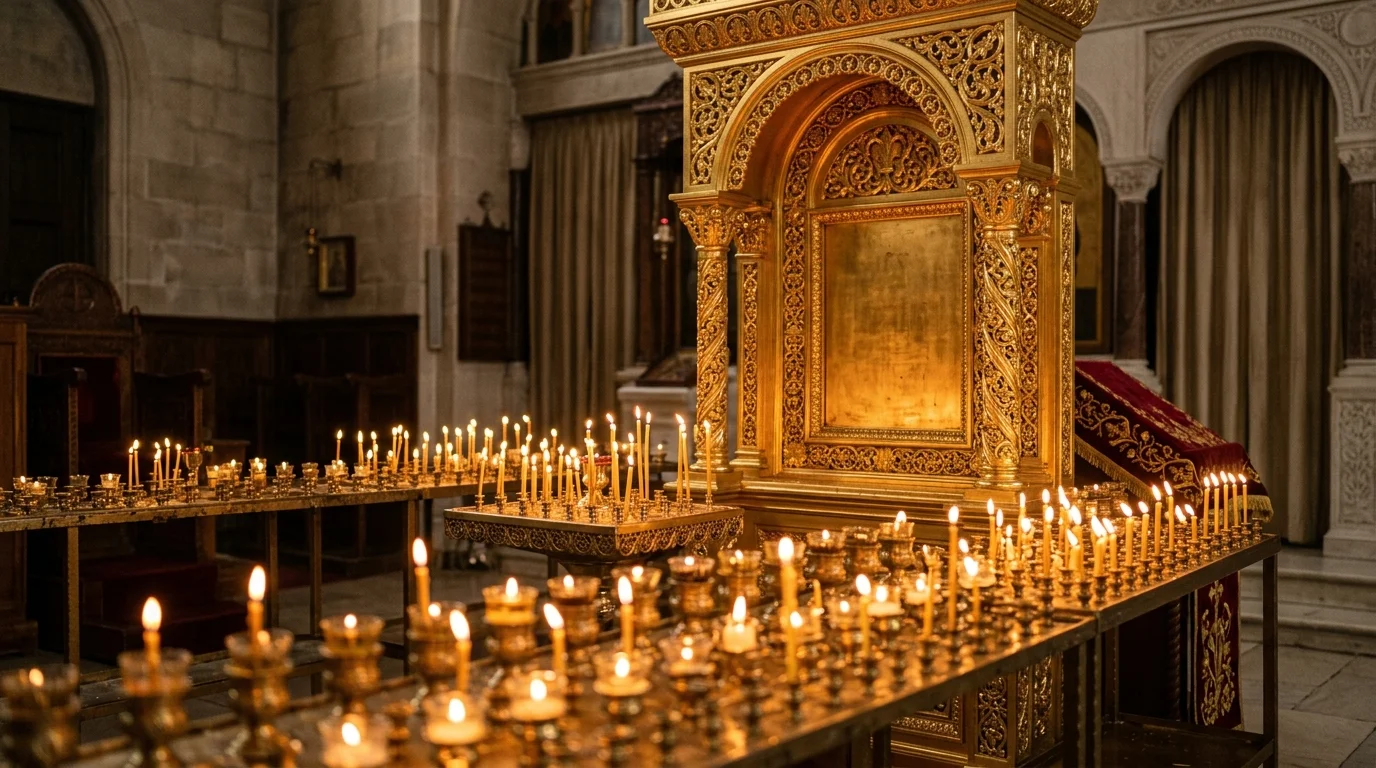

As St. Athanasius the Great writes in On the Incarnation, 4th century, "For He was made man that we might be made God." I don't say this lightly, and neither did Athanasius. He's not claiming we become gods in essence, equal to the Father. He's pointing to 2 Peter 1:4, which speaks of believers becoming "partakers of the divine nature." Grace draws us into real communion with God while we remain fully human, fully created, fully ourselves.
According to the theological study "New Life in Christ: Salvation in Orthodox Theology" (European Express, 2026), Orthodox salvation is best described as communion, sanctification, and deification based on synergy between divine grace and human freedom. Metropolitan Kallistos Ware put this beautifully: salvation isn't a once-for-all event but a lifelong process of theosis. I've gone back and forth many times on how to explain synergy to people raised in traditions built around one decisive moment of conversion. Here's where I've landed: think of Philippians 2:12 to 13, where Paul tells believers to "work out your own salvation with fear and trembling, for it is God who works in you both to will and to do." God works. We respond. Neither cancels the other out. This might be the clearest answer to what do greek orthodox believe about salvation.
Why Faith, Sacraments, and Love Belong Together
Last year, someone came to me after a catechism class — maybe in her late twenties — looking genuinely puzzled. "Father," she said, "if you talk so much about fasting and confession and the Liturgy, are you saying we save ourselves by works?" I've heard some version of that question dozens of times.
My answer is always the same at the core: salvation is entirely by God's grace. Full stop. But grace is meant to transform the whole person, not just settle a legal account. Faith has to become a lived participation in Christ through repentance, prayer, the Eucharist, and love of neighbor. As St. Maximus the Confessor teaches in Four Hundred Texts on Love, 7th century, love of neighbor is inseparable from the knowledge of God. You can't split the two apart. Not in Orthodox theology, anyway. In other words, Greek Orthodox beliefs and practices belong together.
Fr. Alexander Schmemann put it sharply: to seek in the Church anything other than Christ leads to distortion. That line has stayed with me since seminary. Worth repeating, honestly.
What Do Greek Orthodox Believe About the Church, Mary, Icons, and the Sacraments?
The Orthodox Church understands itself as the Body of Christ, with bishops standing in unbroken apostolic succession back to the apostles themselves. Worship centers on the Divine Liturgy, the central Eucharistic service where the community offers prayer, hears Scripture proclaimed, and receives Holy Communion — not as a symbol, but as the real presence of Christ.
Seven sacraments, or Holy Mysteries, mark Orthodox life: baptism, chrismation, confession, the Eucharist, marriage, ordination, and holy unction. None of these are private transactions. Each one draws the whole community around a person's healing.
Mary holds a place of profound honor as the Theotokos, the God-bearer — a title that affirms something about Christ as much as about her. The one she bore is truly God incarnate. "Behold, from now on all generations will call me blessed," she says in Luke 1:48 to 49, and Orthodox hymnography takes her at her word, every single Liturgy, every feast day. If a seeker asks, What do Greek Orthodox believe about Mary, the simplest answer is that we honor her because of who her Son is.
As St. John of Damascus explains in On the Divine Images, 8th century, the honor given to the image passes to the prototype. Icons aren't idols. When an Orthodox Christian kisses an icon of Christ or a saint, the reverence travels through the wood and paint to the person represented — much like kissing a photograph of your grandmother isn't really about the paper. Readers comparing Greek Orthodox vs Catholic often notice real similarities here, even alongside important differences in authority and later doctrinal developments. Learn more: What Do Orthodox Christians Believe? The Main Truths of Our....
What Do Greek Orthodox Believe Happens After Death?
Death, in Orthodox teaching, is a passage, not an ending. The soul continues in a real, conscious existence, experiencing a foretaste of communion with God or separation from Him, awaiting the final resurrection described in 1 Corinthians 15:20 to 28, when soul and body are reunited.
I won't pretend the Church has every detail worked out with mathematical precision. I'm honestly not sure anyone does — what exactly the soul experiences in that middle state stays somewhat veiled. The Fathers themselves show a range of emphasis here. St. Gregory of Nyssa speaks of the soul's ongoing movement toward God even beyond death. St. Isaac the Syrian leans hard into God's mercy stretching further than we can imagine, while still affirming real judgment and the weight of human freedom.
What stays constant is hope grounded in Christ's own resurrection. Not a vague optimism. A confidence rooted in an empty tomb.
How Greek Orthodox Beliefs Compare with Catholic and Protestant Beliefs
[COMPARISON_TABLE]
I knew the Catholic tradition quite well growing up, and I still feel deep respect for its reverence toward the Eucharist and Mary. Most Protestants I've come to know share genuine love for the Trinity and for Christ's divinity, even where we differ on sola scriptura or
<table class="seo-table comparison-table"><caption>How Greek Orthodox Beliefs Compare with Catholic and Protestant Beliefs</caption><thead><tr><th>Aspect</th><th>Orthodox</th><th>Catholic</th><th>Protestant</th></tr></thead><tbody><tr><td>Authority</td><td>Scripture within Holy Tradition; ecumenical councils; communion of autocephalous churches</td><td>Scripture and Tradition under the teaching authority of the Pope and bishops</td><td>Usually Scripture as final authority, with variation by denomination</td></tr><tr><td>Salvation</td><td>Theosis, healing, and synergy by grace</td><td>Justification and sanctification by grace through the Church and sacraments</td><td>Often justification by faith alone, with sanctification following</td></tr><tr><td>Church structure</td><td>No universal pope; bishops in apostolic succession</td><td>Universal papacy with global jurisdiction</td><td>Varies widely: episcopal, presbyterian, congregational, or non-denominational</td></tr><tr><td>Mary</td><td>Theotokos; honored liturgically; Dormition emphasized</td><td>Mother of God; strong Marian dogma and devotion</td><td>Views vary widely, often with less liturgical emphasis</td></tr><tr><td>Icons and worship</td><td>Icons are venerated, not worshiped</td><td>Sacred images honored, though practice differs</td><td>Often less emphasis on images; some traditions avoid them</td></tr></tbody></table>


Help us bring the christian faith to modern seekers worldwide.
Godfinder relies on generous souls to sustain our multilingual platform, develop new tools like the Magic Cube, and support struggling believers. If our work has touched your heart, consider contributing to our nonprofit partner

Do you want to know More? Ask God’s Word!
Do you have questions, worries, or hopes? Feeling lost, burdened, or alone? “Ask God’s Word” brings you gentle guidance rooted in Scripture and the wisdom of the Church. Find hope and strength today!
