.avif)
What is a Presbyterian Church? Discover Core Beliefs
A parishioner of mine, raised Presbyterian in Scotland before she moved to Munich, once asked me a question that stuck with me for years. She said, "Father, I sat in Presbyterian pews my whole childhood and nobody ever explained why we kept splitting into new denominations. Why does that keep...

Who's Actually in Charge Here? What Is a Presbyterian Church, Really?
A parishioner of mine, raised Presbyterian in Scotland before she moved to Munich, once asked me a question that stuck with me for years. She said, "Father, I sat in Presbyterian pews my whole childhood and nobody ever explained why we kept splitting into new denominations. Why does that keep happening?" In other words, she was really asking: what is a presbyterian church when disagreement comes, and who finally has authority to decide? And honestly, that's the real question, isn't it? Not what Calvin taught about grace. Not the Westminster Confession. Just: who's in charge, and what happens when people disagree?
In my years of serving as an Orthodox priest since 2013, I've found that many seekers ask what a Presbyterian church is before they ever ask whether Orthodoxy might be different. And I get it. The word sounds technical, almost bureaucratic. But here's what I've noticed after sitting with dozens of people from Protestant backgrounds: the governance question isn't boring administrative trivia. It's the whole ballgame. How a church organizes itself tells you what it believes the Church actually is. That's not a minor detail buried in a footnote. That's the center of everything.
What most online articles about Presbyterianism miss is that for real seekers, the issue is rarely just church government on paper. In pastoral life, the question quickly becomes existential. When I need confession, communion, spiritual fatherhood, or some kind of certainty about how the Church actually preserves truth across centuries, what kind of Church am I standing in? Does that make sense? I hope it does, because it's the question underneath every other question in this article about what is a presbyterian church.
Quick Answer: A Presbyterian church is a Reformed Protestant congregation governed by elected elders in graded assemblies (session, presbytery, synod, and general assembly) rather than by bishops, emphasizing the sovereignty of God and the final authority of Scripture.
In This Article:
- Who's Actually in Charge Here? What Is a Presbyterian Church, Really?
- What Is a Presbyterian Church? A Simple Answer
- What Is a Presbyterian Church Beliefs and Core Convictions
- How a Presbyterian Church Is Organized
- What a Presbyterian Church Service Is Like
- Orthodox, Catholic, and Presbyterian Compared
- Father Victor's Perspective: Why Church Structure Is Never Just Administration
- Common Misconceptions About Presbyterian and Orthodox Churches
- If You Are Presbyterian and Curious About Orthodoxy
- About Father Victor Meshko
TL;DR — Key Takeaways
- A Presbyterian church is a Reformed Protestant body known above all for elder-led governance rather than rule by bishops or independent congregations.
- Orthodoxy traces its structure to bishops in unbroken apostolic succession, a pattern already visible in St. Ignatius of Antioch's letters from the early 2nd century.
- Roughly 75 million Presbyterians exist worldwide, alongside about 220 to 230 million Orthodox Christians, so we're comparing two substantial, serious Christian traditions, not a giant against a footnote.
- The deepest difference isn't worship style. It's whether biblical leadership can be separated from sacramental continuity and Eucharistic unity under a bishop.
What Is a Presbyterian Church? A Simple Answer
Let's start plainly. A Presbyterian church belongs to the Reformed branch of Protestant Christianity, tracing its theological roots to John Calvin and its historical shape to John Knox and the Scottish Reformation. The name itself comes from the Greek word presbyteros, meaning elder. As J. L., a Reformed pastor and writer, puts it plainly: "Presbyterian is not a doctrine. It is a form of government." I appreciate that honesty. It cuts through a lot of confusion right away. If someone asks for a what is a presbyterian church simple definition, that is probably the cleanest place to begin.

Quick Answer for Seekers
So, in one sentence: a Presbyterian church is a congregation governed by elected elders sitting in graded regional and national assemblies, shaped by Reformed theology and the conviction that Scripture alone holds final authority over doctrine and practice. Not a bishop. Not a pope. A council of elders. That's the core of it, and it is usually the heart of what is a presbyterian church for most people trying to understand the tradition.
Worth repeating: governance first, theology second. Most competitors bury that fact in a single sentence and rush to Calvin's five points. But here's the thing, the governance structure is what actually predicts everything else about how a Presbyterian congregation behaves, worships, and eventually, sometimes, splits. If you want to understand what is a presbyterian church like in practice, start there.
What Is a Presbyterian Church Beliefs and Core Convictions
Across Presbyterian bodies, from the PCUSA to the PCA to the OPC, there's real diversity. But several convictions run through nearly all of them. Any fair answer to What is a Presbyterian Church Beliefs has to begin by admitting both the common core and the real internal differences.
Scripture, Grace, and the Sovereignty of God
Presbyterians hold to the sovereignty of God: the belief that God rules absolutely over creation and salvation, and that salvation is entirely His work. They emphasize salvation by grace through faith, often framed in what theologians call forensic justification, meaning a legal righteousness credited to the believer. And they hold Scripture as the supreme and final authority for what the church believes and does. As one Reformed teaching resource states it, "Reformed churches confess that the Bible is God's own Word written, and the final authority for what the church believes and does." For a helpful Protestant summary of what is a presbyterian church, readers sometimes consult this overview of Presbyterianism.
I want to be fair here. Orthodoxy shares deep reverence for grace, faith, and Scripture. We don't disagree that Scripture is God's Word. Where we part ways is on Sola Scriptura itself, the idea that Scripture functions alone, apart from the living Tradition that produced it, preserved it, and prays it every day in worship. As St. Basil the Great explains in On the Holy Spirit (4th century), the Church also receives unwritten traditions handed down in her life. That's not a small footnote for us. It shapes how we read the Bible at all. For readers exploring this more deeply from an Orthodox angle, our article on Sola Scriptura and Holy Tradition may help.
Why the Word 'Presbyterian' Refers to Church Government
I've gone back and forth on how to explain this simply, and here's where I've landed. The word Presbyterian doesn't describe a set of beliefs about the Trinity or the sacraments. It describes who runs the show. Scripture does speak of presbyters, or elders, appointed in the early churches. Acts 14:23 tells us that Paul and Barnabas "appointed elders for them in every church, with prayer and fasting they committed them to the Lord in whom they had believed." Presbyterians point to this text, and to Titus 1:5-9, where Paul instructs Titus to "appoint elders in every town," as biblical support for elder-led government spread across many towns rather than concentrated in one bishop.
Fair enough. That evidence exists. But Orthodoxy reads these same texts within a fuller apostolic picture, one where the word presbyter develops alongside a separate office of oversight. 1 Timothy 3:1-7 speaks of the qualifications for an overseer, an episkopos, and Philippians 1:1 already shows Paul addressing "bishops and deacons" as recognizably distinct groups within the apostolic Church. So the vocabulary overlaps. The final shape doesn't. If someone asks what is a presbyterian church vs Baptist, this is one of the first distinctions to note: Presbyterian identity is tied especially to elder-led connectional government, not simply to being Protestant.
How a Presbyterian Church Is Organized
Here's where things get interesting, and where I think most articles stop way too early. Explore: What Is a Non Denominational Church? Unveiled!.

Session, Presbytery, Synod, and General Assembly
A Presbyterian congregation is governed locally by a session, a body of elected elders. Congregations connect to each other through a regional presbytery, then sometimes a synod, and finally a national general assembly. No single bishop presides over a diocese. Authority moves collegially, through committees and votes, rather than through one man ordained in a line stretching back to the apostles. Historically minded readers asking where this system came from may find this short history of Presbyterian origins useful.
And this is exactly why Presbyterianism keeps splitting. Not because Presbyterians are quarrelsome by nature (though, well, sometimes). It's structural. A system built to let elected elders and assemblies override individual pastors, and even override each other, will eventually produce competing assemblies whenever a serious disagreement arises. American Presbyterians split over slavery in 1837 and again in 1861. They split again in 1973 over theological liberalism, producing the PCA. Today you'll find PCUSA, PCA, ECO, and others, each claiming the Presbyterian name, each governed the same basic way, and each landing in a different place on major questions. That's not an embarrassing footnote. That's the system working exactly as designed. For many people searching phrases like Why I left the Presbyterian Church, this repeated pattern of division is part of the deeper concern.
How This Differs from Orthodox Bishops, Priests, and Deacons
Orthodoxy inherited a different pattern entirely, and it's ancient. As St. Ignatius of Antioch writes in his Letter to the Ephesians (2nd century), "See that ye all follow the bishop, even as Jesus Christ does the Father, and the presbytery as ye would the apostles; and reverence the deacons as being the institution of God." One bishop. A presbytery serving under him. Deacons assisting both. St. Ignatius says something even sharper in his Letter to the Trallians: "He that does anything without the bishop, and presbyters, and deacons, such a one is not pure in his conscience."
According to Jayms.com's historical summary of the post-apostolic Church, Ignatius gives us the earliest unambiguous witness to a single bishop presiding in each local church, already recognizable by the early 2nd century. That's remarkably early. We're talking decades after the apostles themselves. St. Irenaeus of Lyons builds on this in Against Heresies, Book 3 (2nd century), arguing that the apostolic faith stays intact precisely because of the succession of bishops handing it down, generation after generation. And St. Cyprian of Carthage, writing in the 3rd century, puts it about as bluntly as anyone could: "The bishop is in the Church and the Church in the bishop; and if someone is not with the bishop, he is not in the Church."
So what does this actually mean for someone standing in a parking lot, deciding which building to walk into on Sunday? It means the two traditions aren't just organized differently for convenience. They're organized according to two different answers to the question: what is the Church? And once you begin asking what is a presbyterian church in that deeper sense, the contrast becomes much clearer.
What a Presbyterian Church Service Is Like
I think this matters more to seekers than any theological chart, honestly.
Preaching, Prayer, Music, and the Lord's Supper
A Presbyterian service usually centers on preaching. The sermon carries real weight, often twenty-five to forty minutes, drawing out Scripture verse by verse. You'll find structured prayers, Scripture readings, psalm or hymn singing (ranging from traditional to fully contemporary depending on the congregation), and the Lord's Supper celebrated on a set schedule, sometimes weekly, often monthly or quarterly. Most Presbyterians recognize two sacraments, baptism and the Lord's Supper, understanding Christ's presence there as real but spiritual rather than a physical transformation of bread and wine. So if someone asks what is a presbyterian church service like, that is the ordinary pattern they will usually meet.
1 Corinthians 11:23-29 grounds this practice for them, as it does for us. "For I received from the Lord what I also delivered to you, that the Lord Jesus on the night when he was betrayed took bread..." It's the same institution narrative we pray in the anaphora of the Divine Liturgy. But the theology of what happens on that table differs sharply. Orthodoxy holds that the bread and wine become, in a full sacramental sense, the Body and Blood of Christ. Not a symbol. Not merely a spiritual presence. A mystery, yes, but a real one.
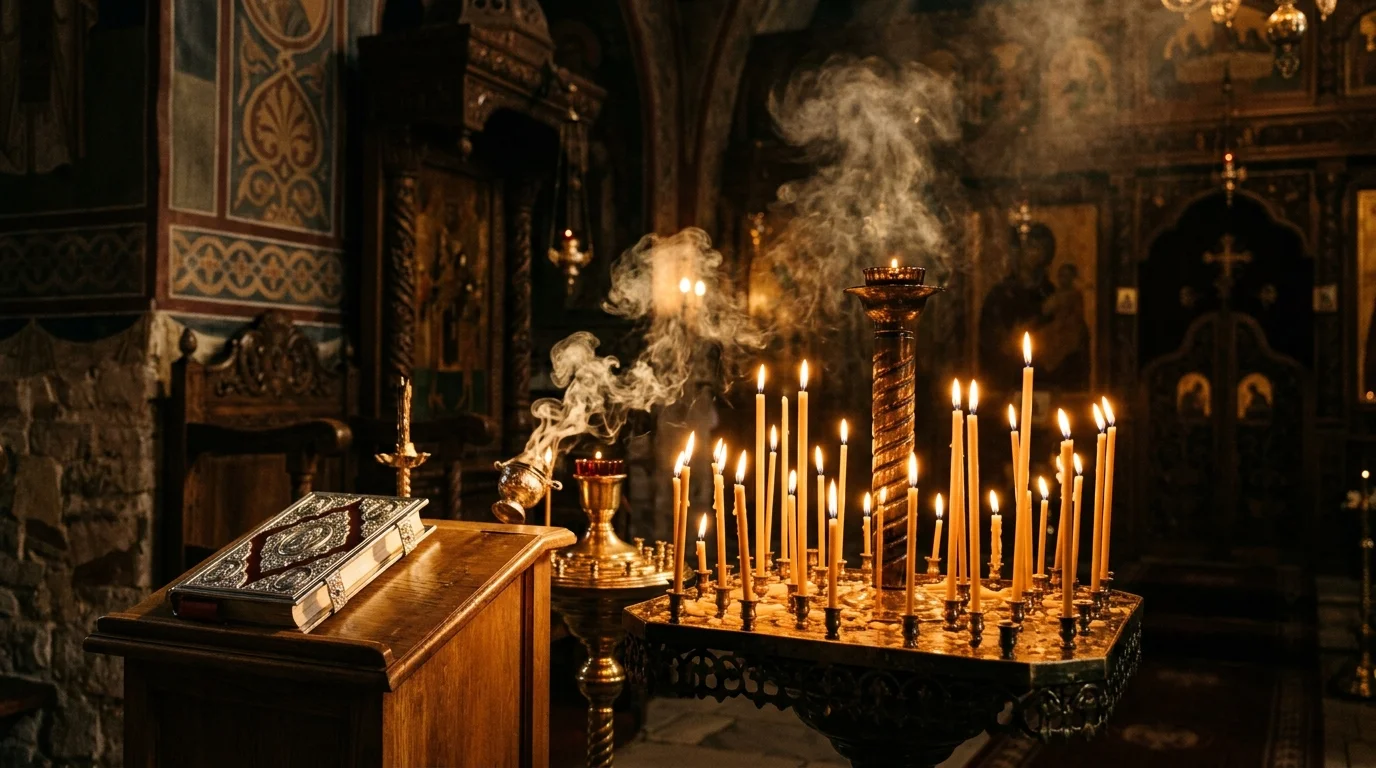
An Orthodox Liturgy, by comparison, unfolds as sung prayer from beginning to end, dense with incense, icons, and movement, culminating in the Eucharist as the center of the whole service rather than one element among several. I remember visitors telling me, half-laughing, half-overwhelmed, "I didn't understand a single thing that just happened, but I didn't want it to end." Not what they expected walking in. And honestly? That reaction happens more often than you'd think. If you'd like a fuller picture, you might also appreciate our guide to what to expect at an Orthodox Liturgy.
Orthodox, Catholic, and Presbyterian Compared
Sometimes a table says what paragraphs can't.
Presbyterian, Catholic, and Orthodox: What Is the Difference?
[COMPARISON_TABLE]
Globally, Presbyterians number around 75 million, according to Wikipedia's overview of Presbyterianism. The PCUSA alone reported 1,045,594 members in 8,380 churches in 2024, according to PC(USA) Church Trends. Orthodoxy sits at roughly 220 to 230 million adherents worldwide, about 11 to 12 percent of global Christians, out of some 2.63 billion Christians total according to EBSCO's Christian Worldview research starter. Neither tradition is a rounding error. Both are serious, sizable expressions of Christian faith, and that's worth remembering before anyone treats either one as a footnote. In many online comparisons framed as Presbyterian vs Catholic or Orthodox versus Protestant, that historical scale is often forgotten.
Father Victor's Perspective: Why Church Structure Is Never Just Administration
Here's something I've come to believe after years of these conversations, and I don't say it to score points. The deepest Orthodox question about Presbyterianism isn't whether elders are biblical. Of course they're biblical. Acts 14:23 settles that easily enough. The real question is whether biblical leadership can be separated from sacramental continuity and Eucharistic unity gathered under a bishop. That's a much harder question, and it's the one competitors almost never ask.

Many seekers assume church government is secondary, a kind of administrative afterthought, while worship style is what really matters. I'd reverse that entirely. How a church orders itself reveals what it believes the Church actually is. A congregation governed by elected committees believes something different about the Church's nature than a community gathered around a bishop who stands in unbroken succession from the apostles. Neither view is stated out loud very often. But it's there, underneath everything, shaping how each tradition handles disagreement, discipline, and unity. This, to me, is the heart of what is a presbyterian church as an Orthodox priest would describe it. Discover: Orthodox vs Protestant: Exploring Key Differences.
And here's something I find genuinely hopeful, something I don't think gets said enough. Presbyterian seriousness about Scripture, that deep, disciplined attention to the biblical text, often becomes a bridge rather than a wall. I've watched inquirers who spent years studying Paul's letters verse by verse discover, almost with surprise, how seriously the early Fathers took those same texts. When someone who already loves Scripture meets St. Ignatius writing about bishops within decades of the apostles, or reads St. Irenaeus tracing doctrine through unbroken succession, something clicks. Not always immediately. But often enough that I've stopped being surprised by it.
Common Misconceptions About Presbyterian and Orthodox Churches
Let me clear up a few things I hear constantly, because charity requires accuracy.
"A Presbyterian church is just any Protestant church with a traditional style." Not quite. Presbyterians are definitely Protestant Christians, but they carry a specific history and structure that separates them from Baptist, Methodist, or Anglican churches. Many online summaries flatten all Protestant groups together, focusing on worship atmosphere rather than actual church government.
"Orthodox and Presbyterian churches are almost the same because both mention elders or presbyters." The Greek word presbyteros does appear throughout the New Testament, so I understand why people assume shared vocabulary means shared structure. It doesn't. Orthodoxy distinguishes bishop, presbyter, and deacon within apostolic succession, while Presbyterianism doesn't treat bishop as a separate sacramental office at all. We share some biblical vocabulary. We understand the shape of the Church quite differently.
"Presbyterians don't believe in sacraments at all." Actually, they do. Most Presbyterians recognize baptism and the Lord's Supper as genuine sacraments or means of grace, even though from the outside, especially compared to Orthodox liturgical life, a low-church service can look non-sacramental. The difference isn't whether these matter. It's how they're understood.
"All Presbyterian churches share the same views on sexuality, ordination, and modern social issues." This one trips people up constantly. Presbyterian bodies differ sharply, especially between the PCUSA and more conservative groups like the PCA or the OPC. Media coverage tends to treat the largest or most controversial denomination as representative of the whole tradition, and that's just not fair to the range that actually exists.
"Exploring Orthodoxy after Presbyterianism means despising your past." I want to be especially clear here, because I've watched this fear paralyze sincere people. Orthodoxy calls people toward fullness and honest discernment, not contempt for whoever helped them come to know Christ in the first place. Gratitude for your upbringing and honest questions about apostolic continuity can coexist. They should coexist.
"Sola Scriptura means Presbyterians care about the Bible while Orthodox rely on mere human tradition." I've heard this one from both sides, honestly, and it's a false choice. Orthodox Christians revere Scripture as God's Word and read it within the life of the Church that received, preserved, and prays it daily. We don't place Tradition against Scripture. We hold that Scripture lives inside the Tradition that gave birth to the New Testament canon in the first place.
If You Are Presbyterian and Curious About Orthodoxy
Someone came to me last year after visiting our cathedral for the first time. She'd grown up Presbyterian in the American Midwest, sung in the choir, served on committees, the whole life. She sat through her first Divine Liturgy looking, in her own words, "completely lost." Then she said something I still think about: "Father, if Presbyterians already believe in Christ and take the Bible seriously, what's actually different here?" Explore: From Apostles to Today: History of the Christian Church.
I told her what I'll tell you. The difference isn't whether Christ is real to you, or whether Scripture matters. It's whether the Church is a visible, sacramental body centered on a bishop in unbroken succession, or a connected system of elder-led assemblies holding Scripture as final authority. Both take Christ seriously. They understand the Church itself differently. That is why the question what is a presbyterian church eventually leads many people into a much larger question about what the Church is at all.
What to Visit, Ask, and Pray About
My honest advice? Attend a Divine Liturgy, more than once if you can. Ask a priest directly about apostolic succession, about confession, about what happens at the altar. Read Titus 1:5-9 and Acts 14:23 alongside St. Ignatius of Antioch and see how the pieces fit together for yourself. And pray. John 17:20-23 records Christ's own prayer "that they may all be one," and I think that prayer should shape how we approach these conversations, gently, without pressure, without treating anyone's sincere faith as worthless.
Different Orthodox jurisdictions handle the reception of converts somewhat differently, some by baptism, others by chrismation, depending on local practice and the bishop's discretion. That's a pastoral and canonical matter, not a doctrinal contradiction. Speak with a priest near you rather than deciding anything from an internet summary alone. I say that as someone who writes internet summaries for a living, so take it seriously. And if you are still asking what is a presbyterian church in relation to Orthodoxy, keep asking patiently, prayerfully, and in person as much as possible.
Frequently Asked Questions
Does the Presbyterian Church support LGBT people?
It depends entirely on which Presbyterian denomination you mean. The PCUSA, the largest mainline Presbyterian body in the United States, ordains LGBT clergy and permits same-sex marriage in many congregations, according to reporting on PCUSA debates and denominational developments. More conservative bodies like the PCA and the OPC hold traditional views on marriage and sexuality and don't ordain LGBT clergy. So there isn't one Presbyterian answer here. There are several, and they diverge sharply.
What are the main beliefs of the Presbyterian Church?
Presbyterians generally hold to the sovereignty of God, the final authority of Scripture, salvation by grace through faith, and covenant theology, which grounds practices like infant baptism. They're governed by elected elders rather than bishops, tracing their theological heritage to John Calvin and their historical roots to the Scottish Reformation. Orthodox Christians share belief in grace and Scripture's authority but differ on Sola Scriptura, apostolic succession, and the nature of justification.
What do Presbyterians not believe in?
Most Presbyterians reject papal authority, a single ruling bishop over a diocese, and the veneration of icons or relics as practiced in Orthodox and Catholic worship. They generally don't hold to seven sacraments, recognizing only baptism and the Lord's Supper. Orthodox Christians hold a full sacramental life, including confession and the anointing of the sick, and understand icons as windows into the reality of the saints, not idols.
What is the main difference between Catholic and Presbyterian?
Catholics are governed by bishops in communion with the Pope, who holds universal authority over the whole Church, while Presbyterians reject any single earthly head and govern themselves through elected elders in regional and national assemblies. Catholics recognize seven sacraments and hold Scripture and Tradition together under the interpretive authority of the magisterium, while Presbyterians hold Scripture alone as final and recognize two sacraments. Orthodoxy shares the Catholic emphasis on bishops and apostolic succession but rejects universal papal primacy, governing instead through synods of bishops equal in dignity.
About Father Victor Meshko
About the Author
Father Victor Meshko is an Orthodox priest of the Russian Orthodox Church Abroad serving at the Cathedral of the Holy New Martyrs and Confessors of Russia in Munich. Ordained to the priesthood in 2013, he holds multiple degrees in philosophy, theology, and psychology, including theological study at LMU Munich, and is the author of the published book Erzbischof Filaret (Gumilevskij) von Cernigov und Nezin. His writing for Find to God joins patristic scholarship with practical pastoral care for seekers.
Researched and written by Father Victor Meshko. AI tools were used during the research process.
<table class="seo-table comparison-table"><caption>Presbyterian, Catholic, and Orthodox: What Is the Difference?</caption><thead><tr><th>Aspect</th><th>Presbyterian</th><th>Catholic</th><th>Orthodox</th></tr></thead><tbody><tr><td>Church government</td><td>Elder-led assemblies such as session, presbytery, and general assembly</td><td>Bishops in communion with the Pope</td><td>Bishops in apostolic succession gathered in synods, without a universal pope</td></tr><tr><td>Authority</td><td>Scripture as final authority, with confessions subordinate</td><td>Scripture and Tradition interpreted by the magisterium</td><td>Scripture within Holy Tradition, interpreted in the life of the Church</td></tr><tr><td>Sacraments</td><td>Usually two: baptism and the Lord's Supper</td><td>Seven sacraments</td><td>Seven sacraments or mysteries</td></tr><tr><td>Eucharist</td><td>Christ truly present spiritually, understood in Reformed categories</td><td>Real presence articulated in Catholic sacramental theology</td><td>Real sacramental presence in the Eucharistic life of the Church</td></tr><tr><td>Historical self-understanding</td><td>Reformed Protestant tradition from the Reformation, especially Scotland and Calvinist influence</td><td>Apostolic Church centered on communion with Rome</td><td>The pre-denominational apostolic Church preserving the ancient faith</td></tr></tbody></table>


Help us bring the christian faith to modern seekers worldwide.
Godfinder relies on generous souls to sustain our multilingual platform, develop new tools like the Magic Cube, and support struggling believers. If our work has touched your heart, consider contributing to our nonprofit partner

Do you want to know More? Ask God’s Word!
Do you have questions, worries, or hopes? Feeling lost, burdened, or alone? “Ask God’s Word” brings you gentle guidance rooted in Scripture and the wisdom of the Church. Find hope and strength today!
