.avif)
What Is an Orthodox Church? Discover Its Unique Appeal
If you walk into an Orthodox church expecting someone to greet you at the door with a welcome packet and a three-point explanation of what's happening, you've already misunderstood what you're walking into. Nobody's going to hand you a bulletin that spells it all out. That's not an accident, and...

The Church That Refuses to Explain Itself: What Is an Orthodox Church?
If you walk into an Orthodox church expecting someone to greet you at the door with a welcome packet and a three-point explanation of what's happening, you've already misunderstood what you're walking into. Nobody's going to hand you a bulletin that spells it all out. That's not an accident, and honestly, I've grown to love that about us. In my years of serving as an Orthodox priest since 2013, I have found that many seekers ask not only what an Orthodox church is, but why it feels so different from the churches they already know. And here's the thing nobody tells you upfront: it's supposed to feel different. It's not trying to make sense to you in the first five minutes.
I remember standing at the back of the Cathedral of the Holy New Martyrs during my first year here in Munich, watching a young man in his twenties hover near the entrance. He didn't come in. He didn't leave either. He just stood there, watching candles get lit, watching people cross themselves in an order that seemed to follow no logic he recognized. Later, over coffee, he told me something I still think about: "I felt like I'd wandered into something that wasn't built for me to understand right away." He wasn't wrong. And that's part of the appeal, if you ask me — not a flaw we need to apologize for. For many people, what is an orthodox church only starts making sense once they stop expecting it to behave like a modern religious presentation.
One of my favorite moments in parish life is watching a visitor realize an Orthodox church isn't an ethnic club or some kind of religious museum. It's a living community, gathered around Christ in prayer and the Eucharist. Most articles online miss this entirely — they'll tell you about the building, the ethnic label, maybe the priest's personality, and skip right past the actual center of things. The real center is the gathered Eucharistic life of the community. That's it. Give it years in this vocation, and you start to see that people only really understand Orthodoxy once they experience how doctrine, prayer, fasting, repentance, and worship fold into a single reality. Not six separate ideas floating around. One thing, breathing.
✏️ By Father Victor Meshko | 📅 Updated: September 2026 | ⏱️ 9 min read
Quick Answer: An Orthodox church is a worshipping community within the historic apostolic Church, a communion of self-governing local churches united in the same faith, sacraments, bishops, and Divine Liturgy — tracing its life back to Christ and the Apostles rather than to a later reform or founder.
In This Article:
- The Church That Refuses to Explain Itself: What Is an Orthodox Church?
- What Is an Orthodox Church?
- What Is an Orthodox Church and Is the Orthodox Church a Denomination?
- What Do Orthodox Christians Believe?
- Why an Orthodox Church Looks and Feels Different
- Father Victor's Perspective: An Orthodox Church as a School of Communion
- How Orthodoxy Differs from Catholic and Protestant Christianity
- What to Expect When You Visit an Orthodox Church
- Scripture and the Church Fathers on the Church
- Common Misconceptions About an Orthodox Church
TL;DR — Key Takeaways
- An Orthodox church is a Eucharistic community first — not a building, a culture, or a brand.
- We understand ourselves as the continuation of the apostolic Church Christ founded, kept alive through Scripture, Holy Tradition, and the Ecumenical Councils.
- There's no pope. Orthodoxy is a communion of autocephalous (self-governing) churches united in the same faith and sacraments.
- Icons, incense, and chant aren't decoration. They flow directly from the belief that God truly became flesh.
What Is an Orthodox Church?
Let me try to say this plainly, without seminary vocabulary getting in the way. An Orthodox church is a community of baptized believers gathered around a bishop or priest, united by the same Creed, the same sacraments, and above all the same Eucharist — in continuity with the Church that began at Pentecost. That's the short version. Worth repeating, actually, because it gets buried fast in debates about history and jurisdiction. When someone asks me what is an orthodox church, that's still the first thing I want them to hear.

Quick Answer for Seekers
Orthodoxy is not a denomination someone invented five hundred years ago. It's not a reform movement, either. According to Encyclopaedia Britannica (2025), the Orthodox Church is one of the three major branches of Christianity, organized as a communion of autocephalous churches rather than a single centralized institution. Roughly 220 million Christians worldwide belong to it — about 12% of global Christianity, according to global Christianity statistics summarized by PrayFocus. So no, this isn't some tiny fringe group. It's a major, ancient, global tradition that just doesn't advertise itself the way modern institutions do. If you're seriously asking what is an orthodox church, start here: you're looking at one of the world's historic Christian bodies, not a fringe experiment.
Orthodox Church vs. Orthodox as a General Word
Here's where a lot of confusion starts, and I don't blame anyone for it. In English, "orthodox" can just mean conventional, strict, or doctrinally correct in a general sense. Someone might call a rabbi "orthodox" or describe strict adherence to any set of rules as "orthodox behavior." People also search strange phrases like What is an Orthodox Jew or What is an Orthodox Muslim, using the word in that broader sense. But when Christians talk about the Orthodox Church, capital O, they mean something specific: a particular ancient communion with its own history, bishops, sacraments, and worship. Not a synonym for conservative. Not a vibe. A Church, with a defined shape. In that sense, what is an orthodox church isn't a generic language question at all — it's a very concrete Christian one.
Christ himself promised, "And I say also unto thee, That thou art Peter, and upon this rock I will build my church; and the gates of hell shall not prevail against it" (Matthew 16:18). Orthodox Christians read this not as a promise to one man's later successors alone, but as a promise about the Church as a living, Spirit-guided body across the centuries. That's the foundation this whole conversation rests on.
What Is an Orthodox Church and Is the Orthodox Church a Denomination?
I get this question constantly, usually phrased something like: "So if you're not Protestant and not Catholic, what exactly are you?" Fair question. A woman at a parish meal asked me almost that exact thing last spring, half-joking, half-genuinely confused. I told her Orthodoxy doesn't slot neatly into the categories most Western Christians grew up with. It's not a hybrid. It's not "Catholicism without the pope," though I understand why people reach for that shorthand. In search-engine language, people often compare Orthodox Christianity vs Catholic or even ask whether Orthodoxy is separate from Christianity altogether. But for the Church herself, what is an orthodox church is really a question about continuity, worship, and communion.
How Orthodox Christians Understand Apostolic Continuity
The Orthodox Church understands herself as the historic apostolic Church, organized as a communion of local churches with conciliar life rather than universal papal jurisdiction, as explained by Holy Apostles Bulgarian Orthodox Church. That's a mouthful, I know. But look at what actually happened at Pentecost: the Church didn't begin as an idea or a book. It began as an event — a gathering, a community devoted to "the apostles' doctrine and fellowship, and in breaking of bread, and in prayers" (Acts 2:42). Teaching, fellowship, sacrament, prayer, all bound together from day one. Orthodoxy insists that same shape has continued, unbroken, through the bishops and councils of every generation since.
Scripture calls "the church of the living God" the "pillar and ground of the truth" (1 Timothy 3:15). Not merely a container for private interpretation. A living guardian of the apostolic message. That's why we read the Bible within the Church's worship and teaching, rather than treating it as a standalone document, cut off from the community that received and canonized it. If you're trying to understand what is an orthodox church, that point matters enormously.
What Do Orthodox Christians Believe?
So what's actually inside all this? I'll try to keep it focused, because this could easily balloon into a book, and I've written enough dense theology in my academic life already. Here I want to keep it human.

The Trinity and Jesus Christ
Orthodox Christians confess one God in three persons — Father, Son, and Holy Spirit — and believe Jesus Christ is fully God and fully man. Not half and half. Not God wearing a human costume. Truly God, truly man, in one person. As St. Gregory the Theologian put it centuries ago, salvation depends on Christ having fully assumed our human nature, "what has not been assumed has not been healed." So if someone asks, Is Orthodox Christian belief really Christian in the historic sense, the answer is an unambiguous yes.
Scripture and Holy Tradition
Here's something that surprises a lot of Protestant visitors. We hold Scripture in the highest reverence, but we read it inside Holy Tradition — the living transmission of apostolic faith through worship, councils, saints, and doctrine, not just old customs for their own sake. St. Paul writes, "Therefore, brethren, stand fast, and hold the traditions which ye have been taught, whether by word, or our epistle" (2 Thessalonians 2:15). As St. Basil the Great teaches in On the Holy Spirit (4th century), "Of the dogmas and proclamations preserved in the Church, some we possess from written teaching and some we receive from the tradition of the apostles." Both matter. Neither stands alone.
The Church, the Sacraments, and the Eucharist
The Eucharist sits at the absolute center. St. Paul writes, "The cup of blessing which we bless, is it not the communion of the blood of Christ? The bread which we break, is it not the communion of the body of Christ? For we being many are one bread, and one body: for we are all partakers of that one bread" (1 Corinthians 10:16-17). Fr. Alexander Schmemann, the Orthodox priest and theologian, put it simply: the Church is revealed most fully in the Eucharist, where the people of God gather around Christ. That's not a slogan for us. That's Sunday morning. Every single time. It's also one of the clearest answers I can give to what is an orthodox church: a people assembled around Christ in the Eucharist. See also: What Is Orthodox Christianity? Discover Its Depth.
We also teach theosis — the understanding that salvation means real transformation by God's grace, becoming Christlike and sharing in God's life by grace, without becoming God by nature. As St. Athanasius the Great writes in On the Incarnation (4th century), "He became what we are that He might make us what He is." I don't fully grasp the depths of that mystery myself, even after years of study. But I've watched it work quietly in people's lives, and honestly, that's enough to keep me convinced it's real.
Why an Orthodox Church Looks and Feels Different
Why is there incense everywhere? Why are the walls covered in painted faces? Why are people bowing and crossing themselves at moments that seem to follow some invisible script? Most articles just list the props and never explain why they're there. Let me try to actually explain it.

Icons, Incense, Candles, and Chant
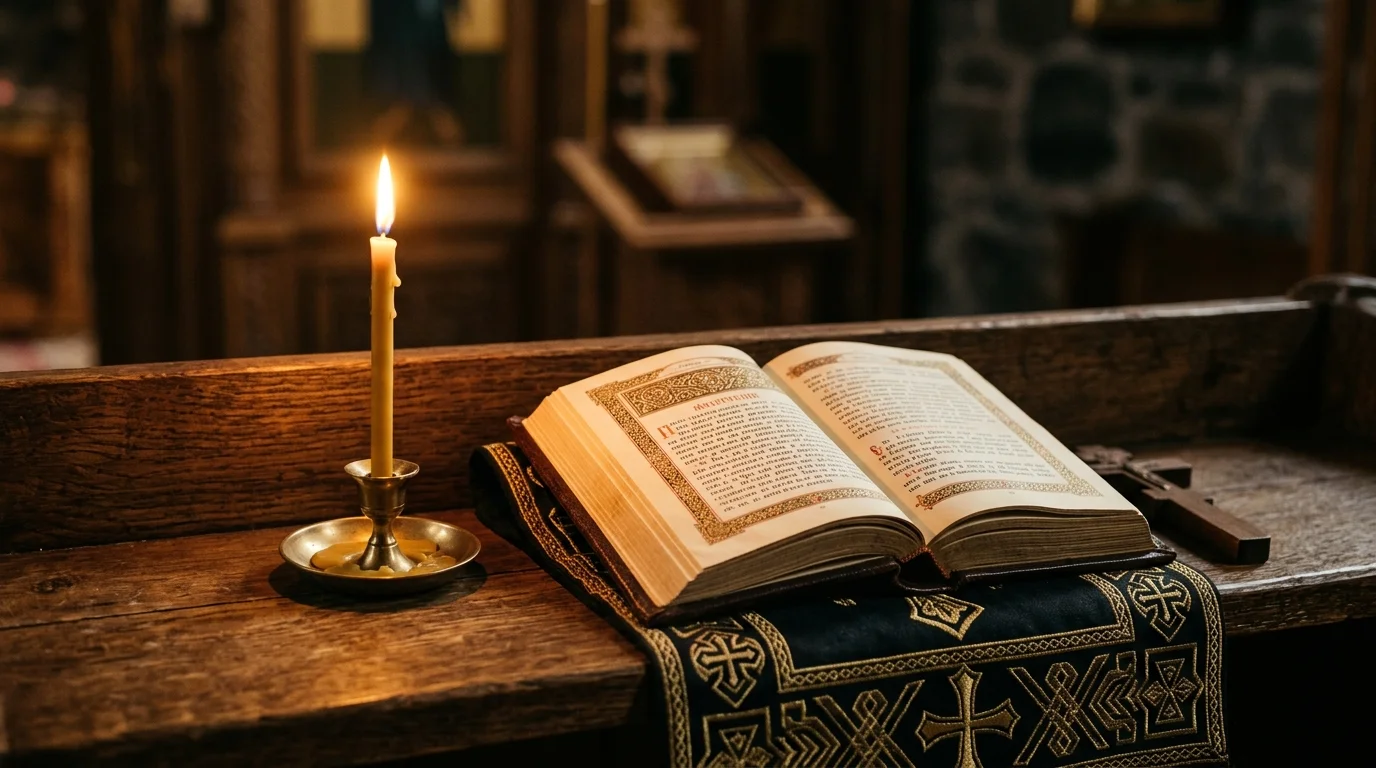
None of this is decoration. Let me put that more carefully: it's decoration in the same way words in Scripture are decoration — which is to say, not decoration at all. It's proclamation. John writes, "And the Word was made flesh, and dwelt among us" (John 1:14). Because God truly took on flesh and became visible, matter itself became capable of carrying holiness. Icons, incense, candles, chant — none of it is extra. It's embodied theology.
As St. John of Damascus explains in On the Divine Images (8th century), "I do not worship matter; I worship the Creator of matter who became matter for my sake." The Seventh Ecumenical Council in 787 affirmed the veneration of icons precisely on these grounds, according to the historical summary of the Seventh Ecumenical Council, distinguishing veneration (honor given to the person depicted) from worship (given to God alone). We don't worship icons. We venerate them, because the Son of God truly became visible in the flesh.
Why the Divine Liturgy Is the Center
During my theological studies at LMU Munich, and in more parish conversations than I can count here in Munich, I've noticed something: people understand Orthodoxy far better once they encounter its worship, before they ever try to debate its claims. The Divine Liturgy isn't a warm-up act before the sermon. It IS the church's life. Once you grasp that Orthodox worship is intentionally embodied — rooted in the Incarnation itself — you start to understand why nothing here feels casual. If you're still wondering what is an orthodox church, come to the Divine Liturgy and just watch what the Church actually does.
A young couple came to the cathedral last year during a Sunday Liturgy, both raised in fairly informal Protestant settings back home. Afterward the husband asked me, half bewildered, half moved: "Is this just a very old style of Christianity, or is there something deeper going on?" I told him what I tell most people: the style IS the theology. The Divine Liturgy is the center of church life, not decorative background to a talk. He came back the next week. And the week after that.
[YOUTUBE_VIDEO]
If you'd like a fast, clear overview before reading further, Fr. Andrew Stephen Damick's short video above covers ten common seeker questions in under five minutes. I think it pairs well with everything I'm trying to say here.
Father Victor's Perspective: An Orthodox Church as a School of Communion
Here's where I want to offer something you probably won't find on the usual encyclopedia pages. I've gone back and forth on how to explain this over the years. This is where I've landed.
An Orthodox church shouldn't be described first as a religious institution. That's the mistake almost every introductory article makes. It's better described as a place where the human person is gradually re-formed in Christ through worship, repentance, and communion. My background in psychology alongside theology has shaped this conviction more than anything else has. People don't come to church primarily to learn facts about God. They come, whether they'd put it this way or not, because something in them needs healing. And the Church exists for exactly that.
The visual richness I described earlier isn't aesthetic excess. It's a theological consequence of the Incarnation. Because Christ truly took flesh, the Church teaches with matter itself — icons, incense, candles, chant, blessing. These aren't extras layered on top of "real" Christianity. They ARE the teaching, delivered through the senses rather than through argument alone. Explore: What is the Orthodox Church? Discover Its Impact.
And here's the insight I keep coming back to, whenever people ask me why anyone would bother with all this in a distracted world: for seekers, the best first definition of an Orthodox church is a school of communion. It teaches communion with God. It teaches communion across generations through Tradition. And it teaches communion with actual, specific, sometimes difficult people sitting in the pew next to you. That answers modern loneliness every bit as much as it answers modern curiosity. Maybe more. If you want a related reflection, you might also read Orthodox Christianity vs Catholic or our introduction to the Divine Liturgy.
How Orthodoxy Differs from Catholic and Protestant Christianity
I knew the Catholic tradition quite well before my conversion, having been raised in it. So I want to be careful and fair here. There's real shared inheritance between Orthodoxy and Catholicism — ancient sacraments, apostolic succession, a high view of the Church's visible continuity. The major difference sits in ecclesiology: Orthodoxy is conciliar and communion-based, without universal papal jurisdiction, while Catholicism unites its whole worldwide body under the pope. So when people search for Is Orthodox Catholic or compare Orthodox Christianity vs Catholic, that's usually where the real distinction lies.

Protestant traditions — and there's tremendous internal variety here, so I want to avoid overgeneralizing — tend to emphasize the authority of Scripture, faith in Christ, and gospel preaching, but often differ from Orthodoxy on church structure, sacramental theology, the authority of Tradition, and the place of icons and liturgical worship. None of this means one tradition has nothing to teach the other. It means the categories genuinely differ, and pretending otherwise doesn't help anyone. In the same way, Orthodox Christianity vs Christianity is really the wrong comparison, because Orthodoxy is Christianity — more precisely, one historic form of the Orthodox Christian Church.
Comparison Table
| Aspect | Orthodox | Catholic | Protestant |
|---|---|---|---|
| What the Church is | The historic apostolic Church lived as a communion of local churches united in faith, sacraments, and bishops | The historic apostolic Church under communion with the pope | Usually a denomination or network seeking fidelity to the Gospel in varying ways |
| Authority | Scripture within Holy Tradition, Ecumenical Councils, and bishops in communion | Scripture, Tradition, and magisterial teaching under the pope | Usually Scripture alone or Scrip support us Help us bring the christian faith to modern seekers worldwide.Godfinder relies on generous souls to sustain our multilingual platform, develop new tools like the Magic Cube, and support struggling believers. If our work has touched your heart, consider contributing to our nonprofit partner  Talk to God’s Word Do you want to know More? Ask God’s Word!Do you have questions, worries, or hopes? Feeling lost, burdened, or alone? “Ask God’s Word” brings you gentle guidance rooted in Scripture and the wisdom of the Church. Find hope and strength today!  |