
Can You Pray in Your Head? Discover the Truth
If your silent prayers feel suspiciously like the same anxious voice that worries about bills, replays an old conversation, or rehearses what you should have said an hour ago, you are not failing at prayer. You are simply asking the wrong question.
If your silent prayers feel suspiciously like the same anxious voice that worries about bills, replays an old conversation, or rehearses what you should have said an hour ago, you are not failing at prayer. You are simply asking the wrong question.
In my years of serving as an Orthodox priest, I have heard this question from students, parents, travelers, and people who are just beginning to pray: does God hear me if I only pray in my head? Usually what troubles them is not really a question about technique. They are asking whether they can actually reach God at all, especially when their inner words feel scattered, uncertain, or indistinguishable from ordinary worrying.
What most articles on this subject miss is that in real parish life, people rarely struggle with silent prayer because someone told them it is forbidden. They struggle because they quietly assume prayer only counts when it feels intense, eloquent, or spiritually impressive. One of the most moving moments in pastoral care is when a person discovers that even a silent cry for mercy, offered in the middle of fear, grief, or sheer exhaustion, is not invisible to God.
✏️ By Father Victor Meshko | 📅 Updated: October 2026 | ⏱️ 16 min read
Quick Answer: Yes, you can pray in your head. Orthodox Christianity teaches that silent, inward prayer is real prayer, because God knows the human heart and is not limited by audible speech.
In This Article:
- Can God hear me when I pray silently in my head?
- What does the Bible say about praying in your head?
- Is it better to pray silently or out loud?
- Does your body position matter, such as praying lying down or with your eyes open?
- What does Orthodox Christian tradition teach about silent, inner prayer?
- What is the Jesus Prayer and how is it prayed silently in the heart?
- How can you grow from silent head prayer to prayer of the heart?
- Father Victor's Perspective
- Common Misconceptions About Silent Prayer
TL;DR: Key Takeaways
- Silent, mental prayer is genuine prayer; God is not deaf to the heart, only indifferent to volume.
- Orthodox tradition places silent prayer alongside the Divine Liturgy, confession, and a daily prayer rule, not as a replacement for them.
- Try short, attentive prayers throughout the day rather than judging yourself by how intense or eloquent they feel.
- The real struggle for most seekers is not whether God hears silence, but whether they can trust that their own scattered inner words truly count as prayer.
Can God hear me when I pray silently in my head?
Yes. God hears every silent prayer you offer in your mind, because Scripture consistently describes Him as knowing the heart before a single word is ever formed aloud. Orthodox tradition has never treated volume as a measure of sincerity. What it measures instead is attention, humility, and whether the person is genuinely turned toward God.

The Psalmist puts it with striking directness: God has searched us and known us, understanding our thoughts before they take shape (Psalm 139:1-4). That verse is often the first one I bring up with someone who is anxious about this question, because it removes the burden of performance. God is not waiting at a distance for a verbal report. He is already present to the thought as it forms.
I remember a woman from my parish who was in the hospital, weak and frightened before surgery, barely able to speak above a whisper. She asked me quietly whether it still counted if she simply turned to Christ inwardly and asked for mercy, since her voice would not cooperate. I told her plainly that God is not limited by human strength or volume, and that a brief, inward turning toward Christ in trust is entirely fitting in a moment like that. Her fear did not vanish immediately, but she found peace in repeating a simple inward prayer, and she later told me she understood prayer differently: not as finishing a verbal formula correctly, but as communion with God.
It is worth saying plainly that global figures, such as the estimate of roughly 293 million Orthodox Christians worldwide in 2024 cited by the Center for the Study of Global Christianity, tell us something about the size of the Orthodox communion. They tell us nothing about how many of those people pray silently rather than aloud. No reliable study measures that, and I would rather say so openly than pretend otherwise.
What does the Bible say about praying in your head?
Scripture does not use our modern phrase for inward prayer, but it gives several clear examples of prayer that is silent, inward, or wordless, alongside prayer that is spoken and communal. Both forms appear as faithful and acceptable to God.

The clearest biblical picture of silent prayer is Hannah at the temple in Shiloh. Her lips moved but no sound came out, and the priest Eli mistook her for a drunk woman. She explained that she was pouring out her soul before the Lord in deep distress (1 Samuel 1:12-15). God heard that prayer and answered it. I find this passage reassuring precisely because Hannah was not misunderstood by God, only by another human being standing nearby.
Christ himself tells His disciples to go into a private room, close the door, and pray to the Father who sees what is hidden (Matthew 6:6). This is not a command against public or spoken prayer, since Christ also taught His disciples the Lord's Prayer for common recitation. It is an invitation to sincerity over display. When words fail entirely, as they do in grief or illness, Saint Paul writes that the Spirit intercedes for us with groanings too deep for words (Romans 8:26-27), which I have returned to often in pastoral conversations with people who feel they cannot pray properly anymore. And Paul also reminds the Corinthians that prayer involves both spirit and understanding (1 Corinthians 14:15), which keeps Christian prayer from becoming either empty mysticism or empty formula. Saint Paul's call to pray without ceasing and give thanks in all circumstances (1 Thessalonians 5:16-18) is, in practice, mostly lived out through short, silent turnings of the mind toward God across an ordinary day. See also: How to Pray to God: Christian Guide and Insights.
Is it better to pray silently or out loud?
Neither form is automatically better. The Orthodox Church gives you both the sung and spoken prayers of the Divine Liturgy and the quiet, hidden prayer of the heart, because human beings need both expression and interiority. The right form depends on the moment, your circumstances, and what actually helps you stay attentive.

A university student once came to see me after Vespers. He lived with roommates and felt embarrassed praying out loud during the day, so he wanted to know whether praying silently on the bus or in his room still counted as something real. I affirmed that it does, since God knows the heart regardless of whether words are spoken. At the same time, I encouraged him not to let silent prayer quietly replace a small daily rule or his attendance at the Divine Liturgy. Over time he began using brief silent prayers during the day and reading evening prayers quietly when he had privacy, and prayer became for him less a performance and more a steady remembrance of God running underneath his day.
This question also comes up across religious traditions, not only within Christianity. Islamic tradition, for instance, recognizes silent inward supplication as well as spoken prayer, though within its own theological framework, which is not mine to teach on. As an Orthodox priest, I can speak with confidence about what the Christian, and specifically the Orthodox, tradition holds, and I want to be honest about the limits of my own expertise rather than overreach into traditions I have not studied as a theologian.
How Christian Traditions Understand Silent Prayer
[COMPARISON_TABLE]
Does your body position matter, such as praying lying down or with your eyes open?
Posture is an aid to reverence, not a legal requirement God checks before listening. Standing or kneeling can help focus the body toward worship, but illness, exhaustion, disability, and ordinary circumstance matter as well. If you can stand, standing may help you; if you cannot, sincere prayer offered lying down remains fully prayer.

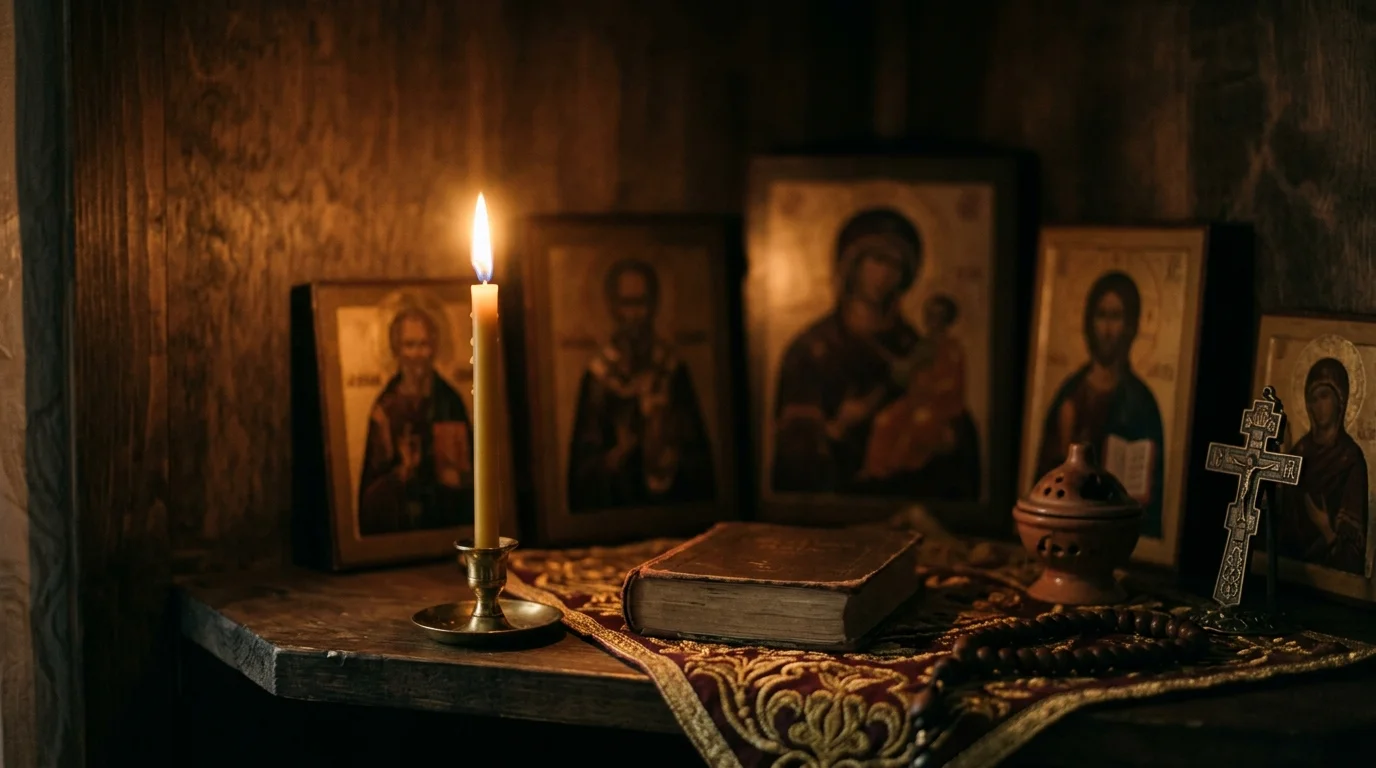
I have sat with parishioners who felt guilty for praying with their eyes open on a crowded train, or for praying while lying in bed because pain made sitting up impossible. There is no reliable teaching, ancient or modern, that treats these situations as invalid prayer. Closed eyes can reduce distraction, and this is why many of us close our eyes during the quiet parts of personal prayer. Open eyes are simply necessary while walking, driving, or standing in public, and praying with your eyes open does not make the prayer less sincere. In our tradition, icons and lit candles exist precisely because looking at something holy while praying is not a distraction but a help.
The same goes for praying in public spaces, which many seekers worry about. A short, unspoken prayer offered while standing in a grocery line or sitting in a waiting room is entirely within the pattern Christ describes, since it is hidden from everyone but God. Reverence is expressed as a person is able, not according to a single fixed posture for every situation.
What does Orthodox Christian tradition teach about silent, inner prayer?
Orthodox tradition fully accepts silent, inner prayer, but it distinguishes carefully between different depths of it. Mental prayer is prayer formed inwardly in the mind, which can be entirely genuine. Prayer of the heart goes further: it describes the whole person, not just the intellect, gathered and turned toward God.

Here it helps to define a few terms carefully, since they are often misused online. Mental prayer means prayer that stays in the mind without necessarily being spoken; its genuineness depends on attention and humility, not on silence by itself. Prayer of the heart is not a bodily sensation or a mystical shortcut; in Orthodox thought, the heart names the spiritual center of the person, where intellect, desire, conscience, and love meet. Hesychasm, from the Greek word for stillness, names the broader Orthodox tradition of watchfulness, repentance, and continual prayer, especially through the Jesus Prayer, and it should never be reduced to a breathing technique for producing special feelings. And spiritual delusion, what the Russian tradition calls prelest, names a state of deception caused by pride, imagination, or the pursuit of extraordinary experiences, which is exactly why Orthodox writers urge caution and guidance.
Metropolitan Kallistos Ware taught that inner prayer in the Orthodox sense is not mere introspection, turning inward to examine your own feelings, but a turning of the whole person toward the living God in Christ. Fr. Thomas Hopko stressed something I repeat often to beginners: prayer is learned within the Church, and it should stay simple, faithful, and rooted in repentance rather than becoming a kind of spiritual performance. Saint Theophan the Recluse, writing to laypeople rather than only to monks, described the goal not as collecting words in the head but as the gradual unification of mind and heart before God, a process he compares to descending slowly rather than forcing anything. Related: How to Pray According to the Bible: True Guidance.
As St. Basil the Great indicates in The Long Rules, prayer belongs within the disciplined and communal life of the Church rather than floating free of it. This is why Orthodox priests, myself included, keep returning private prayer back to the Liturgy, confession, and Scripture. Silent prayer is real, but it was never meant to stand alone.
What is the Jesus Prayer and how is it prayed silently in the heart?
The Jesus Prayer is a short, Christ-centered prayer of repentance usually said as: "Lord Jesus Christ, Son of God, have mercy on me, a sinner." It can be prayed silently, softly, or aloud, sometimes with a prayer rope to help keep count, but it is not a mantra and not a mechanism for producing results on command.

In a study I wrote on St. Gregory of Sinai, the fourteenth-century monk who revived hesychast teaching on Mount Athos, I traced an arresting detail from his biographer. When Gregory arrived on Athos around the year 1300, he found only three hermits on the entire peninsula who still had any real knowledge of the Jesus Prayer as a sustained practice. A single generation later, when Gregory Palamas needed support against the theologian Barlaam of Calabria, virtually every known Athonite ascetic had signed the Hagioritic Tomos defending this same tradition. What had nearly disappeared became common inheritance within forty years, entirely through quiet teaching passed from elder to disciple, never through a mass technique spread by writing alone.
As St. John Cassian teaches in Conference 10 of the Conferences, continual prayer is cultivated through simplicity, perseverance, and attention, not through complexity. One parishioner of mine became fascinated with online material about heart prayer and wanted to begin advanced breathing methods right away to make his prayer, as he put it, more powerful. I cautioned him gently that Orthodox tradition does not treat inner prayer as a technique for manufacturing experiences, and that beginners should pray simply and humbly, under guidance, without chasing sensations. He shifted toward a simpler prayer rule, regular confession, and steady attendance at Liturgy, and his understanding matured from curiosity about method into something closer to genuine repentance and attentiveness. As St. John Climacus teaches in The Ladder of Divine Ascent, prayer requires watchfulness, humility, and guarded attention, which is really the whole point of the Jesus Prayer: not producing a feeling, but keeping the mind from wandering away from God.
How can you grow from silent head prayer to prayer of the heart?
Growth from scattered mental prayer toward prayer of the heart is not achieved by forcing concentration or chasing a special sensation. It develops slowly, through ordinary Christian practices held together over time: the Liturgy, confession, Scripture, a modest prayer rule, and patient perseverance through distraction.
A few concrete habits help most of the people I have guided through this:
- Attend the Divine Liturgy regularly rather than treating private prayer as a replacement for it.
- Keep a small, consistent daily prayer rule instead of an ambitious one you cannot sustain.
- Confess honestly and regularly, since the heart cannot gather around God while carrying unconfessed weight.
- Read Scripture and the lives of the saints to give your silent prayer real content.
- Accept distraction calmly and return to the words, rather than despairing each time your mind wanders.
As St. Augustine explains in Letter 130, prayer is bound up with holy desire and the inward turning of the heart toward God, which means the desire itself, even when it feels weak or inconsistent, is already part of prayer's substance. As St. Isaac the Syrian teaches in the Ascetical Homilies, true prayer is marked by humility, compunction, and inward stillness, qualities that grow far more through patience than through effort alone.
Father Victor's Perspective
When I studied theology in Munich and later returned to this question in parish life, I saw that the real Orthodox question is not whether prayer is silent or spoken, but whether it is scattered or gathered. A spoken prayer can remain entirely superficial, said with the mouth while the mind wanders elsewhere. A silent prayer can become profoundly ecclesial, deeply shaped by the Church's worship, when it grows out of the Liturgy and quietly returns to it. Most online explanations stop at "God hears your thoughts," which is true but incomplete. It leaves out the whole Orthodox understanding of attention and the human person.
In my seminar work on St. Gregory of Sinai, I argued that his teaching on the Jesus Prayer only makes sense against the background of a particular anthropology: before the fall, human memory and attention were a unity; after it, they shattered into fragments, scattered across a thousand competing thoughts. Gregory saw the invocation of Christ's name as a way of gathering what sin had broken apart, drawing the wandering mind back into the heart, where it was always meant to dwell. He even defines prayer itself in a striking way in his writings: not something we manufacture by our own effort, but the working of God himself within us. This reframes the whole question. The goal was never silence for its own sake, nor noise for its own sake, but the slow healing of a mind that has forgotten how to stay in one place.
From my background in psychology, I would add something I rarely see written elsewhere: silent prayer is often the first school of honesty for modern people, because when no one else can hear us, we lose the ability to perform spirituality for an audience. That can be unsettling. Hidden prayer exposes not only our faith but also our inner fragmentation, the gap between what we say to God, what we actually want, and how we live. I do not say this to discourage anyone. I say it because the discomfort many people describe, the sense that their silent prayer feels "just like worrying," is often the honest beginning of real prayer rather than a sign of its failure.
This is why I describe the movement from head prayer to heart prayer not as a mystical upgrade reserved for monks, but as the gradual healing of a division inside each of us: between what we say to God, what we actually desire, and how we live our days. Framed this way, the question stops being "can my silent prayer count?" and becomes something more honest and more hopeful: "will I keep returning, imperfectly, to the God who already hears me?"
Common Misconceptions About Silent Prayer
"God hears only words spoken out loud." Many people absorb this idea from associating prayer mainly with formal, spoken rituals. Scripture and Orth
<table class="seo-table comparison-table"> <caption>How Christian Traditions Understand Silent Prayer</caption> <thead> <tr> <th>Aspect</th> <th>Orthodox</th> <th>Catholic</th> <th>Protestant</th> </tr> </thead> <tbody> <tr> <td>Is silent prayer valid?</td> <td>Yes. God hears inward prayer, but private prayer is meant to remain connected to liturgical and sacramental life.</td> <td>Yes. Silent and mental prayer are widely accepted, including contemplative forms.</td> <td>Generally yes. Most traditions affirm that God hears the heart even when prayer is not spoken aloud.</td> </tr> <tr> <td>Is spoken prayer still important?</td> <td>Yes. It is essential in the Divine Liturgy and often helpful in personal prayer.</td> <td>Yes. Spoken prayer remains central in Mass, the Hours, and devotions.</td> <td>Yes. Spoken prayer is common in personal devotion and congregational worship.</td> </tr> <tr> <td>How is repetition viewed?</td> <td>Helpful when attentive, Christ-centered, and free from mechanical thinking.</td> <td>Often welcomed in prayers such as the Rosary and other devotions.</td> <td>Varies widely; some embrace repeated prayer, while others are wary of formulaic use.</td> </tr> <tr> <td>What is distinctive about the inner life of prayer?</td> <td>The aim is not silence by itself but the gathering of mind, heart, body, and life in communion with God.</td> <td>Often framed through mental prayer, meditation, and contemplation.</td> <td>Often framed through personal sincerity, biblical prayer, and direct relationship with God.</td> </tr> <tr> <td>Role of spiritual guidance</td> <td>Strongly emphasized, especially for sustained use of the Jesus Prayer or ascetical practices.</td> <td>Also important, especially in contemplative and monastic traditions.</td> <td>Varies by denomination, pastor, and spiritual culture.</td> </tr> </tbody> </table>


Help us bring the christian faith to modern seekers worldwide.
Godfinder relies on generous souls to sustain our multilingual platform, develop new tools like the Magic Cube, and support struggling believers. If our work has touched your heart, consider contributing to our nonprofit partner

Do you want to know More? Ask God’s Word!
Do you have questions, worries, or hopes? Feeling lost, burdened, or alone? “Ask God’s Word” brings you gentle guidance rooted in Scripture and the wisdom of the Church. Find hope and strength today!
