
Russian Orthodox Beliefs: Faith Beyond Culture
The first time a visitor stands through a Divine Liturgy in a Russian parish, something in them usually shifts. The candles, the chanting without instruments, the constant crossing of oneself, the dark and golden icons watching from every wall, it can feel like stepping into another century. I...

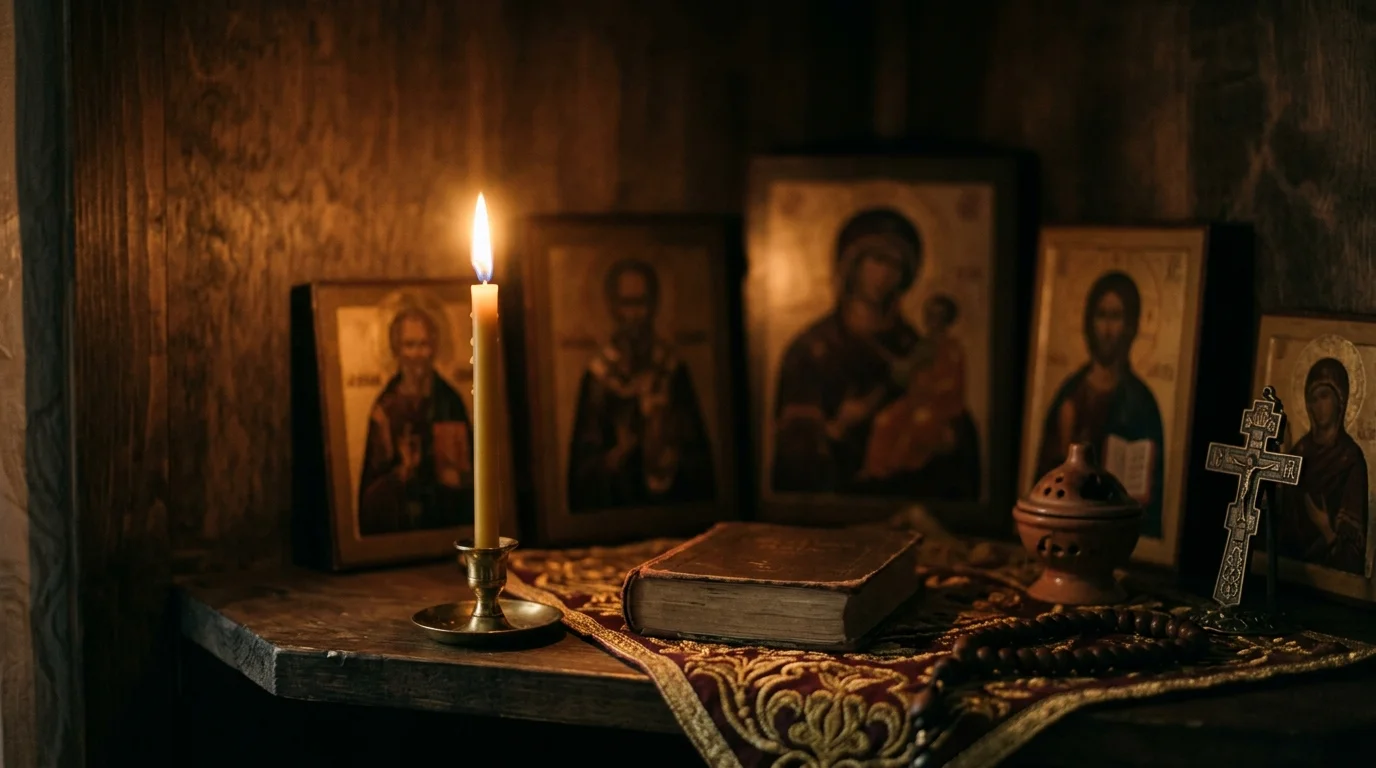
The first time a visitor stands through a Divine Liturgy in a Russian parish, something in them usually shifts. The candles, the chanting without instruments, the constant crossing of oneself, the dark and golden icons watching from every wall, it can feel like stepping into another century. I remember a young German law student who came to our cathedral in Munich after reading an article that reduced Russian Orthodox belief to a short list of customs. She asked me afterward whether what she had seen was faith or culture. It was a fair question, and in my years serving as an Orthodox priest I have found that most people ask about Russian Orthodox beliefs because they are trying to separate the faith itself from Russian culture, politics, or family background.
There is also a harder question sitting underneath that one, and I do not think it is honest to leave it out. In recent years a theology has circulated under the Russian Orthodox name that has very little to do with the Creed recited at every Divine Liturgy: a doctrine of "Holy Rus" that treats a war as a sacred cause and frames the secular West as a civilizational enemy. That is not dogma. It is a political theology built on top of an ancient faith, and the two need to be told apart if the word "Russian" is going to mean anything honest. I say this not as a political commentator but as a priest who has spent years studying how the Russian Church survived a far more brutal attempt to bend it toward state purposes, under the Bolsheviks a century ago, and came through it without losing the faith it had received from the apostles.
What I wish to share with you in this article is the substance underneath both questions: what Russian Orthodox Christians actually confess about God, Christ, salvation, and the Church, how that confession is lived out in fasting, confession, and the Eucharist, and where cultural custom, pastoral practice, and political rhetoric must be kept distinct from the faith itself.
✏️ By Father Victor Meshko | 📅 Updated: November 2026 | ⏱️ 17 min read
Quick Answer: Russian Orthodox beliefs are the beliefs of Eastern Orthodox Christianity as lived within the Russian liturgical and historical tradition: one God in three Persons, Jesus Christ as fully God and fully man, salvation as healing and theosis, and a sacramental life centered on the Divine Liturgy, distinct from any political theology promoted in its name.
In This Article:
- Do Russian Orthodox Christians believe Jesus is God?
- What are the core beliefs and practices of Russian Orthodox Christianity?
- How does Russian Orthodoxy differ from Western Christianity in general?
- What distinguishes Russian Orthodox beliefs from Catholicism?
- What are Russian Orthodox rules on marriage and family life?
- What does the Russian Orthodox Church teach about the role of women?
- What is the Russian Orthodox Church's stance on LGBT issues?
- How do Russian Orthodox beliefs compare to other Eastern Orthodox and Oriental Orthodox churches?
- Father Victor's Perspective
- Common Misconceptions About
TL;DR: Key Takeaways
- Russian Orthodoxy is not a separate religion; it shares the Nicene Creed, the seven sacraments, and the Ecumenical Councils with the rest of Eastern Orthodoxy.
- Salvation is understood as theosis, a lifelong, grace-filled healing and union with God, not merely a legal pardon.
- Most Orthodox Christians learn what they believe first by standing in the Liturgy, and only later by studying doctrine in books.
- Calling oneself Russian Orthodox by baptism or family heritage is not the same as actively practicing the faith through confession, communion, and prayer.
Do Russian Orthodox Christians believe Jesus is God?
Yes. Russian Orthodox Christians confess, with the whole of Eastern Orthodoxy, that Jesus Christ is the eternal Son of God, one Person with two complete natures, fully divine and fully human, exactly as the Councils of Nicaea and Chalcedon defined.

The Gospel of John opens with the words: "In the beginning was the Word, and the Word was with God, and the Word was God... And the Word became flesh and dwelt among us" (John 1:1-18). Orthodox Christology rests on this confession. Christ is not a created intermediary, not an inspired teacher raised to divine status, and not merely God disguised in a human body. He is one Person in whom a complete divine nature and a complete human nature are united without confusion and without separation. As St. Maximus the Confessor argues in his Christological writings, Christ possesses a fully human will alongside His divine will, because only a nature that is truly and completely assumed can truly and completely be healed. If Christ were not fully man, our humanity would not have been touched by His Incarnation at all. This is why Orthodox theology insists so firmly on both natures together: take either one away and the whole promise of salvation collapses.
What are the core beliefs and practices of Russian Orthodox Christianity?
Core Russian Orthodox beliefs include one God in three Persons, Christ's Incarnation and Resurrection, salvation as theosis, the authority of Scripture read within Holy Tradition, and a sacramental life built on baptism, chrismation, confession, and above all the Eucharist.

What most online articles about Russian Orthodox beliefs miss is that parish life teaches doctrine through worship before it teaches doctrine through argument. A newcomer usually learns what the Church believes about Christ, the saints, and salvation first by standing through the Liturgy, hearing the same prayers repeated across centuries, and watching how the faithful cross themselves, bow, confess, and receive communion, long before anyone hands them a catechism. Baptism and chrismation are the doors into this life, entering “Go ye therefore, and teach all nations, baptizing them in the name of the Father, and of the Son, and of the Holy Ghost:” (Matthew 28:19, KJV). The Eucharist stands at the center of it: Christ says plainly, "I am the living bread that came down from heaven... the bread that I will give for the life of the world is my flesh" (John 6:51-58), and Orthodox Christians take this as real communion with Christ's Body and Blood, not a symbolic remembrance. The Book of Acts describes the earliest Christians as "devoted to the apostles' teaching and fellowship, to the breaking of bread and the prayers" (Acts 2:42-47), and Orthodoxy understands its own liturgical and communal life as a direct continuation of that pattern. Read more: Orthodox Religion Beliefs: Beyond Debates and Definitions.
In a study I wrote some years ago on St. Gregory of Sinai and the hesychast revival on Mount Athos, I traced how fourteenth-century monks understood the Jesus Prayer, the simple repeated invocation of Christ's name, as a practical discipline for gathering a scattered mind back into the heart. That same discipline, in a quieter form, shapes ordinary parish life today: a daily prayer rule, the fasting seasons before Christmas and Pascha, confession before Communion, and a habit of returning the mind to God throughout an ordinary day. None of this is decoration. It is how theosis, salvation understood as participation in the life of God by grace, moves from a word in a textbook into an actual way of living.
Two practical notes are worth adding here, because they explain variety without implying division. Liturgical language differs by parish: some Russian communities worship mostly in Church Slavonic, while missionary parishes in Germany, the United States, or elsewhere use German, English, or a mix, depending on who is present. And calendar practice differs too, with some jurisdictions keeping the older Julian calendar for fixed feasts and others using a revised reckoning. Neither difference touches doctrine. They are pastoral and missionary choices, not separate creeds.
How does Russian Orthodoxy differ from Western Christianity in general?
Russian Orthodoxy differs from Western Christianity mainly in its understanding of authority, salvation, and the Holy Spirit: it holds to conciliar rather than papal governance, confesses the Creed without the later Western addition of the filioque, and frames salvation as healing and union with God rather than only a legal verdict.

"Western Christianity" is itself a broad category covering Roman Catholicism and a wide range of Protestant traditions, so no single contrast fits every Western Christian. Still, some patterns hold. Orthodoxy anchors its authority in the seven Ecumenical Councils and reads Scripture within Holy Tradition, meaning the living transmission of the apostolic faith through worship, the councils, the saints, and continuous prayer, not through human custom alone. As St. Basil the Great explains in his writings on the Holy Spirit, the Spirit proceeds from the Father, which is why the Orthodox Creed never added the later Western clause stating that the Spirit proceeds "from the Father and the Son" as well. Salvation, too, carries a different accent: many Western traditions emphasize a legal transaction in which guilt is pardoned, while Orthodoxy, without denying the reality of forgiveness, speaks more often of healing, as Scripture itself puts it, that believers “According as his divine power hath given unto us all things that pertain unto life and godliness, through the knowledge of him that hath called us to glory and virtue: Whereby are given unto us exceeding great and precious promises: that by these ye might be partakers of the divine nature, having escaped the corruption that is in the world through lust.” (2 Peter 1:3-4, KJV). That single verse is the clearest biblical anchor for theosis in the whole New Testament.
Russian Orthodox Beliefs Compared with Catholic and Protestant Christianity
[COMPARISON_TABLE]
What distinguishes Russian Orthodox beliefs from Catholicism?
Russian Orthodoxy and Catholicism share the Trinity, Christ's divinity, apostolic succession, and sacramental worship, but they differ chiefly on the authority of the Pope, the filioque clause, and several later Catholic dogmatic definitions developed after the churches separated.

I knew the Catholic tradition quite well before my conversion, and I want to say plainly that this is not a comparison between a church that honors Mary and one that does not, or between a church with sacraments and one without. Catholics and Orthodox both call Mary Theotokos in substance, meaning "God-bearer," a title the Council of Ephesus confirmed not to elevate Mary but to protect the truth that the child she bore is truly God. Both traditions venerate saints, keep a rich sacramental life, and trace their bishops back to the apostles. The real divergence concerns how authority is exercised: Orthodoxy holds that no single bishop, including the Bishop of Rome, has universal jurisdiction over the whole Church, and that the truth of the faith is safeguarded instead through the conciliar agreement of the bishops together, the model established at Nicaea and reaffirmed at the following Ecumenical Councils. Catholic teaching, by contrast, locates a unique authority in the papacy, including the later definition of papal infallibility. Add to this the filioque addition to the Creed and a handful of dogmas defined in the West after the eleventh century, and you have the real shape of the disagreement, not a dispute over whether Christ is God or whether grace is real. See also: What is Orthodox Christianity Beliefs? Uncover Now.
What are Russian Orthodox rules on marriage and family life?
Orthodox marriage is a sacramental mystery in which a man and woman are joined to each other in Christ, called to lifelong fidelity, mutual self-giving, prayer, and raising children in the faith, with divorce and remarriage addressed pastorally rather than treated as unthinkable.

In my training as a theologian, and in my work as a counselor, I have come to see Orthodox marriage less as a legal contract and more as a shared discipline of healing two people together. The Church takes seriously that marriages break, and its pastoral tradition allows for remarriage after divorce within a penitential framework, acknowledging human brokenness without pretending it does not exist. Questions about contraception, family planning, or the exact pastoral path after a divorce vary somewhat by bishop and jurisdiction, so I always tell people in my parish: speak with your own priest, because general principles need a concrete pastoral conversation to become useful. What never varies is the conviction that domestic abuse finds no justification whatsoever in religious language about headship or obedience. A marriage that wounds rather than heals has already failed the vocation it was meant to serve.
What does the Russian Orthodox Church teach about the role of women?
The Church teaches that women and men share equal dignity as bearers of God's image, called equally to holiness, while reserving ordination to the priesthood and episcopate for men, a distinction Orthodox theology grounds in received apostolic order rather than any claim of spiritual inferiority.

St. Paul writes that “There is neither Jew nor Greek, there is neither bond nor free, there is neither male nor female: for ye are all one in Christ Jesus.” (Galatians 3:28, KJV), and Orthodox theology takes that spiritual equality with full seriousness. Women have shaped the Church from its first generation as martyrs, monastics, theologians, missionaries, and mothers; several of the Church's most venerated saints are women. What Orthodoxy does not do is ordain women to the priesthood, and it is honest to say that this remains a point many seekers struggle with. I try to separate two things clearly in conversation: equal dignity before God is not the same question as who is ordained to a particular liturgical office, and conflating the two usually generates more heat than light. The historical role of women in the Church's life, from desert mothers to parish educators today, tells a far richer story than either praise or criticism offered in slogans.
What is the Russian Orthodox Church's stance on LGBT issues?
The Church's traditional teaching holds that sexual intimacy belongs within marriage between a man and a woman and does not bless same-sex sexual relationships, while also insisting that every person, without exception, must be treated with dignity, compassion, and freedom from hatred or humiliation.
A seeker recently asked me, after reading a string of conflicting and politicized claims online, whether harsh rhetoric he had encountered represented official Russian Orthodox belief or just the opinions of certain loud voices. It is a question worth answering honestly, because the two are not the same thing. Official teaching, pastoral practice, and the personal rhetoric of individual clergy or laypeople belong to three different categories, and good theology keeps them apart. Orthodox moral teaching on sexuality is traditional and has not changed, but it is not a license for contempt. I find this is where the bridge between theology and psychology matters most in my own ministry: moral teaching detached from the Church's larger vision of healing, repentance, and communion easily hardens into rule enforcement, and that is a distortion of what the tradition actually asks of us. Every person carries the image of God, whatever their struggles, and pastoral care has to begin there. Related: What Is the Difference Between Orthodox and Catholic?.
How do Russian Orthodox beliefs compare to other Eastern Orthodox and Oriental Orthodox churches?
Russian Orthodoxy is one of several autocephalous, or self-governing, churches within Eastern Orthodoxy, sharing the same Creed, councils, and sacraments as the Greek, Serbian, Romanian, Antiochian, and other Orthodox churches, while differing from Oriental Orthodox churches mainly in how each received the Council of Chalcedon.
Autocephaly means a church governs its own internal affairs, electing its own bishops and primate, while remaining in full doctrinal and sacramental communion with the other Orthodox churches worldwide. The Russian Orthodox Church is simply the largest of these self-governing churches, distinguished by its own calendar customs, chant traditions, architecture, and history, not by a different faith. Oriental Orthodox churches, including the Coptic, Syriac, Armenian, and Ethiopian traditions, received the first three Ecumenical Councils but did not accept the Council of Chalcedon in the same terms as the Eastern Orthodox churches did. Decades of careful theological dialogue have clarified that much of the historic dispute was a matter of Christological terminology and how it was received, rather than a straightforward disagreement over whether Christ is truly God and truly man.
Father Victor's Perspective
If I could correct one thing that most explanations of Russian Orthodox belief get wrong, it would be this: "Russian" functions grammatically as an adjective, not as a creed. It names a historical and liturgical inheritance, the chant, the language, the architecture, the saints raised up on Russian soil, while the actual content of the faith remains the same catholic faith confessed by the whole ancient Church. I came to see this clearly through my academic work in church history and through years of pastoral work among German, Russian, Ukrainian, and Serbian faithful who all stand at the same chalice. When I worked through Archbishop Filaret of Chernigov's own writings on Church history for my doctoral dissertation, I was struck by how he defined the Church first as a divine institution existing outside the laws of changing society, and only afterward as a visible community that takes concrete historical form. That order matters. A church's historical and national expression is real and worth honoring, but it is not the foundation; the foundation is the apostolic faith itself.
This is also where I think the current conversation about "Holy Rus" theology needs careful handling rather than either dismissal or panic. In a paper I wrote on Patriarch Tikhon, who led the Russian Church through the Bolshevik persecutions after 1917, I found a striking historical precedent for resisting exactly this kind of co-option. When the civil war broke out in 1918, Patriarch Tikhon refused to bless either the Red or the White armies for battle. He gave his blessing only for the burial of the fallen on both sides. He understood, even under direct threat to his own life, that the Church's task was to hold the Gospel apart from any army's cause, however patriotic its language. A political theology that blesses a war as a holy mission is not a new invention of our decade; it is an old temptation the Church has had to resist before, and resisting it has always cost something.
The deeper biblical pattern behind this goes back further still. In my diploma thesis on the prophetic-eschatological character of the Book of Revelation, I examined how the letters to the seven churches in its opening chapters rebuke exactly this kind of compromise: the church at Pergamon, for instance, is warned for tolerating teaching that bound believers too comfortably to the altar of Caesar. Those letters were written to real churches in real cities, and Christian tradition has always read them as addressed to every church in every age, including our own. A doctrine that sacralizes a state's
Common Misconceptions About
There are several common misunderstandings about this topic. Let's address them with clarity and charity:
- [Misconception 1 - What people commonly get wrong about ]
- [Misconception 2 - A misunderstanding about Orthodox teaching on this]
- [Misconception 3 - How this differs from what the Church actually teaches]
Understanding these distinctions helps us approach with both accuracy and an open heart.
<table class="seo-table comparison-table"> <caption>Russian Orthodox Beliefs Compared with Catholic and Protestant Christianity</caption> <thead> <tr> <th>Aspect</th> <th>Orthodox</th> <th>Catholic</th> <th>Protestant</th> </tr> </thead> <tbody> <tr> <td>Church identity</td> <td>Russian Orthodoxy is the Russian tradition within Eastern Orthodoxy, sharing the faith of the ancient Church.</td> <td>Roman Catholicism is a global communion under the Pope.</td> <td>Protestant traditions are diverse and organized by denomination rather than a single sacramental communion.</td> </tr> <tr> <td>Authority</td> <td>Scripture is read within Holy Tradition, the councils, liturgy, and the life of the Church.</td> <td>Scripture and Tradition are interpreted within the Magisterium and papal structure.</td> <td>Many traditions emphasize Scripture as the final norm, though interpretation varies widely.</td> </tr> <tr> <td>Salvation</td> <td>Salvation is grace-filled healing, sanctification, and theosis in Christ.</td> <td>Salvation is by grace and includes justification and sanctification within Catholic sacramental theology.</td> <td>Often emphasizes justification by faith, with major differences across traditions regarding sanctification and sacraments.</td> </tr> <tr> <td>Eucharist</td> <td>The Eucharist is true communion in Christ's Body and Blood within the Divine Liturgy.</td> <td>Catholics also affirm the Real Presence, often explained through transubstantiation.</td> <td>Views range from Real Presence to symbolic memorial depending on denomination.</td> </tr> <tr> <td>Icons and saints</td> <td>Icons and saints are venerated; worship belongs to God alone.</td> <td>Catholics also venerate saints and sacred images, with different devotional emphases and later Marian dogmas.</td> <td>Many Protestants honor biblical saints historically but reject invocation of saints and religious images in worship.</td> </tr> <tr> <td>Church governance</td> <td>Conciliar communion among autocephalous churches; no universal papal jurisdiction.</td> <td>Universal papal jurisdiction is central.</td> <td>Governance varies from episcopal to presbyterian to congregational.</td> </tr> </tbody> </table>




Help us bring the christian faith to modern seekers worldwide.
Godfinder relies on generous souls to sustain our multilingual platform, develop new tools like the Magic Cube, and support struggling believers. If our work has touched your heart, consider contributing to our nonprofit partner

Do you want to know More? Ask God’s Word!
Do you have questions, worries, or hopes? Feeling lost, burdened, or alone? “Ask God’s Word” brings you gentle guidance rooted in Scripture and the wisdom of the Church. Find hope and strength today!
