.avif)
Orthodoxy in Brief
This post explains Eastern Orthodoxy beyond stereotypes – it's apostolic continuity from Pentecost, the rise of the patriarchates and the 1054 schism, the Russian Orthodox Church’s claim that the Church is one, cautious engagement in ecumenism (no intercommunion), and the classical “symphony” model of Church–state relations shaped by 20th-century persecutions and the duty to obey God over unjust laws.
Introduction
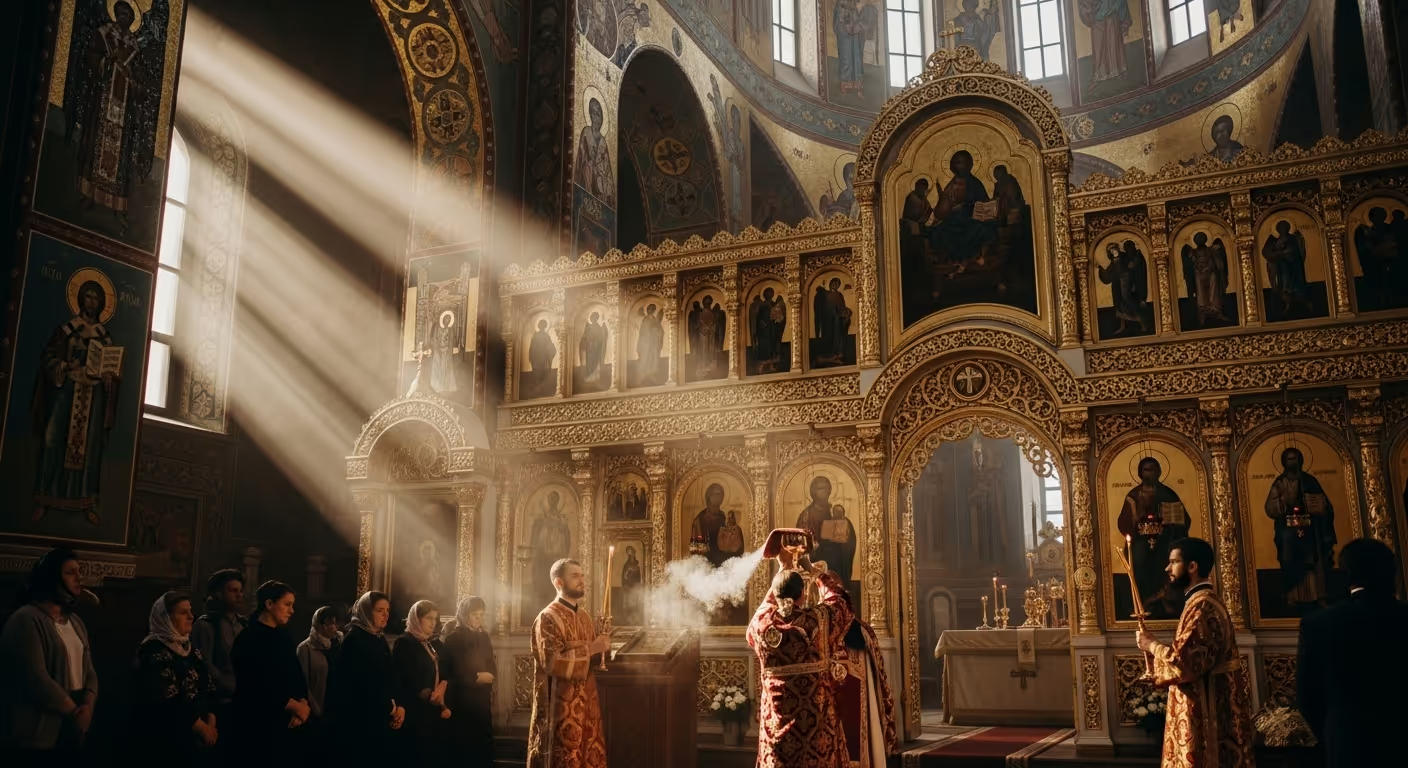
Patriarchs in ornate vestments, veneration of icons, choral chanting, and fragrant incense – this is what many associate with “Orthodox Christianity.” Some see Orthodoxy as an antiquated form of Christianity, while others are drawn to its ritual mysticism and spirituality. Both perceptions, however, are one-sided and often contribute to a distorted picture of Orthodoxy. A short historical overview is necessary to better understand Orthodox Christianity.
History
The Orthodox Church calls herself simply “the Church,” just as, in the past, Greeks used the word “Christians” when they meant the Orthodox. This naturally follows from the fact that the Eastern Orthodox Church is, in organic continuity, the same community or ecclesia whose birth was the outpouring of the Holy Spirit at Pentecost in Jerusalem. She stands in direct succession to the Jerusalem mother church that goes back to Jesus of Nazareth and to the apostolic church foundations outside Palestine.
In A.D. 395, the Roman Empire was divided into a Western and an Eastern half. Constantinople became the capital of the Eastern Roman Empire, which continued until its conquest by the Turks in 1453. With its status as capital, Constantinople also received the ecclesial honors of Rome and thus became the second most important center of the Church of that time. Alongside the patriarchates (patriarchate: a central ecclesiastical jurisdiction, comparable to a diocesan see) of Rome and Constantinople, the patriarchates of Alexandria, Antioch, and Jerusalem also emerged. Within the communion of self-governing churches, the bishop of Rome (the pope) held the rank of primus inter pares (“first among equals”), followed by the patriarch of Constantinople. Power struggles between Rome and Constantinople led to repeated disputes, though these could be settled. In 1054, it happened once again: divergent theological opinions and mutual excommunications (removed only in 1965 as a symbolic gesture of reconciliation) between West and East finally led to a schism. In the Eastern Church, the patriarch of Constantinople then held the first rank – a position he retains to this day.
On the relationship of the Orthodox Church to non-Orthodox confessions and interconfessional organizations
The Orthodox Church holds firmly to the doctrine formulated in the Creed that the Church of Christ is one.
Since the Body of Christ is the unique vessel of salvation, the pillar and ground of the truth, it has never been divided and has never disappeared; throughout the entire history of Christianity it has continued to hand down the pure teaching of the Gospel in the fullness of the gifts of the Holy Spirit.
In accordance with the mandate given by the Lord Jesus Christ Himself, the Church is called to realize her apostolic mission and “proclaim the Gospel to all creation” (Mk 16:15). For this reason, over the course of her thousand-year history the Orthodox Church enlightened both the peoples among whom she lived and those of neighboring lands with the light of Christ. At the same time, she strove to bring separated Christians of other confessions back into the saving bosom of the Church and, with this goal in mind – and taking into account their distance from the faith and practices of the Ancient Church—she established special commissions for dialogue with them even in the 19th century. For example, the Russian Orthodox Church Abroad, founded by refugees who fled the anti-religious authorities after the 1918 revolution in Russia, repeatedly sent its representatives to such interconfessional meetings until the 1960s, hoping that participation would acquaint Christians of other confessions with Orthodoxy. The aims of such participation were formulated in the decision of the Synod of the Russian Orthodox Church Outside Russia of December 18/31, 1931:
“Believing in the One, Holy, Catholic, and Apostolic Church, the Synod of Bishops confesses that this Church has never divided. The only question is who belongs to her and who does not. At the same time the Synod most warmly welcomes all efforts of other Christian confessions to study Christ’s teaching about the Church, in the hope that through such study – especially when the Holy Orthodox Church takes part – they will finally come to the conviction that the Orthodox Church, as the pillar and ground of the truth (1 Tim 3:15), has preserved the doctrine perfectly and without any error, just as the Savior Jesus Christ taught His disciples.”
Notwithstanding this, a large part of the Protestant world has, in the course of its development, taken the path of humanistic liberalism and is increasingly losing its bond with the traditions of the Holy Church, altering the moral norms and dogmatic teachings established by God at its own discretion and thereby placing itself at the service of the interests of a consumer society, submitting to convenience and political aims. Like “salt that has lost its savor” (Mt 5:13), such communities have lost the power to oppose human passions and vices.
Trends of this kind arouse grave concern and prompt the Orthodox Church to review her relations with individual confessions as well as with interconfessional organizations. This issue was addressed in particular at the Inter-Orthodox meeting in Thessaloniki (1998). The practice of interconfessional relations was thoroughly analyzed in the Basic Principles of the Attitude of the Russian Orthodox Church Toward the Non-Orthodox, adopted by the Bishops’ Council of the Russian Orthodox Church (2000). It was determined that, should these negative tendencies continue to prevail in interconfessional organizations, the Orthodox would be compelled to withdraw from them. For this reason it is necessary in the near future to clarify to what extent existing forms of inter-Christian cooperation allow Orthodox representatives to avoid complicity in views and practices contrary to the spirit of Orthodoxy. A condition for Orthodox participation in interconfessional organizations, including the World Council of Churches, is the exclusion of any religious syncretism. Orthodox Christians insist on their right freely to proclaim faith in the Orthodox Church as the One, Holy, Catholic, and Apostolic Church, without any concessions to the so-called “branch theory,” and they categorically reject any attempt to dilute Orthodox ecclesiology.
The Orthodox Church excludes any possibility of liturgical communion with non-Orthodox. In particular, the participation of Orthodox faithful in liturgical acts associated with so-called ecumenical or interconfessional services is deemed impermissible. In general, the forms of relations with non-Orthodox are to be determined by the Church in conciliar fashion in accordance with her doctrine, canonical discipline, and ecclesial prudence.
At the same time, the possibility of cooperation with non-Orthodox – for example, in the protection of the poor or the defense of the innocent, in the common struggle against immorality, and in the realization of charitable and educational projects—is not rejected. Participation in public ceremonies of social significance at which other confessions are also represented may likewise be appropriate. Furthermore, dialogue with non-Orthodox remains necessary in order to bear witness to Orthodoxy, to overcome prejudices, and to correct erroneous opinions. In doing so, one should not attempt to blur the real differences between Orthodoxy and other confessions.
In the Orthodox tradition, the ideal form of the relationship between Church and state has been conceived as a “symphony” between spiritual and temporal authority. This symphony presupposes that conditions are created for the Church and the faithful to live a free ecclesial life that leads believers to eternal salvation—“that we may lead a quiet and peaceable life in all godliness and dignity” (1 Tim 2:2).
Since, according to the word of God, “the whole world lies in the power of the evil one” (1 Jn 5:19), the ideal of such a symphony has never been fully realized. As a result of the Petrine reforms, this symphony was effectively replaced by a system of state control of the Church, in which the state deprived the Church of full independence.
In the 20th century, after the Bolshevik upheaval, an unprecedented persecution of the Church began in Russia. In those years, through God’s providence, the Russian Church brought forth the great host of the New Martyrs and Confessors of Russia. Not all withstood the time of persecution. Some clergy and laity transgressed against God’s truth and aided the persecutors in their deeds aimed at the destruction of the Church. Such conduct can in no way be considered permissible or justified; it deserves every form of condemnation, lest it be repeated should the Lord allow new persecutions.
During these persecutions, different approaches to the meaning of Church-state relations took shape. Some church leaders considered it necessary, in dealing with powers hostile to the Church, to take the path of compromise in order to preserve ecclesial structures for open service to the People of God. Others rejected this path. In the end, both groups suffered terrible repressions. These two approaches are also reflected in the regrettable divisions within the Russian Church, which in the following decades were gradually overcome.
In light of the Church’s bitter experience in the 20th century and on the basis of the testimony of the New Martyrs, a line must be drawn to distinguish what is permissible and what is impermissible in relations between Church and state, especially where states aim at the complete annihilation of the Church and the Christian faith. Orthodox Christians have come to recognize that the absolutization of state power is inadmissible. In particular, it is unacceptable to use biblical texts (for example, Romans 13:1–5) in a way that contradicts the interpretation and spirit of the Holy Fathers. The earthly and transitory power of the state is acknowledged as valuable to the extent that it serves to preserve the good and restrain evil.
This question was treated in detail in a document very important for the history and self-understanding of the Russian Church Abroad, namely, the Encyclical of the Bishops’ Council of the Russian Church Outside Russia from 1933:
“As long as the Church exists on earth, she remains closely bound to the fate of human society and cannot be thought of as standing outside time and space. It is impossible for her to have no contact with so powerful a social organization as the state; otherwise she would have to withdraw from the world. The attempt to separate the spheres of influence of Church and state according to the principle: to the former belongs the soul, to the latter – the body of man – never achieves its goal, for man can be divided into two separate parts only in abstraction; in reality they form an inseparable whole, and only death can dissolve this union between them. Therefore, the principle of separation of Church and state can never be fully realized in real life.”
The Bishops’ Council of the Russian Orthodox Church also addressed this in its 2000 Social Doctrine:
“In all that concerns exclusively the earthly order of things, the Orthodox Christian is obliged to submit to the laws, regardless of how perfect or imperfect they are. But if the fulfillment of the law and its requirements endangers eternal salvation, entails apostasy from the faith, or involves committing another indisputable sin against God and neighbor, then for the sake of God’s truth and the salvation of the soul for eternal life, the Christian is called to show heroic confession. It is his duty to speak openly and by lawful means against obvious violations of God’s commandments and ordinances by society or the state; and if this is impossible or ineffective, he is obliged to civil disobedience.” (IV.9)
“The Church maintains loyalty toward the state; yet above this duty of loyalty stands the divine command to fulfill the mission of salvation unconditionally under all conditions and in all circumstances. If state power forces Orthodox believers to turn away from Christ and His Church and to perform sinful acts harmful to the soul, the Church is bound to refuse obedience to the state.” (III.5)
The Church is bound to exercise spiritual influence upon the state and its citizens, to proclaim Christ, and to defend the moral principles of society. In cooperation with the state for the good of the people, however, the Church must not assume state functions. For its part, the state must not interfere in the Church’s internal affairs, governance, or life. It is incumbent upon the Church to support all good undertakings of the state, while at the same time resisting evil, counteracting immoral and harmful social phenomena, and always proclaiming the truth without compromise—and, should new persecutions arise, to continue openly bearing witness to the truth and be ready, for Christ’s sake, to take the path of confession and martyrdom.
Source: Der Bote/2005/4


Help us bring the christian faith to modern seekers worldwide.
Godfinder relies on generous souls to sustain our multilingual platform, develop new tools like the Magic Cube, and support struggling believers. If our work has touched your heart, consider contributing to our nonprofit partner

Do you want to know More? Ask God’s Word!
Do you have questions, worries, or hopes? Feeling lost, burdened, or alone? “Ask God’s Word” brings you gentle guidance rooted in Scripture and the wisdom of the Church. Find hope and strength today!
