.avif)
Protestant vs Orthodox Christian: Key Differences
Someone asked me last month, after Liturgy, over coffee in our parish hall in Munich, whether he should become Orthodox or just find "a good Bible-believing church." He had been visiting an Anglo-Catholic parish and a Pentecostal congregation in the same month, trying to decide, as he put it,...

Comparing Protestant Christian vs Orthodox Christian: A Country and a Continent
Someone asked me last month, after Liturgy, over coffee in our parish hall in Munich, whether he should become Orthodox or just find "a good Bible-believing church." He had been visiting an Anglo-Catholic parish and a Pentecostal congregation in the same month, trying to decide, as he put it, "which side of the Reformation" made more sense. In other words, he was wrestling with Protestant christian vs Orthodox christian, though not yet in those words. I told him something that surprised him: he was not actually comparing two sides of anything. He was comparing one thing to two hundred things.
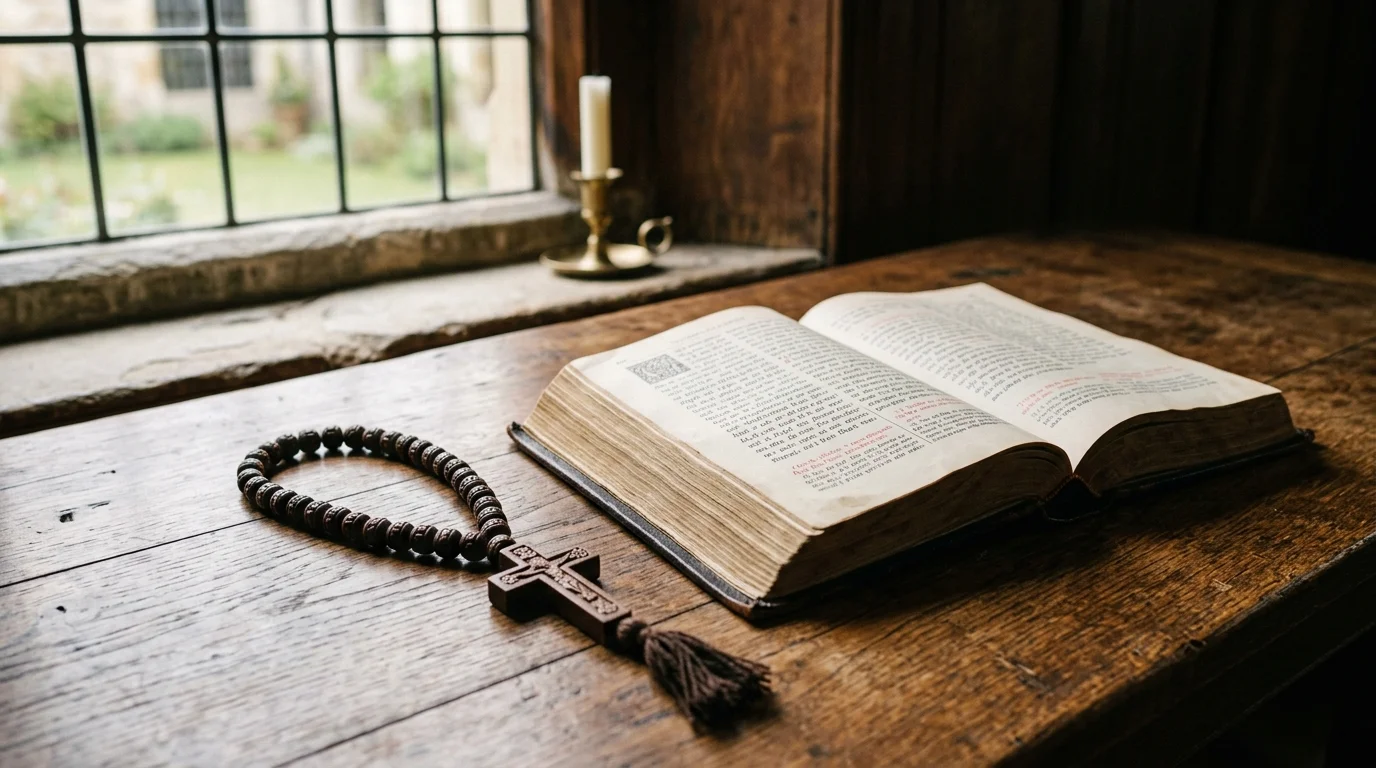
That is the trouble with the question Protestant christian vs Orthodox christian as it usually gets asked online. Orthodoxy is a single communion, bound together by shared bishops, shared sacraments, and a shared Liturgy that has changed remarkably little in over a thousand years. Protestantism is not that kind of thing at all. It is an umbrella covering Lutherans, Anglicans, Baptists, Pentecostals, Reformed Presbyterians, and non-denominational churches that often disagree with one another about baptism, the Lord's Supper, and church government more sharply than some of them disagree with Orthodoxy. Asking what separates "Protestant" from "Orthodox" is a bit like asking what separates "Italian food" from "food." One side of that comparison is a specific, coherent thing. The other is a category containing enormous internal variety.
In my years of serving as an Orthodox priest since 2013, I have found that many seekers are not first asking, "Who is right?" They are asking, "Where can I meet Christ in a way that is whole and historically grounded?" That is a better question, and it deserves a careful, honest answer rather than a scorecard.
✏️ By Father Victor Meshko | 📅 Updated: September 2026 | ⏱️ 25 min read
Quick Answer: Orthodox and Protestant Christians share belief in the Trinity, the divinity of Christ, and the authority of Scripture, but they differ substantially in how they understand Church authority, the sacraments (especially the Eucharist), salvation, and the role of Holy Tradition, and because Protestantism includes many distinct traditions, the differences are sharper with some Protestant churches than with others.
In This Article:
- Comparing Protestant Christian vs Orthodox Christian: A Country and a Continent
- Orthodox Christian vs Protestant Christian: What Is the Difference?
- The Biggest Difference in Protestant Christian vs Orthodox Christian Is How Authority Is Understood
- What Happens in an Orthodox Divine Liturgy?
- Why Is the Eucharist More Than One Topic Among Many?
- How Does Orthodoxy Understand Salvation?
- Why Do Orthodox Christians Honor Mary, the Saints, and Icons?
- Are Orthodox Christians Catholic?
- What Should a Protestant Expect When Visiting an Orthodox Church?
- Father Victor's Perspective: What Seekers Often Miss
- Common Misconceptions About Protestant Christian vs Orthodox Christian
TL;DR: Key Takeaways
- Orthodoxy is one unified apostolic communion; Protestantism is an umbrella term for over two hundred distinct traditions, so comparisons need care.
- Orthodox Christians receive Scripture within Holy Tradition rather than treating the Bible as a self-interpreting authority standing apart from the Church.
- The Eucharist is not one topic among many but reveals what each tradition believes the Church actually is.
- Orthodoxy does not teach salvation by works; it teaches salvation as grace that heals, transforms, and draws a person into communion with God.
Orthodox Christian vs Protestant Christian: What Is the Difference?
Before naming differences, I want to say plainly what Orthodox Christians and Protestants hold in common, because this gets lost quickly in online debates. According to Orthodox teaching as reflected in official church resources, the comparison should begin with shared Christian confession: faith in the Holy Trinity, the true divinity and true humanity of Jesus Christ, His death and bodily Resurrection, the inspiration of Scripture, and the call to repentance and holiness of life. When a Protestant visitor comes to our cathedral, I do not meet a stranger to the Gospel. I meet a fellow believer in the Risen Christ who has been formed in a different ecclesial home.
Quick Answer
Orthodox Christianity understands the Church as a visible, sacramental body continuous with the apostles, where Scripture, worship, and doctrine form one integrated life. Protestant traditions vary widely, but many emphasize Scripture as the supreme authority (sola Scriptura), a more symbolic or diverse view of the sacraments, and salvation described primarily through justification by faith. That is the heart of Protestant christian vs Orthodox christian in its broadest form.
What Orthodox and Protestant Christians Share
As the available research and demographic summaries indicate, "Protestant" covers multiple traditions rather than a single church body, and this diversity matters as much as the shared foundation. Both Orthodox and Protestant Christians affirm the Nicene faith in one God, three Persons. Both baptize in the name of the Father, Son, and Holy Spirit. Both read the same Old and New Testaments as the word of God. Where they diverge is not on whether Christ is Lord, but on how the Church, across time, knows and lives that Lordship. For that reason, any serious Protestant christian vs Orthodox christian comparison must begin with both shared faith and real ecclesial differences.
The Biggest Difference in Protestant Christian vs Orthodox Christian Is How Authority Is Understood
What strikes me about this question, after years of pastoral conversations, is that the sharpest disagreement is rarely about a single doctrine. It is about what counts as an authoritative source of Christian teaching in the first place. If someone asks me about the biggest difference between Orthodox and Protestant, this is usually where I begin.
Scripture in the Life of the Church
Orthodoxy fully affirms that “All scripture is given by inspiration of God, and is profitable for doctrine, for reproof, for correction, for instruction in righteousness: That the man of God may be perfect, throughly furnished unto all good works. ” (2 Timothy 3:16-17, KJV). We do not diminish the Bible. What we resist is the idea that Scripture floats free of the community that wrote it, canonized it, and has read it in worship for two thousand years. St. Paul tells the Thessalonians to “Therefore, brethren, stand fast, and hold the traditions which ye have been taught, whether by word, or our epistle.” (2 Thessalonians 2:15, KJV), and he calls the Church “But if I tarry long, that thou mayest know how thou oughtest to behave thyself in the house of God, which is the church of the living God, the pillar and ground of the truth.” (1 Timothy 3:15, KJV). Those two verses, read together, describe something quite different from Scripture standing alone against every reader's private judgment.
Acts 2:42 tells us that the earliest Christians "continued steadfastly in the apostles' teaching and fellowship, in the breaking of bread, and in prayers." Notice how doctrine, communal life, Eucharist, and prayer appear together, as one fabric, not as separate compartments a believer might choose among. That integrated pattern is what we mean by Holy Tradition: the living transmission of the apostolic faith through Scripture, worship, the councils, the Fathers, and the Church's sacramental life. It is not the same thing as local custom, and it is not a rival to the Bible. It is the room in which the Bible has always been read. Readers who want a concise official Orthodox overview can see the Orthodox Church in America's introduction to the Orthodox faith, which reflects this same scriptural and ecclesial vision.
Sola Scriptura and the Diversity of Protestant Approaches
Many Protestant traditions hold to sola Scriptura, the conviction that Scripture is the final and supreme authority for doctrine. I want to be fair here, because this principle is understood quite differently across Protestant communities. Anglicans and Lutherans typically hold Scripture as supreme while still giving real weight to the ancient creeds and the first councils. Reformed Baptists often read Scripture through confessions like Westminster. Non-denominational and Pentecostal communities frequently emphasize the individual believer's direct encounter with the biblical text, with much less reliance on historic creeds at all. What most online comparisons miss is that the real contrast is often not "Bible-centered" versus "tradition-centered." It is a church-shaped reading of Scripture versus a reader-shaped reconstruction of Christianity, and how strongly that reconstruction happens depends heavily on which Protestant tradition you are actually looking at. In that sense, the difference between Orthodox and Protestant Bible reading is not whether Scripture matters, but how Scripture is received in the life of the Church.
As St. Irenaeus of Lyons argues in Against Heresies, the apostolic faith is not something reconstructed from scratch by each generation. It is known and preserved in the churches that hold the succession and teaching handed down from the apostles themselves. That was true against the Gnostics of the second century, and I think it remains a fair question to put to any modern movement that treats the Bible as though it arrived without a community already surrounding it. This is also why the Orthodox vs Protestant debate so often turns, sooner or later, toward the question of who has the authority to interpret rightly.
What Happens in an Orthodox Divine Liturgy?
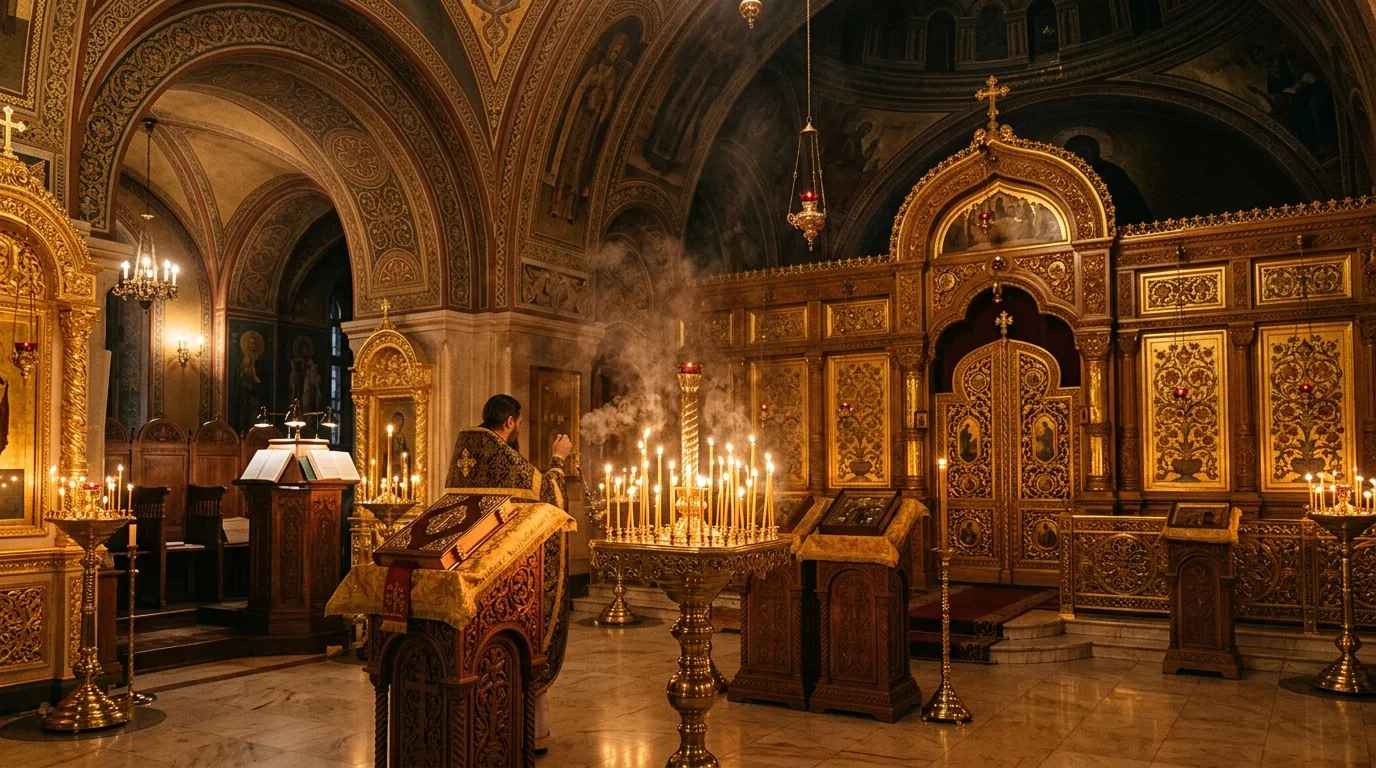
If you have never attended a Divine Liturgy, I can tell you what a Protestant guest usually notices first: everything is sung or chanted, very little is spoken in an ordinary conversational tone, and the entire service moves toward one center, which is Holy Communion. Fr. Alexander Schmemann, the Orthodox theologian and longtime dean of St Vladimir's Seminary, wrote that worship is not an ornament added to faith but the place where the world itself is received and offered back to God. I find that a precise description of what actually happens on a Sunday morning in our cathedral.

In my parish in Munich, I have watched Protestant visitors sit through their first Liturgy slightly disoriented, then slowly begin to understand that nothing here is decorative. The incense, the icons, the repeated litanies, the procession with the Gospel book, all of it belongs to one act of offering and reception before God. It is not a performance meant to move emotions, though it often does. It is theology being prayed rather than merely explained. Read more: Protestant vs Orthodox: Discover Real Faith.
How Protestant Worship Differs Across Traditions
Here again, generalizing about "Protestant worship" is risky. A high-church Anglican Eucharist, with vestments, incense, and a fixed liturgical calendar, can feel remarkably close to Orthodox worship in its shape and reverence. A Reformed Baptist service centered on expository preaching and simple congregational singing looks nothing like that. Pentecostal worship, with extended spontaneous prayer and contemporary music, is different again. If you are trying to decide what "Protestant worship" means for you personally, the honest answer is that you have to ask about a specific congregation, not the category as a whole. This is one reason Protestant christian vs Orthodox christian cannot be answered honestly with a single stereotype.
Why Is the Eucharist More Than One Topic Among Many?
This is where Orthodox Christianity offers something distinctive, and it is the point I most want a seeker to sit with. Most comparison articles list the Eucharist as one item on a checklist, somewhere between baptism and church government. I have come to believe, both from years at the altar and from my theological formation, that the Eucharist is not one difference among many. It is a window into what each tradition believes the Church actually is.
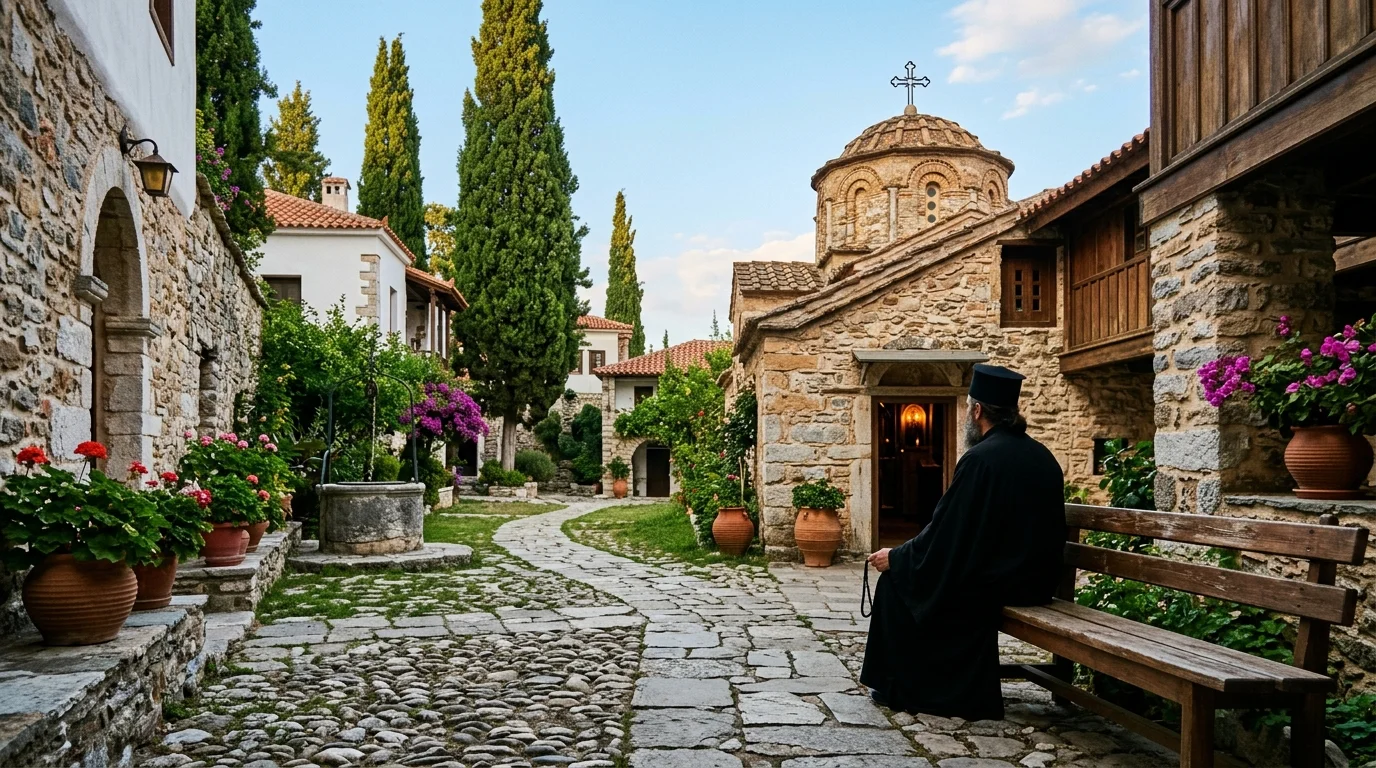
St. Paul asks the Corinthians, “The cup of blessing which we bless, is it not the communion of the blood of Christ? The bread which we break, is it not the communion of the body of Christ? For we being many are one bread, and one body: for we are all partakers of that one bread.” (1 Corinthians 10:16-17, KJV). Notice the logic: because the bread is truly Christ's Body, the many who share it become one body. Ecclesiology follows from Eucharistic reality, not the other way around. As St. Ignatius of Antioch teaches in his Letter to the Smyrnaeans, Eucharistic communion and the visible unity of the local Church, gathered around its bishop, belong together as one reality. If the Eucharist is understood as a sacramental participation in Christ's actual Body and Blood, the Church has to be understood as a sacramental body, visibly gathered, with bishops in unbroken succession guarding that gathering. If the Eucharist is understood primarily as a memorial or a symbol, the Church can be understood more as an assembly united by shared confession and preaching, without the same structural necessity for episcopal continuity.
That is why I tell seekers the Eucharist question is worth more time than almost any other. It is not a side issue. It is the diagnostic center of the whole comparison. In practice, this is often the place where Protestant christian vs Orthodox christian becomes most concrete and least abstract.
Infant Baptism, Believer's Baptism, and Initiation into the Church
Orthodoxy baptizes by triple immersion, including infants, followed immediately by chrismation and first Communion. Baptism, chrismation, and Eucharist form one act of initiation into the Body of Christ. Many Protestant traditions baptize infants as well, particularly Lutherans, Anglicans, and Reformed churches, while Baptist, Pentecostal, and many non-denominational churches practice believer's baptism only, usually by immersion, reserved for those old enough to profess personal faith. Neither approach among Protestants is uniform, and a fair conversation has to name which specific tradition is under discussion.
Orthodox Christian vs Protestant Christian: Key Differences and Similarities
[COMPARISON_TABLE]
How Does Orthodoxy Understand Salvation?
When I studied theology at LMU Munich and later spoke with parishioners coming from Protestant backgrounds, I saw that the deepest anxiety was usually the same: does Orthodoxy think I have to earn my salvation? Let me answer this as directly as I can. Orthodoxy does not teach salvation by works. It teaches salvation by grace that heals and transforms the human person.
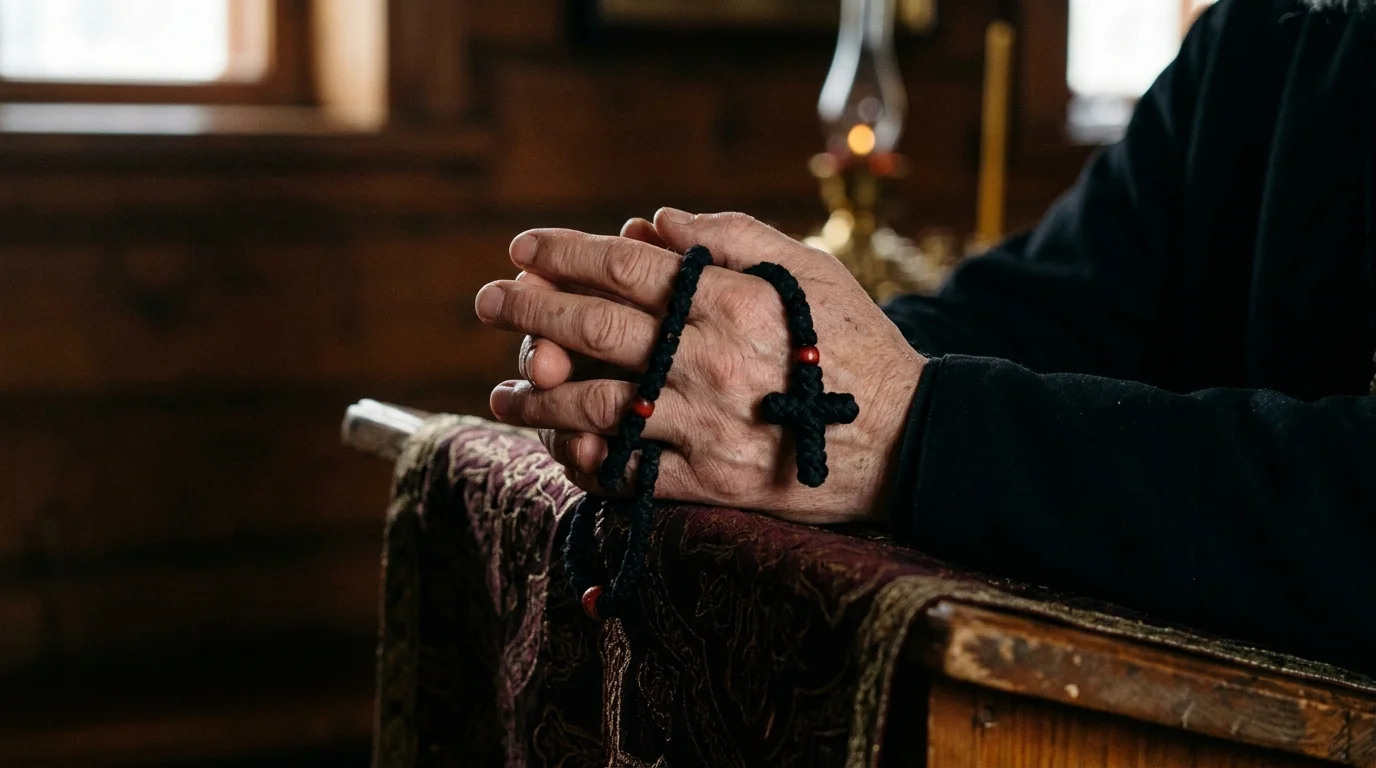
Grace, Faith, Synergy, and Theosis
As St. Athanasius the Great explains in On the Incarnation, Christ came not merely to change our legal standing before God but to restore and transform human nature itself, taking on what is ours so that we might receive what is His. This is the foundation of what we call theosis, participation in the life of God by grace. Salvation, in Orthodox teaching, is not only forgiveness, though it is truly that. It is healing, transformation, and union with God without any confusion between Creator and creature.
St. Paul writes to the Philippians, “Wherefore, my beloved, as ye have always obeyed, not as in my presence only, but now much more in my absence, work out your own salvation with fear and trembling. For it is God which worketh in you both to will and to do of his good pleasure.” (Philippians 2:12-13, KJV). I find this verse quietly resolves the whole "grace versus works" debate, because it refuses to separate the two. God works; we are called to work out what God is working in us. We call this synergy, cooperation with grace. It is not a competition between divine and human effort. St. James makes a similar point when he writes that faith without works is dead (James 2:14-26): not because works earn salvation, but because living faith is active, and a faith that changes nothing in a person's life was never fully alive to begin with. Much of the confusion around Orthodox vs Protestant salvation comes from treating healing and justification as though one must cancel out the other.
Why Orthodoxy Does Not Teach Salvation by Works
Fasting, confession, almsgiving, and the daily prayer rule that I keep myself, along with the Jesus Prayer repeated quietly through the day, are not payments offered to God. They are how a wounded person opens the heart to a Physician who is already present and already willing to heal. I sometimes wonder whether the language of "earning" salvation says more about how modern people think about transactions than it does about how the Fathers actually described the Christian life.
Why Do Orthodox Christians Honor Mary, the Saints, and Icons?
Orthodox Christians worship God alone. We honor Mary as Theotokos, a title confirmed at the Council of Ephesus in 431, precisely as a confession about who Jesus Christ is: true God and true man from the moment of His conception. If Mary is not rightly called God-bearer, then something has gone wrong in how we confess her Son. We ask the saints to pray for us the same way we ask a friend to pray for us, trusting that “Wherefore seeing we also are compassed about with so great a cloud of witnesses, let us lay aside every weight, and the sin which doth so easily beset us, and let us run with patience the race that is set before us,” (Hebrews 12:1, KJV) who are alive in Christ, not extinguished by death. Related: What Is the Difference Between Orthodox and Catholic?.
Why Orthodox Christians Ask the Saints to Pray
This is not a substitute for Christ's unique mediation. It is a confession that the Church includes the living and the departed together, one Body, not divided by the grave.
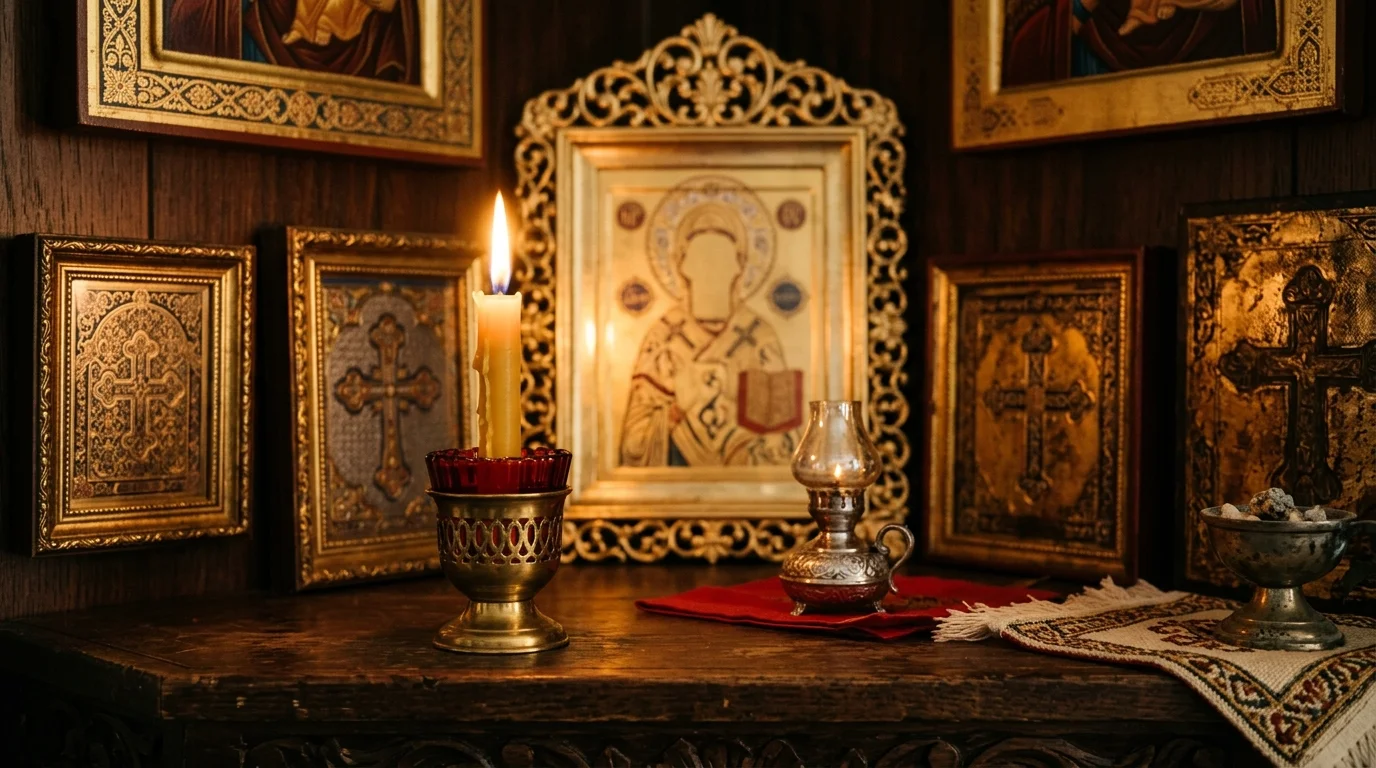
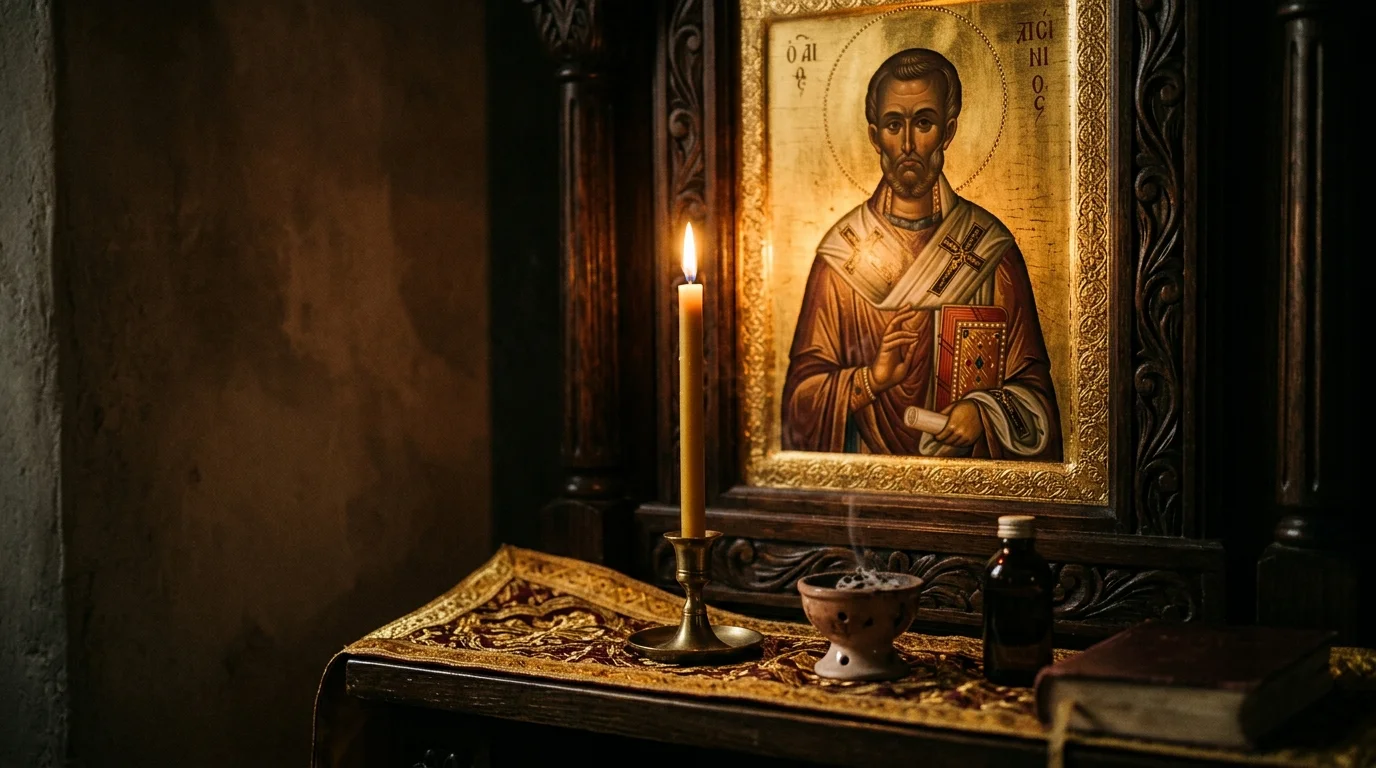
Why Orthodox Christians Use Icons
As St. John of Damascus argues in On the Divine Images, the defense of icons rests entirely on the Incarnation. Because the Word truly became flesh and was seen with human eyes, depicting Christ is not a claim to capture the invisible God but a confession that God has made Himself visible in history. The Seventh Ecumenical Council in 787 confirmed this distinction carefully: the honor given to an icon passes to its subject, while worship in the full sense belongs to God alone. For readers exploring Orthodox vs Protestant vs Catholic questions on these practices, the Greek Orthodox Archdiocese's introduction to Orthodox Christianity offers another accessible overview.
Are Orthodox Christians Catholic?
Orthodox and Catholic Christians share far more with each other than either shares with most Protestant traditions: apostolic succession, seven sacraments understood sacramentally, veneration of saints, a strong doctrine of the real presence in the Eucharist, and a self-understanding rooted in the ancient Church. The major line of division between East and West is not the Protestant question of Scripture versus tradition. It concerns papal primacy and jurisdiction, along with certain doctrinal developments in the West that Orthodoxy has not received in the same way.
Orthodoxy, Catholicism, and Protestantism in Brief
When I researched Pope Gregory the Great for an earlier academic paper, I was struck by how gradual and political, as much as theological, the widening gap between Rome and the East actually was. Gregory corresponded extensively with the Eastern churches, defended the honor of the other patriarchates, and was deeply engaged in the affairs of the whole Church, East and West together, even as he also became, almost by circumstance, the effective civil authority in a collapsing Italy, negotiating directly with the Lombard king Agilulf to spare Rome from destruction. That slow accumulation of unique authority in Rome, worked out over centuries of real historical pressure rather than a single dramatic break, helps explain why the eventual division between East and West looks so different from the sixteenth-century Protestant Reformation. Protestantism emerged as a reform movement within Western Christianity roughly a thousand years later, reacting against developments Orthodoxy had never adopted in the first place. That is part of why comparing Orthodoxy to Protestantism, and comparing Orthodoxy to Catholicism, are really two different conversations. It is also why the biggest difference between Orthodox and Protestant and Catholic cannot be reduced to one modern controversy.
What Should a Protestant Expect When Visiting an Orthodox Church?
I have watched this scene many times. A Protestant visitor, often coming from an evangelical background, walks in during the Divine Liturgy and is met immediately by incense, chanting, and a service that seems to have no obvious beginning or end. The natural question is why so much of it is sung, repeated, and centered on the Eucharist rather than built around a single sermon. The honest Orthodox answer is that worship here is not primarily a teaching event. It is participation in the heavenly and earthly communion of the Church, where Scripture, prayer, chant, incense, and Eucharist belong together as one act of offering and reception before God.
Practically speaking: you may stand for most of the service, since Orthodox churches traditionally have few or no pews. You will see people crossing themselves, venerating icons, and lighting candles before the service properly begins. Communion is reserved for baptized and chrismated Orthodox Christians who have prepared through confession and fasting, so a visitor should not feel excluded if invited instead to receive blessed bread after the service. Bring patience rather than expectations, and if questions arise, ask the priest afterward rather than trying to decode everything in the moment.
Father Victor's Perspective: What Seekers Often Miss
What most online articles miss is that the sharpest difference between Orthodoxy and much of Protestantism is not simply a list of doctrines. It is a different spiritual ecology. In Orthodoxy, Scripture, sacrament, ascetic discipline, the liturgical calendar, and the communion of saints are not separate optional practices a believer assembles individually. They form one integrated life, inherited as a whole rather than built piece by piece.
I want to offer a second observation, drawn from my training in psychology as much as theology. Many modern seekers who come to our cathedral are not drawn to Orthodoxy because they want more rules or more strictness. Quite the opposite. They arrive exhausted by a Christianity that feels disembodied, historically thin, and spiritually individualized, where faith has been reduced to private conviction and a weekly gathering. What they find instead in Orthodox worship, sometimes to their own surprise, is a faith that involves the whole person: the body through fasting and prostrations, the senses through incense and icons, the memory through the liturgical calendar and the lives of the saints. This pastoral-psychological hunger, more than doctrinal argument, explains a great deal of what I see in my own parish.
And I return once more to the Eucharist, because I think it is the single most underused lens in popular comparisons. The Eucharist is not one difference among many. It is a diagnostic center. Ask what a tradition believes happens at the altar, and you will already know most of what it believes about the Church, about authority, and about how salvation reaches an ordinary human life. In the end, Protestant christian vs Orthodox christian is not best answered by slogans, scorecards, or even by what one reads on Orthodox vs Protestant reddit, but by asking where the apostolic faith is lived as a whole.
Common Misconceptions About Protestant Christian vs Orthodox Christian
"Orthodox Christians do not really care about the Bible the way Protestants do." Orthodoxy fully affirms the inspiration and authority of Scripture and reads the Bible constantly in worship, prayer, and personal devotion. A secondary report citing Pew Research Center found that around 15% of Orthodox Christians read Scripture outside of services at least weekly, compared with roughly 51% of evangelical Protestants, a figure worth checking against Pew's original tables before drawing firm conclusions. That gap reflects a different mode of biblical life, liturgical rather than primarily individual study, not biblical neglect. Orthodoxy is not less biblical; it is biblical in a more liturgical and ecclesial way.
"Orthodoxy teaches salvation by works, while Protestants teach salvation by grace." Orthodoxy teaches salvation by God's grace in Christ from beginning to end. Prayer, fasting, and almsgiving are responses to grace, means of healing, not payments offered to earn divine favor. Orthodoxy is not opposing grace. It is describing what grace actually does to a person. Read more: What Is Orthodox Greek? Discover Its True Meaning.
"Protestants only see Communion as symbolic." Protestant theology is genuinely diverse here. Some traditions teach memorialism, others affirm a spiritual presence, and some, particularly high-church Lutherans and Anglicans, hold a real-presence theology close to the Catholic and Orthodox view. The fair question is never what all Protestants think, but what a particular Protestant tradition actually teaches.
"Orthodox Christians worship Mary, the saints, or icons." Orthodox Christians worship God alone. Mary is honored as Theotokos, the saints are asked for their prayers, and icons are venerated as witnesses to the Incarnation. Orthodox veneration is about love, memory, and confession of what God has done in His saints. It is not the worship owed to God alone.
"Holy Tradition means human customs added on top of the gospel." Holy Tradition is the Spirit-guided life of the apostolic faith in the Church, including Scripture, worship, the councils, and patristic teaching. It is not identical to every local custom. Orthodoxy distinguishes between apostolic Tradition and small-t customs, which vary by parish and jurisdiction.
"Orthodoxy is just a stricter or more ethnic version of Christianity." Some Orthodox parishes carry strong cultural histories, Greek, Russian, Romanian, Antiochian, and so on, but Orthodoxy itself is not reducible to ethnicity. Its fasting, liturgy, and disciplines are therapeutic and communal, aimed at communion with Christ, not cultural preservation for its own sake.
Frequently Asked Questions
What do Protestants and Orthodox disagree on?
The core disagreements concern Church authority, the nature of the Eucharist, the role of Holy Tradition alongside Scripture, apostolic succession, and how salvation, sanctification, and good works relate to one another. Because Protestantism includes many traditions, the sharpness of each disagreement depends heavily on which specific Protestant church is being compared.
Can an Orthodox Christian go to a Protestant church?
An Orthodox Christian may attend a Protestant service out of respect, family ties, or curiosity, but Holy Communion in the Orthodox Church is reserved for Orthodox Christians in good standing, so an Orthodox believer would not receive Communion at a Protestant service. Attendance and sacramental participation are two different things, and I would encourage anyone facing this question in a mixed family or friendship to speak directly with their priest rather than decide alone.
Can a Protestant become Orthodox without rejecting Jesus?
Yes. Becoming Orthodox is not a rejection of Christ but a fuller entry into the sacramental and historical life of His Church. Reception practice varies: some jurisdictions receive converts by baptism, others by chrismation after examining the form of a person's prior baptism, and this is a pastoral and canonical matter rather than a contradiction in doctrine. Speak with your local Orthodox priest, since practice can differ by bishop and jurisdiction.
Which is stricter, Orthodox or Catholic?
Neither tradition is simply "stricter" than the other; they emphasize different things. Orthodox fasting rules are, on paper, more extensive across the liturgical year, but pastoral application always accounts for health, age, and a person's spiritual capacity, guided by one's confessor. Catholicism has its own disciplines around fasting, confession, and canon law. Comparing "strictness" misses that both traditions understand discipline as medicine for the soul, not punishment.
Is LGBTQ allowed in Orthodox Christianity?
Orthodox Christians and clergy welcome every person as someone made in the image of God, and no one is turned away from a church building or from pastoral care because of same-sex attraction. At the same time, the Orthodox Church teaches that sexual union belongs within marriage between a man and a woman, consistent with the Church's historic reading of Scripture. This means Orthodoxy holds together a clear teaching on marriage with genuine pastoral compassion for every person's struggles and dignity. If this question touches your own life or a loved one's, please raise it directly and honestly with a parish priest rather than relying only on articles like this one.
About the Author
Father Victor Meshko is an Orthodox priest of the Russian Orthodox Church Abroad (ROCA), Diocese of Berlin and Germany, serving at the Cathedral of the Holy New Martyrs and Confessors of Russia in Munich since his ordination in 2013. He holds multiple degrees in philosophy, theology, and psychology, including a Diplom in Theology and a Doctorate in Theology (Dr. theol.) from LMU Munich's Institute for Orthodox Theology, and he is the published author of a dissertation on Archbishop Filaret (Gumilevskij) of Chernigov and Nezhin. For Find to God, he writes from both scholarly depth and lived pastoral experience.
Researched and written by Father Victor Meshko. AI tools were used during the research process.
Lorem ipsum dolor sit amet, consectetur adipiscing elit. Suspendisse varius enim in eros elementum tristique. Duis cursus, mi quis viverra ornare, eros dolor interdum nulla, ut commodo diam libero vitae erat. Aenean faucibus nibh et justo cursus id rutrum lorem imperdiet. Nunc ut sem vitae risus tristique posuere.
Lorem ipsum dolor sit amet, consectetur adipiscing elit. Suspendisse varius enim in eros elementum tristique. Duis cursus, mi quis viverra ornare, eros dolor interdum nulla, ut commodo diam libero vitae erat. Aenean faucibus nibh et justo cursus id rutrum lorem imperdiet. Nunc ut sem vitae risus tristique posuere.
Lorem ipsum dolor sit amet, consectetur adipiscing elit. Suspendisse varius enim in eros elementum tristique. Duis cursus, mi quis viverra ornare, eros dolor interdum nulla, ut commodo diam libero vitae erat. Aenean faucibus nibh et justo cursus id rutrum lorem imperdiet. Nunc ut sem vitae risus tristique posuere.



Help us bring the christian faith to modern seekers worldwide.
Godfinder relies on generous souls to sustain our multilingual platform, develop new tools like the Magic Cube, and support struggling believers. If our work has touched your heart, consider contributing to our nonprofit partner

Do you want to know More? Ask God’s Word!
Do you have questions, worries, or hopes? Feeling lost, burdened, or alone? “Ask God’s Word” brings you gentle guidance rooted in Scripture and the wisdom of the Church. Find hope and strength today!
