.avif)
The Miraculous Kursk Root Icon
The Kursk Root Icon (“Znamenie”, “Kursk Root Icon of the Sign”) was discovered in 1295 on a tree root near Kursk, where a spring miraculously appeared. Venerated for many healings, it survived Tatar attacks, an 1898 bombing attempt, and multiple relocations. After Russia’s upheavals, the wonder-working icon traveled through Serbia and Germany and is now enshrined with the ROCOR Synod in New York, continuing to visit Orthodox communities worldwide.
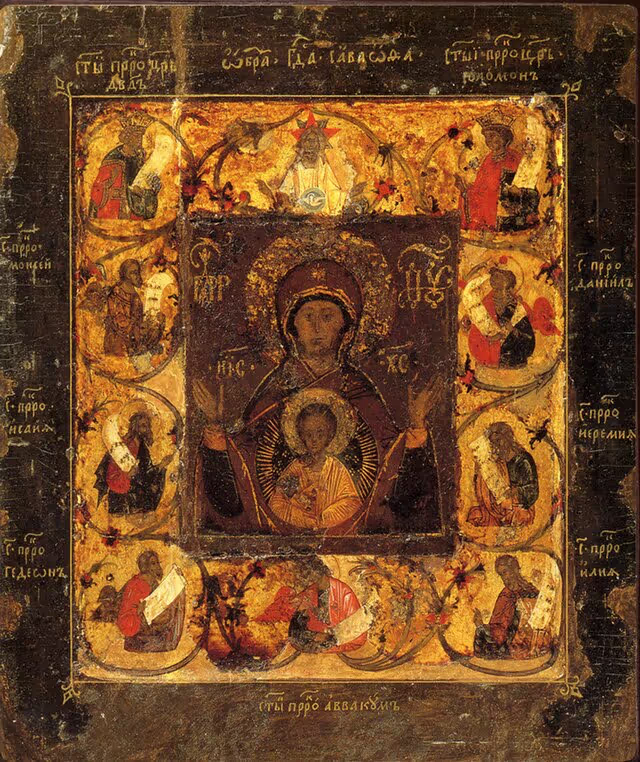
In the 12th century, the region of Kursk—like almost all of Russia at that time—suffered terrible devastation from the Tatar invasion. The city of Kursk was completely destroyed and turned into a desolate wilderness overgrown by primeval forest and inhabited by wild animals. The inhabitants of the city of Ryl’sk, about 90 versts (162 km) from Kursk, which by a happy chance had been spared the Tatar pogrom, used to go hunting there. Thus it happened that on September 8, 1295, the feast of the Nativity of the Most Holy Mother of God, a small band of hunters from Ryl’sk went to hunt by the River Tuskora, 27 versts (48.6 km) from Kursk. While one of the hunters, a venerable and pious man, was searching the forest for game, he came upon an icon of not very large size lying face-down on a tree root. Hardly had he lifted the icon to look at it when a strong, abundant spring of clear water gushed forth from the spot where it had lain.
The icon belonged to the type of Mother-of-God icons known as “Znamenie” (“Sign”). The hunter who found it realized this was no ordinary icon. He called his companions, and together they immediately cut wood for a small chapel in which they set up the icon they had found. When the people of Ryl’sk learned of the newly appeared icon of the Mother of God, they began to visit and venerate it, and numerous miracles occurred through this icon.
When Prince Vasily Schemjaka of Ryl’sk heard of the icon, he ordered that it be brought to the city of Ryl’sk, which was done with great festivity. The whole city went out in procession to meet the wonder-working icon being carried in. Only Vasily Schemjaka himself refused to take part in the celebration, whereupon he went blind. After fervent repentance and prayer before the icon, he regained his sight. In gratitude he built in Ryl’sk a church dedicated to the Nativity of the Mother of God, in which he had the icon placed; from then on, September 8, the day of its appearance, was kept annually as its feast.
But the icon did not remain long in Ryl’sk. Three times it disappeared from there in a wondrous manner and was found again at the place where it had first appeared to the hunter. Then the people of Ryl’sk understood that it pleased the Mother of God for her icon to remain at the place of its appearance; so they built a chapel there and placed the icon in it permanently.
In 1385 the region of Kursk was again ravaged by the Tatars. They also tried to burn the chapel and the icon, but the wooden chapel would not catch fire. The priest who lived next to the chapel, Father Bogolep, told them that the cause of this miracle lay in the icon itself. Enraged, the Tatars chopped the icon in two and threw the halves in different directions, and they burned the chapel down. They took the priest captive and exiled him to Crimea, where he had to tend the Tatars’ herds. After some time he was ransomed by envoys of the Prince of Moscow who had come to the Tatar horde, and thus he returned to the site where the chapel had stood. After long searching with prayer and fasting, he found the two halves of the holy icon, put them together, and they grew together so well that no trace of the cut remained, and at that spot there appeared only something “like dew.”
When the inhabitants of Ryl’sk learned of this miracle, they wished to bring the icon back to their city, but again it returned from there to its place; from then on it remained there for almost two hundred years and was the cause of many miracles.
The city of Kursk was rebuilt in 1557 under Tsar Feodor Ioannovich, and at that time the holy icon was brought by his order to Moscow, where the pious tsar prayed much before it and had it set in a frame with a depiction of the Lord Sabaoth above and, at the sides, the prophets who had foretold the Mother of God. Tsarina Irina Feodorovna adorned the icon with a rich covering, after which the holy icon was returned to its chapel. In the same year, with the tsar’s support, a church of the Nativity of the Most Holy Mother of God was built in place of the chapel and a monastery was founded; in addition, over the spring at the site of the icon’s appearance another church was built, dedicated to the “Life-giving Spring.” The new monastery was called “Korennaya Pustyn” (“Root Hermitage”) in memory of the icon’s appearance upon a tree root.
In 1598, because of the incursion of the Crimean Tatars into southern Russia, the holy icon was brought to Kursk for safekeeping, and an exact copy of it was placed in the hermitage. In 1603 the False Dmitry carried it off from Kursk to his camp at Putivlj and then to Moscow, where it remained in the imperial apartments until 1615, when, by order of Tsar Mikhail Feodorovich, it returned to Kursk and was placed in the cathedral there—and in 1618 in the church of the Znamensky (“Sign”) Monastery. From that time the holy icon spent most of the year in Kursk and was only occasionally brought to the Korennaya Pustyn. From 1806 it was decreed by highest authority that the holy icon was to remain in the Korennaya Pustyn from the Friday of the 7th week after Pascha until September 12. On that day the holy icon was carried in a solemn procession from Kursk to the Korennaya Pustyn, stretching in all 27 versts (48.6 km) from the Znamensky Monastery in Kursk to the Korennaya Pustyn; it was brought back in the same way. This order was observed until 1919, when the holy icon left Russia.
In 1676 the holy icon made a journey to the Don to bless the Don Cossack regiments there. In 1684 Tsars Ivan and Peter Alexeyevich sent a copy of the holy icon to the Korennaya Pustyn with the command that this copy was to accompany the Orthodox warriors on their campaigns. In 1687 the holy icon visited the “great regiment.” In 1689 the regiments on the Crimean campaign received copies of the holy icon. In 1812 a copy of the holy icon was sent to Prince Kutuzov for the active army.
There were many copies of the holy Kursk icon “of the Root,” which were likewise famed as wonder-working.
On the night of March 7–8, 1898, malicious atheistic revolutionaries tried to blow up the wonder-working icon with an infernal device, but the Lord Jesus Christ further glorified His All-Pure Mother, for despite the terrible destruction in the church around the icon, the icon itself remained unharmed.
On April 12, 1918, the holy icon was stolen and plundered from the church of the Znamensky Monastery, but on May 2 it was found again and returned to its place.
Finally, in 1919 the holy icon left Russia in the company of Bishop Theophan of Kursk and Obojan and several of the brethren of the Znamensky Monastery and was brought to friendly Serbia. In 1920, at the request of General Wrangel, it visited Russian soil once more in the Crimea and remained there until the general evacuation of the Russian Army of General Wrangel in the first days of November 1920. The holy icon returned to Serbia, where it remained until 1944, when together with the Synod of Bishops it went abroad, and after the war it was in Munich with Metropolitan Anastassy.
In 1951 Metropolitan Anastassy moved to America. There the wonder-working icon found a place in the New Korennaya Hermitage in Mahopac near New York. Since 1957 it has resided permanently in the cathedral church of the Synod of Bishops in New York dedicated to it. From time to time the icon travels to places where Russian refugees have been scattered throughout the world. Now that Russian emigrants from Germany are moving to various parts of the world, all, insofar as they have the opportunity, pray before the icon prior to their departure and ask our wondrous Protectress for her help and blessing for life in new, unfamiliar places.
We have seen from the history of this holy icon that it has always traveled much, yet wherever it was taken it always returned to its native place. If it was not returned voluntarily, then it came back to its place on its own. We have also seen that all attempts to destroy the holy icon only led to its greater glorification. And as she shares our heavy exile and our life among foreign peoples of another faith, the holy icon most surely protects us from destruction by our enemies—and she will return again to her original place in the Korennaya Hermitage and in the Znamensky Monastery of the city of Kursk when the time appointed by the Lord is fulfilled. Let us firmly trust that this will be so; the whole history of the holy icon stands as a pledge of this. And she will also bring all of us back home—we who fall down before her with faith and love, who expect and seek her help and intercession.
Most Holy Mother of God, save us!


Help us bring the christian faith to modern seekers worldwide.
Godfinder relies on generous souls to sustain our multilingual platform, develop new tools like the Magic Cube, and support struggling believers. If our work has touched your heart, consider contributing to our nonprofit partner

Do you want to know More? Ask God’s Word!
Do you have questions, worries, or hopes? Feeling lost, burdened, or alone? “Ask God’s Word” brings you gentle guidance rooted in Scripture and the wisdom of the Church. Find hope and strength today!
