
Ethiopian Orthodox Beliefs: Faith and Practice Explained
Ask an Ethiopian Orthodox Christian what they believe, and more often than not they will not start with the nature of Christ. They will tell you what they cannot eat today. Wednesday and Friday are fast days nearly every week of the year, and depending on the season, whole months follow the same...

Ask an Ethiopian Orthodox Christian what they believe, and more often than not they will not start with the nature of Christ. They will tell you what they cannot eat today. Wednesday and Friday are fast days nearly every week of the year, and depending on the season, whole months follow the same discipline, no meat, no dairy, no eggs, sometimes no food at all until mid-afternoon.
Scripture itself gives this church its oldest memory of the Gospel reaching African soil. “And the angel of the Lord spake unto Philip, saying, Arise, and go toward the south unto the way that goeth down from Jerusalem unto Gaza, which is desert.” (Acts 8:26, KJV), and there he met an Ethiopian official reading the prophet Isaiah, who asked to be baptized on the spot (Acts 8:26-39). That single encounter shapes how Ethiopian Christians understand their own place in the biblical story, not as recent converts on the edge of Christendom but as a people who met the Gospel while the apostles were still alive.
What most articles on this subject miss is that doctrine, worship, fasting, and sacred objects in Ethiopian Orthodox life are not separate categories you can explain one at a time and then set side by side. They hold together. The confession that Christ is one united reality, divine and human, is the same confession that shapes the calendar, the reverence shown to the tabot resting on every altar, and the rhythm of a believer's kitchen. Describing only the unusual customs gives you an exotic picture. Describing the theology underneath gives you the actual church.
Ethiopian Orthodox beliefs center on the Holy Trinity, the confession that Christ is one united divine-human reality (called Tewahedo), a wide biblical canon, seven sacraments, and an ascetical life of fasting and veneration, all belonging to the Oriental Orthodox family rather than the Eastern Orthodox communion.
TL;DR: Key Takeaways
- The Ethiopian Orthodox Church goes back to the baptism of the Ethiopian official in Acts 8, became the faith of the Aksumite court in the fourth century, and has had its own patriarch since 1959.
- It confesses the Holy Trinity: one God in three eternal, co-equal Persons.
- Tewahedo means “made one”: in Christ, divinity and humanity are united in one incarnate reality, without division or confusion.
- Its Bible is commonly counted at 81 books, including 1 Enoch and Jubilees.
- It belongs to the Oriental Orthodox family, not the Eastern Orthodox communion, and lives its faith through seven sacraments, long fasts and the veneration of the cross.
How old is the Ethiopian Orthodox Church and how did it begin?
The Ethiopian Orthodox Church traces its first contact with the Gospel to the apostolic age through the baptism recorded in Acts 8, and historically it became the religion of the Aksumite royal court in the fourth century through St. Frumentius and King Ezana. It became a fully self-governing patriarchate, independent from the Coptic Church of Alexandria, only in 1959.

These are two different kinds of history, and it helps to keep them apart. The biblical memory of the Ethiopian official baptized by the deacon Philip belongs to sacred Scripture itself. The institutional story, a boy named Frumentius shipwrecked and enslaved on the Red Sea coast, later rising to become tutor and advisor at the Aksumite court, and eventually consecrated as the kingdom's first bishop by St. Athanasius of Alexandria, belongs to church history proper. For roughly sixteen centuries the Ethiopian Church remained under the spiritual authority of the Patriarch of Alexandria, receiving its bishops from Egypt. Full autocephaly, meaning the right to elect and consecrate its own patriarch, came only in 1959.
Ethiopian tradition adds a third layer again: the account of the Queen of Sheba's visit to Solomon (1 Kings 10:1-13) and the belief that her son Menelik later brought the Ark of the Covenant to Aksum. This national memory runs very deep in Ethiopian identity, and I do not wish to treat it dismissively. But it is a tradition of sacred history, not a doctrinal statement on the same level as the Trinity or the incarnation, and a careful reader does well to notice the difference.
Does the Ethiopian Orthodox Church believe in the Trinity?
Yes. The Ethiopian Orthodox Church confesses one God in three eternal, co-equal Persons, the Father, the Son, and the Holy Spirit, grounded in Christ's own command to baptize “Go ye therefore, and teach all nations, baptizing them in the name of the Father, and of the Son, and of the Holy Ghost:” (Matthew 28:19, KJV). It stands firmly within the ancient catholic confession shared by every apostolic church.

According to the Ethiopian Orthodox Tewahedo Church doctrinal page, the Church confesses one divine essence existing in three Persons, rejecting both the idea of three separate gods and the idea that Father, Son, and Spirit are merely three temporary masks worn by a single divine actor. As St. Basil the Great teaches in On the Holy Spirit, the Spirit is worshipped and glorified together with the Father and the Son, not as a lesser force but as fully God. This is not a late or borrowed doctrine for the Ethiopian Church; it is the same confession recited at every Liturgy I have served since my ordination in 2013, and I find it one of the quiet joys of ecumenical conversation that Ethiopian, Greek, Russian, Catholic, and most Protestant Christians can still say the Creed's words on the Trinity together, even where we differ elsewhere.
What does Ethiopian Orthodox Tewahedo mean, and how does it shape their Christology?
Tewahedo is a Ge'ez word meaning "being made one" or "unified." It names the Church's confession that the eternal Word of God truly became human, and that His divinity and humanity exist united in one incarnate reality, without division, confusion, or separation, so that the One who was born, suffered, and rose is never divided into two separate subjects.

This is sometimes called a miaphysite Christology, from the Greek for "one nature," and it needs careful handling. As St. Cyril of Alexandria writes in his Third Letter to Nestorius, there is one incarnate nature of God the Word, a phrase meant to protect the unity of Christ's person, not to erase His humanity. As St. Athanasius the Great teaches in On the Incarnation, the Word became what we are so that we might become what He is, a logic of salvation that only works if the same Christ is genuinely God and genuinely man. And as St. Gregory the Theologian insists in his Epistle 101 to Cledonius, whatever in our human nature is not truly taken up by Christ is left unhealed; his whole argument depends on Christ possessing a complete and real humanity, body, mind, and will together. Ethiopian Orthodox theology stands on exactly this Cyrillian ground. "Monophysite," with its older suggestion that Christ's humanity was swallowed up by His divinity, is not the term Ethiopian theologians use for their own faith, and using it carelessly misrepresents what they confess. Related: Orthodox Religion Beliefs: Beyond Debates and Definitions.
How Ethiopian Orthodox Beliefs Compare with Catholic, Eastern Orthodox, and Protestant Traditions
[COMPARISON_TABLE]
What books are in the Ethiopian Orthodox Bible?
The Ethiopian Orthodox biblical tradition is commonly described as holding 81 books, considerably wider than the 66-book Protestant canon, the 73-book Catholic canon, or the various Eastern Orthodox lists. It includes books such as 1 Enoch, Jubilees, and the three books of Meqabyan, which should not be confused with 1-4 Maccabees found in Western Bibles.

I find this a good moment to be honest about how messy canon history actually is across the whole ancient church, not only in Ethiopia. In my diploma thesis on the prophetic-eschatological character of the Book of Revelation, written at LMU Munich, I traced how unevenly that one book was received in the early centuries. The 85th Apostolic Canon omits it from its list of holy books. The Syriac Peshitta translation, made at the end of the second century, does not contain it at all, and for the first five centuries there is no trace of it in any Syriac-speaking church. The Council of Laodicea in 360 left it off its recommended reading list, and St. Gregory the Theologian's own catalogue of New Testament books skips it as well. Yet, as I noted in that research, Revelation was accepted early precisely by the Coptic and the Ethiopian churches, long before most Greek-speaking Christians fully settled the question, and it was not until the Council of Carthage in 419 that its place in the Western canon was finally fixed. I share this history because it should soften our instinct to treat the 66-book Protestant Bible as the unquestioned default against which every other canon is measured. According to The Habari Network, the Ethiopian tradition reflects a real and ancient church inheritance, not a later collection of folklore stitched onto a smaller Bible, though it is also honest to say that counting systems and manuscript groupings for the 81 books are not perfectly uniform across every Ethiopian edition.
What role do sacraments and prayer play in Ethiopian Orthodox worship?
Ethiopian Orthodox worship centers on seven sacraments, baptism, chrismation, repentance, Holy Communion, anointing of the sick, marriage, and ordination, framed by chanted prayer in Ge'ez, incense, long standing Liturgies, and deep reverence for the tabot that rests on the altar of every consecrated church.

The tabot is a consecrated tablet associated with the Ark of the Covenant and the tablets of the Law; it is what makes a church building a church in the fullest sense, and it is treated with the kind of reverence we would show the altar itself. “Is any sick among you? let him call for the elders of the church; and let them pray over him, anointing him with oil in the name of the Lord: And the prayer of faith shall save the sick, and the Lord shall raise him up; and if he have committed sins, they shall be forgiven him.” (James 5:14-15, KJV), a passage that grounds the Church's sacramental ministry to the sick and dying, Ethiopian Orthodox included. Fasting belongs inseparably to this sacramental life rather than standing apart from it as a private diet rule. As reported by The Eastern Church, citing figures that still require verification against the original Pew source, roughly 87 percent of Ethiopian Orthodox Christians keep the fast during holy periods and around 78 percent attend church weekly. Whatever the precise number turns out to be once checked against the original data, the pattern those figures point to is real: for Ethiopian Orthodox Christians, worship is not an occasional event but a rhythm that organizes the week and the year.
What does the Ethiopian Orthodox cross symbolize?
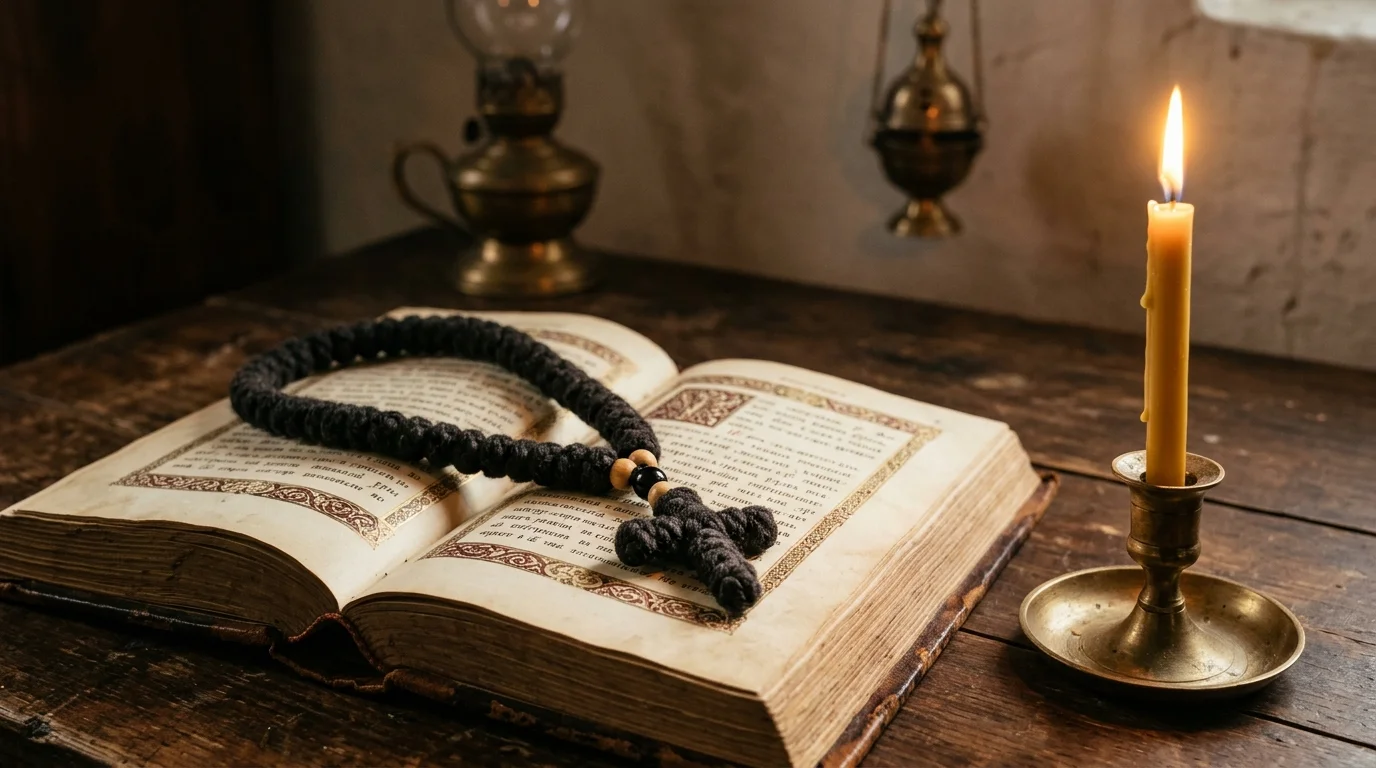
The elaborate lattice and geometric patterns of the Ethiopian cross proclaim the saving death and resurrection of Christ, the unity of creation drawn together in Him, and an unbroken line of Ethiopian Christian art stretching back centuries. The cross is venerated as a sign that points toward Christ; it is never worshipped as an object carrying power of its own.

That distinction, between venerating a sacred sign and worshipping God, is one the Church worked out carefully in its first centuries, long before any controversy over images. In my dissertation on Archbishop Filaret (Gumilevskij) of Chernigov, I examined his study of early Christian reverence for sacred images, where he gathers patristic testimony reaching back to Eusebius of Caesarea, who reports having personally seen an old icon of Christ that Julian the Apostate ordered destroyed. Filaret quotes St. Theodore the Studite's observation that the veneration of sacred images grew hand in hand with the spread of Christianity itself, not as a later addition but from the earliest generations. As St. John of Damascus summarizes in An Exact Exposition of the Orthodox Faith, honoring a cross or an icon directs the mind and heart toward the One it represents; it does not transfer worship, which belongs to God alone, onto wood, paint, or metal. The same logic protects the tabot and every venerated cross in Ethiopian worship.
What is the Ethiopian Orthodox Church's teaching on marriage and sexuality?
The Ethiopian Orthodox Church teaches that marriage is a sacramental, lifelong covenant between a man and a woman, calling for fidelity, chastity, and openness to family life, and it holds the traditional Christian teaching that sexual intimacy belongs within marriage, without affirming same-sex marriage.

I will not pretend this teaching is easy for everyone to hear in a modern context, and many of us wrestle honestly with how to hold moral conviction together with genuine compassion. What I can say plainly is that Orthodox moral teaching, Ethiopian or otherwise, has never been a checklist for condemning people; it is meant as medicine for the soul, aimed at repentance, mercy, and self-control rather than at scorekeeping. The Church calls every person to the same dignity and the same invitation to grace, regardless of struggle, and rejects cruelty, shaming, or violence toward anyone. Pastoral care for a person navigating questions of sexuality belongs with a trusted priest who knows that person, not with a general article, and I would encourage any reader facing this in their own life to seek that kind of patient, individual conversation. Learn more: What is Orthodox Christianity Beliefs? Uncover Now.
How many Ethiopian Orthodox Christians are there today, and where can you find a church near you?
Commonly cited estimates place around 36 million Ethiopian Orthodox Christians within Ethiopia, nearly half the country's population, though these figures still need confirmation against the original Pew data behind them. Readers looking for a local parish should check a diocesan or parish website directly and contact a priest before visiting.

According to the Knelstrom Factbook's 2016 estimate, Ethiopia's religious composition runs roughly 43.8 percent Ethiopian Orthodox, 31.3 percent Muslim, and 22.8 percent Protestant, an older figure that gives a sense of scale even if a newer count would be preferable. No reliable current total exists for Ethiopian Orthodox believers living outside Ethiopia, across the diaspora in Europe, North America, and elsewhere, so it is best not to treat the 36 million figure as a worldwide number. If you are searching for the Ethiopian Orthodox community nearest you, the most reliable path is still the oldest one in Christian life: find the parish, write or call ahead, and ask to come and see for yourself.
Father Victor's Perspective
What I wish to share with you is a small shift in how to read everything above. The usual way Western readers approach Ethiopian Orthodox belief starts with what sounds strange, one nature instead of two, an 81-book Bible, a replica Ark on every altar, and works outward from there. I would rather start with the problem Tewahedo theology is trying to solve: how do you keep Christians from quietly dividing Jesus into a human teacher on one side and a distant divine Son on the other? That division has haunted Christian history more than once, and the Ethiopian Church's insistence on the unity of Christ exists to guard a believer's confidence that the One who hung on the cross and the One who rose and reigns are the same Lord, not two.
I would also push back gently against a trope I see repeated often, that Ethiopian Orthodox customs are simply Old Testament practices preserved in Africa, as if fasting rules and the tabot were leftovers waiting to be modernized away. The more I have studied comparative liturgical theology, the more clearly I see this as the wrong frame entirely. Biblical memory in Ethiopian worship has been transfigured sacramentally. Fasting, chant, procession, and reverence for the tabot are not survivals from before Christ; they are expressions of an incarnational worldview where the physical world genuinely carries grace, the same conviction that underlies icons, holy water, and the Eucharist in every Orthodox church I know.
Finally, the most useful tool I can offer a reader trying to sort through this topic is a simple question to ask of any claim you encounter: is this dogma, liturgy, canon, or custom? The Trinity and the unity of Christ are dogma, settled and non-negotiable. The exact wording of an anaphora or the precise count of canonical books is closer to living tradition, real but historically textured. The Solomon and Sheba narrative, head coverings, or particular seating customs belong to national memory and local piety, meaningful but not doctrine in the same sense. Keeping those levels distinct is, in my experience, the single habit that prevents most of the confusion outsiders bring to this subject.
Common Misconceptions About Ethiopian Orthodox Beliefs
"Ethiopian Orthodox Christians do not believe Jesus is God." They do. “For in him dwelleth all the fulness of the Godhead bodily.” (Colossians 2:9, KJV) is as true for the Ethiopian Orthodox confession as for any Chalcedonian church. The confusion usually starts when someone hears that the Church rejects the Council of Chalcedon and assumes this must mean a denial of Christ's divinity or humanity. The actual disagreement concerns how to word the union of the two, not whether Jesus is truly God.
"Ethiopian Orthodoxy is just another branch of Eastern Orthodoxy, like Greek or Russian Orthodoxy." It is not. The Ethiopian Orthodox Tewahedo Church belongs to the Oriental Orthodox communion, together with the Coptic, Armenian, Syriac, Eritrean, and Malankara churches, according to The Habari Network's overview of Ethiopia's biblical tradition and church family. Both communions are ancient, sacramental, and deeply liturgical, but they followed separate historical paths after the fifth century and remain formally distinct.
"Tewahedo means Christ had only divinity and no real humanity." The word means unity, not erasure. Ethiopian Orthodox teaching affirms a genuine, complete human nature united with the divine Word, following the Cyrillian theology discussed above. The point of "one nature" language is to protect the oneness of Christ's person, not to remove His humanity. See also: What Is Orthodox Greek? Discover Its True Meaning.
"The Ethiopian Bible is just the Protestant Bible plus legends." The 81-book tradition reflects a long-standing, distinct church inheritance, not an arbitrary later addition. Different Christian traditions received and organized biblical books differently over the centuries, and the Ethiopian canon represents one of the oldest and most complete of these inheritances.
"Ethiopian Orthodox Christians worship the Ark, the tabot, crosses, or saints." Worship belongs to God alone. The veneration shown to the tabot, the cross, the Theotokos, and the saints directs attention toward God rather than competing with Him, in the same way kissing a Gospel book does not mean worshipping paper and ink.
"Ethiopian Orthodox moral teaching is just a list of harsh rules about food, sex, and ritual purity." Its ascetical practices belong to a larger vision centered on repentance, prayer, mercy, and sacramental life. Fasting and other disciplines function as medicine for the soul, not as a checklist for earning salvation or judging others.
Frequently Asked Questions
Do Ethiopian Orthodox believe Jesus is God?
Yes. The Ethiopian Orthodox Church confesses Jesus Christ as the eternal divine Word who became fully human while remaining fully God, united in one incarnate reality. This rests directly on texts like "In the beginning was the Word, and the Word was with God, and the Word was God... And the Word became flesh and dwelt among us" (John 1:1, 14), and on the confession that in Christ “For in him dwelleth all the fulness of the Godhead bodily.” (Colossians 2:9, KJV). Their disagreement with Chalcedonian churches concerns theological wording, never Christ's divinity itself.
Does the Orthodox Church support LGBT?
Orthodox Christianity, Ethiopian and otherwise, holds the traditional teaching that sexual intimacy belongs within marriage between a man and a woman and does not bless same-sex unions. At the same time, the Church insists on the full human dignity of every person and rejects cruelty, bullying, or contempt toward anyone, whatever their struggles. Pastoral guidance on any individual situation is best found in honest conversation with a priest rather than a general answer.
Do Ethiopian Orthodox drink alcohol?
Alcohol is not universally forbidden in Ethiopian Orthodox life, but strict fasting periods, which exclude animal products and can include abstaining from other indulgences, shape when and how it is used. As with most questions of personal discipline, the exact expectation can vary by parish, season, and individual pastoral guidance, so it is worth asking your own priest directly.
What's the difference between Ethiopian Orthodox and Orthodox?
"Orthodox" on its own usually refers to the Eastern Orthodox communion, Greek, Russian, Serbian, Romanian, and similar churches, which accept seven Ecumenical Councils including Chalcedon. Ethiopian Orthodox Christians belong instead to the Oriental Orthodox communion, which accepts the first three councils but not Chalcedon in the same way. Both share the Trinity, the sacraments, and reverence for Mary and the saints, but they are historically and canonically distinct families of churches.
About the Author
Father Victor Meshko is an Orthodox priest and theological advisor for Godfinder, serving in the Russian Orthodox Church Abroad at the Cathedral of the Holy New Martyrs and Confessors of Russia in Munich. A priest since 2013, he holds multiple theology degrees, including a Diplom in Theology from LMU Munich's Institute for Orthodox Theology, and he is the published author of a scholarly book on Archbishop Filaret of Chernigov. His background in both theology and psychology helps him explain complex Christian traditions with pastoral clarity for modern readers.
Researched and written by Father Victor Meshko. AI tools were used during the research process; theological and factual claims were reviewed by the author before publication.
<table class="seo-table comparison-table"> <caption>How Ethiopian Orthodox Beliefs Compare with Catholic, Eastern Orthodox, and Protestant Traditions</caption> <thead> <tr> <th>Aspect</th> <th>Ethiopian Orthodox</th> <th>Roman Catholic</th> <th>Eastern Orthodox</th> <th>Protestant</th> </tr> </thead> <tbody> <tr> <td>Church family</td> <td>Oriental Orthodox communion</td> <td>Catholic communion</td> <td>Eastern Orthodox communion</td> <td>Many different communions and denominations</td> </tr> <tr> <td>Christology</td> <td>Miaphysite: one united incarnate nature of the Word</td> <td>Chalcedonian: one Person in two natures</td> <td>Chalcedonian: one Person in two natures</td> <td>Usually Chalcedonian, though wording varies by tradition</td> </tr> <tr> <td>Councils received</td> <td>Accepts the first three Ecumenical Councils; does not receive Chalcedon in the same way</td> <td>Accepts Chalcedon and later councils</td> <td>Accepts seven Ecumenical Councils</td> <td>Views vary widely</td> </tr> <tr> <td>Biblical canon</td> <td>Traditionally counted as 81 books</td> <td>73 books in the standard canon</td> <td>Broader than Protestant canon in many jurisdictions; exact lists vary</td> <td>Usually 66 books</td> </tr> <tr> <td>Saints and Mary</td> <td>Strong veneration of Mary, angels, and saints</td> <td>Strong veneration of Mary and saints</td> <td>Strong veneration of Mary and saints</td> <td>Varies widely; many reject invocation of saints</td> </tr> <tr> <td>Fasting life</td> <td>Extensive fasting calendar integrated with worship</td> <td>Fasting disciplines vary by rite and region</td> <td>Extensive fasting calendar</td> <td>Often lighter or highly variable depending on denomination</td> </tr> </tbody> </table>


Help us bring the christian faith to modern seekers worldwide.
Godfinder relies on generous souls to sustain our multilingual platform, develop new tools like the Magic Cube, Ask God's Word and support struggling believers. If our work has touched your heart, consider contributing to our nonprofit partner

Do you want to know More? Ask God’s Word!
Do you have questions, worries, or hopes? Feeling lost, burdened, or alone? “Ask God’s Word” brings you gentle guidance rooted in Scripture and the wisdom of the Church. Find hope and strength today!
