.avif)
Do Greek Orthodox Say the Rosary? Discover Truth!
A woman came up to me after Liturgy a few months back, glancing around like she'd been caught doing something wrong. She had a Rosary tucked in her coat pocket, and she wanted to know if she needed to throw it away now that she was exploring Orthodoxy. For many people, the real question behind do...

Do Greek Orthodox Say the Rosary? The Rosary in My Coat Pocket
A woman came up to me after Liturgy a few months back, glancing around like she'd been caught doing something wrong. She had a Rosary tucked in her coat pocket, and she wanted to know if she needed to throw it away now that she was exploring Orthodoxy. For many people, the real question behind do greek orthodox say the rosary is not academic at all. I told her no. And then I watched her shoulders actually drop with relief.
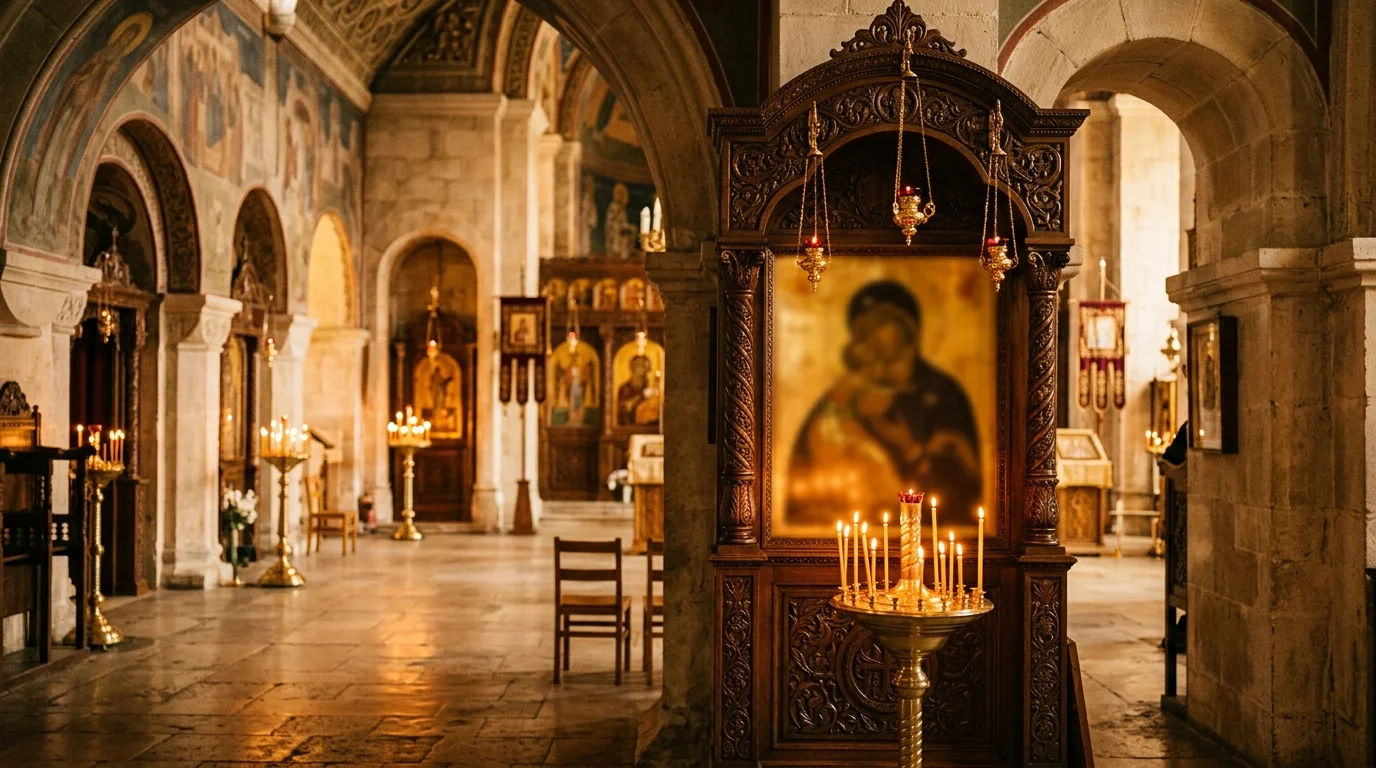
In my years of serving as an Orthodox priest since 2013, I've been asked this question more times than I can count, especially by people coming from Catholic backgrounds. And honestly, I've noticed something most articles about this topic completely miss: the question is almost never really about beads. It's about grief. It's about someone quietly wondering if becoming Orthodox means losing a prayer that raised them.
So let's talk about it honestly. Not as a doctrinal quiz, but as the real, tender question it usually is.
✏️ By Father Victor Meshko | 📅 Updated: September 2026 | ⏱️ 9 min read
Quick Answer: Greek Orthodox Christians don't typically pray the Roman Catholic Rosary; instead, they use a prayer rope called a komboskini, most often paired with the Jesus Prayer, though there's no absolute prohibition on private use of the Rosary.
In This Article:
- Do Greek Orthodox Say the Rosary? The Rosary in My Coat Pocket
- Do Greek Orthodox Say the Rosary? The Quick Answer
- Why Isn't the Rosary Normal Greek Orthodox Practice? Do Greek Orthodox Say the Rosary Historically?
- Do Greek Orthodox Say Hail Mary?
- Rosary Beads vs. Komboskini: What's the Real Difference?
- Father Victor's Perspective: What's This Question Really About?
- Common Misconceptions About Greek Orthodox and the Rosary
- Practical Guidance for Seekers and Converts
TL;DR — Key Takeaways
- Greek Orthodox Christians normally pray with a komboskini (prayer rope) and the Jesus Prayer, not the Rosary.
- Orthodox Christians do say a form of "Hail Mary," rooted in Scripture, but it's woven into liturgy rather than the Rosary structure.
- There's no universal Church ban on privately praying the Rosary, but it's not part of the Church's normative prayer life.
- The deeper question usually isn't permission. It's about which spiritual language forms your heart.
Do Greek Orthodox Say the Rosary? The Quick Answer
No, not as a rule. Greek Orthodox Christians pray with the komboskini, a knotted wool prayer rope, and the prayer most often attached to it is the Jesus Prayer: "Lord Jesus Christ, Son of God, have mercy on me, a sinner." According to the Orthodox Church in America on prayer, the Rosary in its present form dates to around the fifteenth century, centuries after the separation between East and West, so it simply never entered the Byzantine spiritual bloodstream.
Fr. Thomas Hopko put it plainly: the Rosary "is not a part of the Orthodox Christian tradition," since it developed long after Rome and Constantinople parted ways. That's a clear, honest answer. But I've found it rarely satisfies the person actually asking. When people ask, do greek orthodox say the rosary, they are often also asking whether love for Christ and His Mother must now be expressed in a different key.
The Short Answer for Seekers
Here's what I tell people over coffee after Liturgy. Orthodoxy isn't rejecting your love of Mary, or your love of repetitive prayer, or even your Rosary itself as an object. What it's offering is a different, older river to swim in, one that flows through the Desert Fathers, through Mount Athos, through the hesychasts, straight into your own heart. Not a rejection. An invitation.
Worth repeating: it's an invitation, not a command.
Why Isn't the Rosary Normal Greek Orthodox Practice? Do Greek Orthodox Say the Rosary Historically?
The short version: history. The Rosary as we know it, with its decades and its specific meditations, crystallized in the Western Church well after 1054. Orthodoxy simply developed along a different path, one shaped by the desert, by monasticism, by centuries of a very particular theology of attention.

History After the East-West Schism
Once the schism happened, East and West grew in somewhat separate directions liturgically and devotionally, even while sharing the same ancient roots. Rome developed the Rosary as a popular, accessible form of meditative prayer for lay people who couldn't read the Psalter. Meanwhile, the Christian East kept refining something older: the Jesus Prayer, already present in seed form in the Desert Fathers, later systematized by the hesychasts of the 13th and 14th centuries.
According to global Christianity statistics summarized by PrayFocus from the Center for the Study of Global Christianity, Orthodox Christians number around 291.6 million worldwide in 2025, roughly 11 percent of the world's Christians. That's not a fringe group with a quirky prayer habit. That's a massive, ancient, living tradition with its own complete spiritual grammar.
The Orthodox Prayer Rope and the Jesus Prayer
The komboskini is usually made of black wool, tied in intricate knots, often 33, 50, or 100 of them. You hold it, you pray the Jesus Prayer with each knot, and you let your mind sink, slowly, toward your heart. If you want a simple overview of the prayer rope's history and use, this brief guide on the prayer rope or chotki is helpful, even if it comes from outside Orthodox sources.
As St. Basil the Great says in his Homily on Psalm 1, we must remember God more often than we breathe. That's the whole point of the rope. Not counting for counting's sake. Remembrance. As St. Paul writes, we're called to “Pray without ceasing.” (1 Thessalonians 5:17, KJV), and the Jesus Prayer on a prayer rope is the Orthodox answer to that command, lived out in a very concrete, physical way.
Metropolitan Kallistos Ware once explained that the Jesus Prayer sits at the center of the hesychast tradition precisely because it fulfills this Pauline call to unceasing prayer, and the prayer rope itself is only an aid, never an end in itself. I find that distinction important. The rope isn't magic. It's a tool, nothing more.
Do Greek Orthodox Say Hail Mary?
Yes, actually. This one surprises people every time.

The Biblical Greeting to the Theotokos
Orthodox Christians pray a form of the angelic greeting rooted directly in Scripture. When the angel Gabriel greets Mary in Luke 1:28, and when Elizabeth, filled with the Spirit, blesses her in Luke 1:41-42, we get the biblical bones of what Catholics call the Hail Mary. In Orthodox worship, this usually takes the shape of "Rejoice, O Virgin Theotokos," chanted often in the Divine Liturgy and woven through countless hymns.
So no, we haven't dropped Marian prayer. We just never adopted the specific Roman medieval additions that came later, like "pray for us sinners, now and at the hour of our death," phrases that developed in the West after the schism. See also: How to Pray the Rosary PDF: Unveil Hidden Secrets.
Why Orthodox Marian Prayer Sounds Different
Here's where I think a lot of well-meaning articles get too tidy. Orthodox Marian devotion isn't less intense than Catholic devotion. It's just distributed differently, spread across the Akathist Hymn, the Paraklesis service, the daily hymns of Vespers and Matins, rather than concentrated into one repeatable formula. So when people ask, Do Orthodox pray to Mary or even Do greek Orthodox pray to Mary, the careful Orthodox answer is that we ask for her intercessions and honor her as Theotokos, but we worship God alone.
As St. John of Damascus writes in On the Orthodox Faith, Book IV, the Church honors the Theotokos but doesn't adore her as God. We seek her prayers the way we seek the prayers of any beloved family member who's gone ahead of us into glory (Hebrews 12:1 speaks of this great cloud of witnesses surrounding us). And we see her intercession active even in Scripture, at the Wedding at Cana, where she moves her Son to act on behalf of others (John 2:1-11). That's not a Rosary. But it's every bit as Marian.
Rosary Beads vs. Komboskini: What's the Real Difference?
People assume these are basically the same thing with different names. I understand why. Both involve knots or beads. Both involve repetition. Both involve Mary, at least somewhat.

Form, Content, and Spiritual Method
But the content and purpose diverge quite a bit. The Rosary structures prayer around five decades, each attached to a "mystery," a scene from the life of Christ or Mary that you're meant to picture and meditate on while your lips move through Hail Marys. The komboskini structures prayer around a single, short invocation of the Name of Jesus, repeated with as little mental imagery as possible.
That difference matters if you're comparing the Orthodox rosary vs Catholic rosary. What some people call a Greek Orthodox Rosary is usually not a rosary in the Roman sense at all, but a prayer rope used for the Jesus Prayer. In Slavic contexts, people also ask, Do russian Orthodox pray the Rosary or speak loosely of a Russian Orthodox Rosary; again, the more accurate term is ordinarily prayer rope, chotki, or komboskini.
Greek Orthodox Prayer Rope vs. Catholic Rosary vs. Typical Protestant Prayer Practice
[COMPARISON_TABLE]
Why Is Hesychasm Different from Imaginative Meditation?
This is where I think the real theological substance lives, and where I don't see other articles going deep enough. As St. Gregory Palamas explains in the Triads in Defense of the Holy Hesychasts, the mind returns to the heart in pure attention through noetic prayer. Noetic, meaning of the nous, the deepest faculty of spiritual perception we have. Orthodox prayer generally distrusts mental imagery during prayer, not because images are evil, but because we've learned, painfully, over centuries, how easily imagination becomes self-generated fantasy rather than genuine encounter with God.
Catholic meditation on the mysteries invites you to picture the Annunciation, the Nativity, the Crucifixion. Orthodox hesychasm asks you to set pictures aside and simply stand, in humility, before the Name of Jesus. Two beautiful paths. Genuinely different destinations of attention.
Some people ask me if this means Orthodoxy thinks imagination is dangerous or sinful in itself. I don't think that's quite right either. Let me put it more carefully: Orthodoxy is cautious, not condemning, about where unguarded imagination can lead a person during prayer, especially without a spiritual father's guidance.
Father Victor's Perspective: What's This Question Really About?
I've gone back and forth on how to frame this section, because I don't want it to sound like I'm scoring points for Orthodoxy against Catholicism. That's not the goal. Let me try again.

Prayer as Ecclesial Formation
Here's what I've come to believe after years of sitting with converts and seekers: the Rosary question is rarely, at bottom, a question about whether something is technically allowed. It's a question about belonging. "Whose spiritual grammar am I learning?" That's the real question underneath the surface one. Learn more: Do Catholics Pray to Saints? Discover the Truth.
Prayer rules aren't interchangeable techniques you can swap in and out like apps on a phone. And I say this having lived it myself, having been raised Catholic and having known that tradition well before I encountered Orthodoxy at Munich's Cathedral of the Holy New Martyrs. What I discovered is that prayer forms the mind of the person praying. It shapes the phronema, the mindset, of the Church into which you're being received. That's not a small thing. That's formation, slow and real, whether we notice it happening or not.
If you've been wrestling with do greek orthodox say the rosary, that's why the answer can feel bigger than a yes-or-no fact. The question reaches into memory, identity, and the slow reshaping of the heart.
A Gentle Path for Catholics Exploring Orthodoxy
So what does this actually look like in practice? A healthy pastoral response, in my experience, does two things at once. First, it refuses to shame anyone for loving the Rosary; that love is real, it's formed real faith, and it deserves respect, not mockery. Second, it gently invites the person from devotional continuity toward liturgical integration, where private prayer starts flowing naturally out of the Church's own worship rather than sitting beside it as a separate island.
I remember one young man, engaged to an Orthodox woman, who told me he felt like a traitor even considering giving up his Rosary. I didn't ask him to give up anything that day. I just handed him a komboskini and said, "Try this for a month. See what happens to your heart." A gift, really. Not a demand.
Six months later he was chrismated. He still keeps his childhood Rosary in a drawer. He told me once it reminds him where he started. I think that's exactly right, honestly.
Common Misconceptions About Greek Orthodox and the Rosary
"Greek Orthodox are basically Catholic, so they must say the Rosary too." Not quite. Both traditions share ancient roots, both are liturgical and sacramental, both deeply honor Mary. But the Rosary itself developed inside Roman Catholicism after the schism, so it never became part of normative Byzantine practice. Orthodox Christians honor Mary intensely, just through different forms.
"Orthodox Christians don't say Hail Mary at all." They do, in the biblical form rooted in Luke 1:28 and 1:41-42, chanted regularly as "Rejoice, O Virgin Theotokos." It's just embedded in the Liturgy and hymnography rather than in a Rosary structure.
"The prayer rope is basically an Orthodox Rosary." They look similar. They aren't. The komboskini grew out of Desert Father monasticism and hesychasm, centered entirely on the Jesus Prayer, while the Rosary developed centuries later in a different theological environment with a different method of meditation.
"If an Orthodox person prays the Rosary privately, they're violating Church teaching." As Orthodox pastoral sources note, there's no universal canonical prohibition here. It's simply not part of mainstream practice, and it shouldn't replace the Church's own prayer life. Discernment with your priest matters more than fear.
"Orthodox Christians find the Rosary offensive." Not at all, in my experience. It's respected as a genuine Catholic devotion. The issue was never offense. It's simply that it's foreign to our own ascetical inheritance. Discover: Do Catholics Pray to Mary? Insights from Both Traditions.
"Repetitive prayer is always vain repetition." Christ warns against empty babbling in Matthew 6:7-8, not against a humble heart returning again and again to His Name. There's a real difference between mechanical recitation and attentive, repentant prayer, whether that's a Rosary said with love or a Jesus Prayer said with distraction.
Practical Guidance for Seekers and Converts
If you're standing at this crossroads right now, here's what I'd actually say to you, not as theory, but as pastoral counsel I've given more times than I can count.

If You Already Pray the Rosary
Keep praying. Don't stop cold out of fear or guilt. Talk to a priest, ideally one who knows your story, and let him walk with you toward the Church's own prayer life at whatever pace fits your soul. Some priests move faster on this, some more gradually, especially with former Catholics, and that variation reflects pastoral wisdom, not disagreement on doctrine. If you're sorting through questions like do greek orthodox say the rosary, how to pray the Jesus Prayer and what a prayer rope is for may help you begin from the Orthodox side of the conversation.
How to Begin with a Prayer Rope
Get a komboskini. Hold it during morning or evening prayer. Say the Jesus Prayer slowly, one knot at a time, without rushing: "Lord Jesus Christ, Son of God, have mercy on me, a sinner." Some communities also use the Rule of the Theotokos, associated with St. Seraphim of Sarov, repeating the angelic greeting a set number of times alongside the Lord's Prayer. It's not universal across every parish, but it exists, and it might feel like familiar ground under new feet.
And if you're still asking, in a tender or even anxious way, do greek orthodox say the rosary, let the answer be gentle: usually not as the Church's normal practice, yes to honoring the Mother of God, and always yes to learning the prayer of the Church patiently, with guidance, peace, and hope.
Frequently Asked Questions
Do Greek Orthodox say Hail Mary?
Yes, in the biblical form rooted in Luke 1:28 and Luke 1:41-42, most often chanted as "Rejoice, O Virgin Theotokos" during services. Orthodox Christians honor Mary deeply, though this prayer is woven into liturgical worship rather than structured into a Rosary.
Do Greek Orthodox use rosary beads?
Not typically. Greek Orthodox Christians use a knotted wool prayer rope called a komboskini, paired with the Jesus Prayer, rather than Rosary beads structured around the five mysteries.
Is Greek Orthodox basically Catholic?
No, though the two traditions share ancient roots and much theology from before the 1054 schism. Greek Orthodox Christians differ from Roman Catholics on papal authority, certain doctrines, and devotional practices like the Rosary, while sharing a common inheritance in Scripture, the Fathers, and sacramental life.
Is Tom Hanks a Greek Orthodox?
Tom Hanks has spoken publicly about being a member of the Greek Orthodox Church, connected through his wife Rita Wilson's Greek Orthodox family background. I'll leave the details of any public figure's faith to their own words rather than speculate further here.
About the Author
Father Victor Meshko is an Orthodox priest of the Russian Orthodox Church Abroad, serving at the Cathedral of the Holy New Martyrs and Confessors of Russia in Munich since 2013. He holds multiple degrees in philosophy, theology, and psychology, including advanced theological study at LMU Munich's Institute for Orthodox Theology, and is the published author of Erzbischof Filaret (Gumilevskij) von Cernigov und Nezin. At Find to God, he writes with both scholarly depth and pastoral sensitivity for English-speaking seekers.
Researched and written by Father Victor Meshko. AI tools were used during the research process.
Lorem ipsum dolor sit amet, consectetur adipiscing elit. Suspendisse varius enim in eros elementum tristique. Duis cursus, mi quis viverra ornare, eros dolor interdum nulla, ut commodo diam libero vitae erat. Aenean faucibus nibh et justo cursus id rutrum lorem imperdiet. Nunc ut sem vitae risus tristique posuere.
Lorem ipsum dolor sit amet, consectetur adipiscing elit. Suspendisse varius enim in eros elementum tristique. Duis cursus, mi quis viverra ornare, eros dolor interdum nulla, ut commodo diam libero vitae erat. Aenean faucibus nibh et justo cursus id rutrum lorem imperdiet. Nunc ut sem vitae risus tristique posuere.
Lorem ipsum dolor sit amet, consectetur adipiscing elit. Suspendisse varius enim in eros elementum tristique. Duis cursus, mi quis viverra ornare, eros dolor interdum nulla, ut commodo diam libero vitae erat. Aenean faucibus nibh et justo cursus id rutrum lorem imperdiet. Nunc ut sem vitae risus tristique posuere.


Help us bring the christian faith to modern seekers worldwide.
Godfinder relies on generous souls to sustain our multilingual platform, develop new tools like the Magic Cube, and support struggling believers. If our work has touched your heart, consider contributing to our nonprofit partner

Do you want to know More? Ask God’s Word!
Do you have questions, worries, or hopes? Feeling lost, burdened, or alone? “Ask God’s Word” brings you gentle guidance rooted in Scripture and the wisdom of the Church. Find hope and strength today!
