.avif)
How to End a Prayer: A Gentle Guide for Seekers
If the word "Amen" feels like a lie you're not ready to tell, you don't have to say it. I mean that, and I say it as a priest. When people wonder how to end a prayer, they often assume there must be one right formula, in the right tone of confidence, or else the prayer somehow doesn't count. And if...

How to End a Prayer When the Word Feels Too Heavy
If the word "Amen" feels like a lie you're not ready to tell, you don't have to say it. I mean that, and I say it as a priest. When people wonder how to end a prayer, they often assume there must be one right formula, in the right tone of confidence, or else the prayer somehow doesn't count. And if you can't manage that confidence yet? You just... don't pray at all. Sound familiar?
In my years of serving as an Orthodox priest since 2013, I have found that many seekers worry far too much about the last words of prayer, when the deeper question is whether the heart is being offered to God in faith. I've sat with catechumens who apologize before they even start, as if God needs the paperwork in order first. And I've sat with people who don't call themselves religious at all, who whispered something honest into the dark one night, and then felt strange, almost fraudulent, not knowing how to close it or how to end a prayer simply and truthfully.
What most articles about ending a prayer miss is the lived experience underneath the words. Orthodox Christians don't just finish prayers with a phrase; they're formed, slowly, over years of services, where every final "Amen" trains the soul to consent to God's will and return to praise. That's the real subject here. Not vocabulary. Permission.
✏️ By Father Victor Meshko | 📅 Updated: September 2026 | ⏱️ 9 min read
Quick Answer: Orthodox Christians typically end a prayer with "Amen," often preceded by a short doxology to the Holy Trinity, but no single English formula is required for God to hear you.
In This Article:
- How to End a Prayer When the Word Feels Too Heavy
- How to End a Prayer: The Orthodox Christian Answer
- Why Do Orthodox Christians End Prayer with Amen?
- How to End a Prayer with Praise of the Holy Trinity
- Do I Need to Say 'In Jesus' Name'?
- Simple Orthodox Prayer Endings for Beginners
- How Does the Church End Her Prayers?
- Father Victor's Perspective: Prayer Endings as Spiritual Formation
- Orthodox, Catholic, and Protestant Prayer Endings Compared
- Common Misconceptions About Ending a Prayer
TL;DR — Key Takeaways
- You don't need an exact phrase like "in Jesus' name, amen" for your prayer to count.
- Orthodox tradition ends prayer with "Amen," often joined to praise of the Father, Son, and Holy Spirit.
- A short, honest ending, even just "Lord, have mercy" or silence followed by "Amen," is fully sufficient.
- How you end a prayer often reveals how you picture God, and Orthodox endings are meant to heal fear, not create it.
How to End a Prayer: The Orthodox Christian Answer
So let's get the practical question out of the way first, because I know that's what brought most of you here. If you're searching for how to end a prayer, the Orthodox answer is simpler and gentler than many people expect.


Quick Answer for Seekers
End your prayer with "Amen," a word that means "truly" or "so be it." You can say it alone, or after a short line of praise, such as "Glory to You, O God. Amen," or after asking for mercy through Christ. That's it. Not a script. An offering.
Our analysis of how seekers describe this question online (across forums, comment threads, private messages I get after Liturgy) shows something consistent: the anxiety isn't really about wording. It's about whether God is listening at all, and whether getting the words wrong might close the door. I don't think that fear ever fully goes away for some people. But it does soften, with time and with the right teaching. You can see that same concern in discussions like this seeker thread on how a prayer should end and this conversation about whether a simple prayer is acceptable.
Why Do Orthodox Christians End Prayer with Amen?
Approximately 291.6 million Orthodox Christians worldwide, according to Gordon-Conwell Theological Seminary's Center for the Study of Global Christianity (2025), end their prayers this way, day after day, in dozens of languages. That's not a small or eccentric habit. It's one of the oldest continuous practices in Christian worship.
What 'Amen' Means in Scripture and the Church
Amen isn't a period at the end of a sentence. It's closer to a signature. In Hebrew it means something like "truly" or "it is firm," and Scripture uses it as a seal on prayer and praise. We see this pattern at the end of Psalm 106:48, where the psalmist closes with blessing and the people's response, “Blessed be the Lord God of Israel from everlasting to everlasting: and let all the people say, Amen. Praise ye the Lord.” (Psalm 106:48, KJV). That double movement, blessing followed by assent, is basically the Orthodox instinct in miniature. If someone asks how to end a prayer in Hebrew, this is part of the answer too: the ancient Christian ending "Amen" comes to us directly from that biblical world.
As St. Basil the Great explains in On the Holy Spirit, chapter 21, saying "Amen" bears witness that we believe what we have prayed and desire its fulfillment. Not a magic syllable. A statement of trust.
And here's something I find genuinely moving, even after all these years: the Bible itself ends this way. Revelation 22:20-21 closes the entire Scripture with a short, almost breathless prayer, "He who testifies to these things says, 'Surely I am coming quickly.' Amen. Even so, come, Lord Jesus! The grace of our Lord Jesus Christ be with you all. Amen" (Revelation 22:20-21). If the last book of the Bible can end with something that short and that hopeful, so can your prayer tonight.
How to End a Prayer with Praise of the Holy Trinity
In our tradition, we understand prayer as fundamentally Trinitarian, addressed to the Father, through the Son, in the Holy Spirit. That shapes how we begin, and it shapes how we end. If you're learning how to end a prayer in an Orthodox way, this Trinitarian shape matters more than memorizing one exact English line.
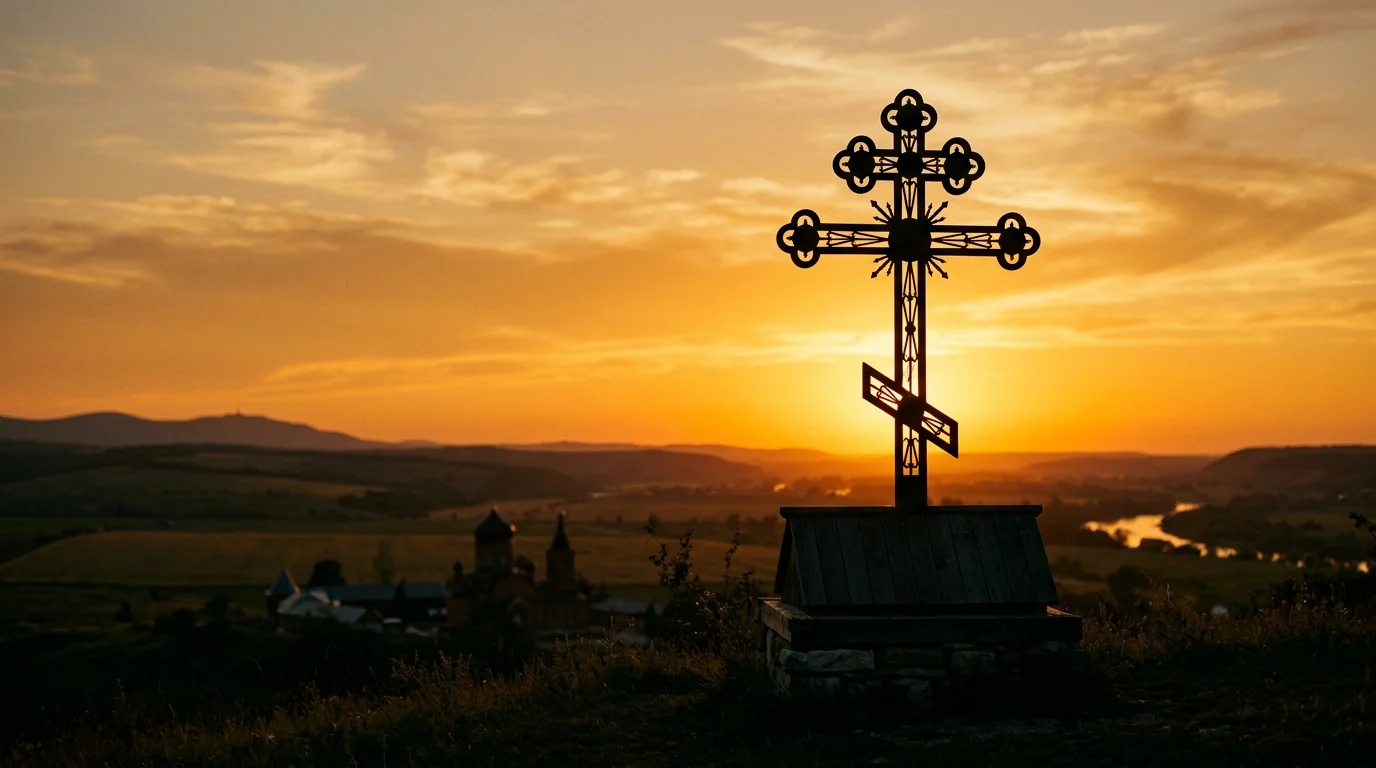
Why Doxology Matters
A doxology is simply a short burst of praise. "Glory to the Father, and to the Son, and to the Holy Spirit, now and forever and unto the ages of ages. Amen" is the classic Orthodox form, used constantly, after psalms, after litanies, after nearly everything. According to Catholicism.wiki's liturgical summary of the Gloria Patri, this ending is used across English-speaking Orthodox churches worldwide. For readers wanting a fuller Orthodox overview of prayer itself, the Orthodox Church in America prayer resources are also helpful.
As St. Gregory the Theologian teaches in Oration 27, it is fitting that prayer be concluded with thanksgiving and glorification of the Trinity. Metropolitan Kallistos Ware puts it simply: in liturgical worship, prayer begins and ends with doxology, glory given to the Holy Trinity. And Fr. Alexander Schmemann adds something I think about often, that the final "Amen" is the Church's assent, her joyful yes to God's gift and presence. Not a formality. A yes.
The Sign of the Cross at the End of Prayer
St. John of Damascus writes in Exposition of the Orthodox Faith, Book IV, that Christians begin and end all things with the sign of the Cross and the doxology of the Father, Son, and Holy Spirit. In practice, that means many Orthodox Christians simply cross themselves as they say "Amen." No words required beyond that gesture and the name of the Trinity. As St. Michael Ukrainian Orthodox Church notes in its catechetical guide to the Jesus Prayer, a beginner's practice may end with the sign of the Cross and a brief prayer of thanks. That's genuinely enough. If you'd like more on simple Orthodox prayer habits, see our Orthodox prayer rule for beginners.
Do I Need to Say 'In Jesus' Name'?
This is probably the single most common question I get, both in the confession line and from strangers who find our parish through the internet. Let me try to answer it honestly. Discover: How to Pray According to the Bible: True Guidance.

The Biblical Basis
Christ does tell His disciples, “And whatsoever ye shall ask in my name, that will I do, that the Father may be glorified in the Son. If ye shall ask any thing in my name, I will do it.” (John 14:13-14, KJV). And again, “And in that day ye shall ask me nothing. Verily, verily, I say unto you, Whatsoever ye shall ask the Father in my name, he will give it you. Hitherto have ye asked nothing in my name: ask, and ye shall receive, that your joy may be full.” (John 16:23-24, KJV). So yes, this is deeply biblical. Nobody is disputing that.
The Orthodox Clarification
Here's where I want to slow down, because I think this is where most explanations miss something important. To end a prayer "in Jesus' name" in an Orthodox way isn't primarily about pronouncing a phrase. It's about letting your final words align your heart with Christ's mercy, the Father's will, and the Spirit's peace. Fr. Thomas Hopko says it well: the characteristic ending of Christian prayer is the glorification of God and the affirmation "Amen," through Jesus Christ in the Holy Spirit. The verbal formula matters less than the orientation it expresses. So if you're asking how to end a prayer in Jesus' name, the deeper Orthodox answer is: end it in communion with Christ, whether or not you use that exact English wording every time.
As a parish priest in Munich, I'm often asked after services whether simply saying "Amen" is enough, and I've seen how much peace comes when people learn that Orthodox prayer isn't a verbal password but a living relationship. A catechumen once stayed behind after Vespers, clearly working up the nerve to ask something. He'd been copying Protestant prayer endings he'd picked up online, because he was genuinely afraid God wouldn't hear him otherwise. "Father, do I always have to say 'in Jesus' name, amen,' or my prayer doesn't count?" I told him what I'll tell you: Orthodox Christians absolutely pray through Jesus Christ, always, but the Church doesn't treat one English phrase as a required password. "Amen" alone, a Trinitarian doxology, the Jesus Prayer, or a short thanksgiving, all of these are fully Orthodox. He started praying more calmly after that. Stopped treating prayer like a test he might fail. That's the goal, honestly, for everyone I talk to.
How Christians Commonly End a Prayer: Orthodox, Catholic, and Protestant Comparison
[COMPARISON_TABLE]
Simple Orthodox Prayer Endings for Beginners
Let's make this concrete. If you want a handful of endings you can actually use tonight, here they are. For many people searching how to end a prayer examples, what they really need is permission to keep it simple.

Short Endings for Home Prayer
- "Amen." (Said slowly, with attention, this is complete.)
- "Glory to You, O God. Amen."
- "Lord Jesus Christ, have mercy on me. Amen."
- "In the name of the Father, and of the Son, and of the Holy Spirit. Amen," with the sign of the Cross.
- "O Lord, into Your hands I commend myself and all whom I love. Amen."
A tired mother in my parish once asked me almost apologetically whether an ending that short was too little, whether "Lord, have mercy" or "Glory to You, O God. Amen" counted as real prayer when she only had sixty seconds between getting the kids dressed and running out the door. I told her the opposite is true. Short, attentive prayer said with the whole heart is deeply Orthodox. St. Isaac the Syrian reminds us not to be anxious about many words, because even a single heartfelt glorification can be enough. She started praying briefly but steadily, and what she found, over months, was that consistency mattered more than length. Every single time. That is often the most important lesson in how to end a prayer: not elegance, but faithfulness.
What to Say Before 'Amen'
If you want something right before the "Amen," a short move toward praise or surrender fits naturally: "For Yours is the kingdom, the power, and the glory" (echoing the Lord's Prayer, Matthew 6:9-13), or simply "Let Your will be done." St. John Chrysostom says in his Homily on Ephesians 3 that we seal our petitions with "Amen." A seal, not a lock. It closes the letter. It doesn't undo what was written inside. In very practical terms, if you're wondering how to end a prayer before Amen, a brief act of praise, surrender, or thanksgiving is beautifully fitting.
I once worked with a young man wrestling with real anxiety, the kind that made him restart prayers over and over because he felt he'd ended them wrong or lost focus before finishing. "What if I forget the proper ending, Father, or my mind wanders before Amen?" I told him the end of prayer should move toward surrender, not scrupulosity. If his attention slipped, he could simply cross himself and say, "Lord Jesus Christ, have mercy on me. Amen," and let that be the whole prayer. Prayer became less obsessive for him after that. More peaceful. He started associating the ending of prayer with trust instead of fear, which, honestly, is the whole point. For people searching simple closing prayer patterns, this is often enough.
How Does the Church End Her Prayers?
Let's briefly look at what the Church herself does, because private prayer grows out of this soil.
Divine Liturgy
In the Byzantine Rite, every Eucharistic prayer, the anaphora itself, ends with a Trinitarian doxology followed by the people's Amen. Robert Taft's research on the structural evolution of the Byzantine Liturgy shows that these Trinitarian doxologies became universal in Eastern worship by the 4th and 5th centuries. This isn't a minor custom tacked onto the highest prayer of the Church. It's the pattern the highest prayer follows.
Compline and Daily Prayer Rules
According to OrthodoxChristianity101.com's overview of the Orthodox prayer rule, a typical rule opens with the Trisagion sequence and closes with the Lord's Prayer and "Amen." Aristotle Papanikolaou's research at Fordham describes this as a kind of doxological habitus, a habit of praise formed by repetition, that trains believers to see life itself as praise. I find that phrase genuinely helpful. We don't just end prayers with praise. We're slowly shaped by ending prayers with praise. For a fuller sense of that liturgical rhythm, see also our guide to how to pray the Jesus Prayer.
Here's a short video from an Orthodox parish teaching class that shows this in action, a priest walking through a prayerbook and demonstrating exactly how these endings sound in real practice.
[YOUTUBE_VIDEO]
Father Victor's Perspective: Prayer Endings as Spiritual Formation
I want to share something I've come to see clearly over years of confession and counseling, something I don't think most articles on this subject touch. Read more: What the Bible Says About Prayer and Silence.
From my studies in theology at LMU Munich and my pastoral work in confession and conversation, I've come to appreciate that the way a prayer ends often reveals how a person understands God: as a judge to satisfy, or as the Holy Trinity to whom we entrust ourselves. When someone tells me they keep restarting their prayers, or feel compelled to add more words out of fear, or bargain right up to the last second before "Amen," I've learned to hear that not primarily as a liturgical problem. It's usually a wounded image of God underneath. A rightly Orthodox ending, said without anxiety, actually works to heal that wound. It returns the soul to praise, to trust, to something closer to a child's confidence than a defendant's fear.
There's a second thing I've noticed, maybe even more important. Orthodox prayer endings aren't only conclusions. They're re-entry points into life. The final doxology teaches you how to leave prayer and walk back into your kitchen, your inbox, your waiting room, your grief, without leaving God's presence behind you. That's what I mean when I say the end of prayer is formation, not just etiquette. You're practicing, in miniature, how to carry the presence of God into an ordinary Tuesday.
I don't fully understand why this works the way it does. I've just watched it happen, in myself and in people I've sat across from for fifteen years now. And I keep coming back to something Archimandrite Sophrony wrote, that if prayer ends in self-satisfaction, it's barren, but if it ends in praise and thanksgiving, it's a true movement into God. That distinction has shaped how I counsel people more than almost anything else I studied in seminary.
Orthodox, Catholic, and Protestant Prayer Endings Compared
I knew the Catholic tradition quite well before my conversion, having been raised in it, so I want to say this carefully and without any edge to it.
Catholic prayer often ends with Amen and formulas like "Through Christ our Lord. Amen," which overlaps significantly with Orthodox practice. Many Protestant traditions, especially evangelical ones, commonly end with "In Jesus' name, amen," sometimes treated as close to the expected form, sometimes used more loosely. As seen in recurring seeker questions in ranked Reddit discussions, this exact question, whether you "have to" say it that way, comes up constantly across denominational lines. So when people ask how to end a prayer Catholic or compare that with Orthodox practice, there is real overlap, but also a different liturgical atmosphere around the ending.
What makes the Orthodox approach distinct isn't a rejection of any of this. It's the doxological and liturgical shape of the whole thing. Prayer doesn't just close politely. It participates, however briefly, in the Church's ongoing Trinitarian worship. That's the piece I wish more comparison articles actually explained instead of just listing phrases side by side.
Common Misconceptions About Ending a Prayer
Let me walk through a few things I hear constantly, gently, because most of these come from good intentions and honest fear, not bad theology.
"You must always end every prayer with 'in Jesus' name, amen,' or God won't hear you." Orthodoxy teaches that Christian prayer is always through Christ and in the Holy Spirit, but not every prayer needs one fixed English formula. This misunderstanding often comes from popular habits where a phrase functions almost like a password, even if that was never quite the intention. Praying in Jesus' name is deeply biblical; it's just understood first as a spiritual reality of communion with Christ, not a verbal key.
"Only long or formal endings are properly Orthodox." Not true, and honestly, kind of the opposite of true. The Church gives us both the cathedral and the prayer corner, solemn liturgical language and simple personal prayer, and they belong together. Visitors sometimes hear the beauty of a full Liturgy and assume private prayer has to match that scale. It doesn't.
"If I forget to end prayer properly, the prayer is invalid." Prayer is a real relationship, not a legal contract voided by an incomplete formula. If you lose focus or forget the words, a simple "Amen" or the sign of the Cross is enough. God sees intention and humility long before He notices whether you finished the sentence. Explore: Prayer of the Heart: An Orthodox Christian Guide to....
"Ending with 'Lord, have mercy' is only for monastics or clergy." "Lord, have mercy" is the prayer of the whole Church, not an advanced technique. Listen at any Divine Liturgy. The whole congregation says it, over and over. It belongs to ordinary life every bit as much as to the monastery.
"Orthodox, Catholic, and Protestant endings are basically the same, so there's nothing distinctive to say." All three traditions share "Amen" as common Christian inheritance, and that's worth honoring. But Orthodoxy places special weight on ending prayer within a liturgical, Trinitarian, doxological frame shaped by centuries of Byzantine worship. Similar surface, different depth.
"A successful prayer ending is mainly about feeling spiritually uplifted." Feelings matter, but they're not the measure. Prayer can end in tears, in silence, in dry gratitude, in simple faithfulness with nothing dramatic at all, and every one of those can be holy. The true end of prayer, as St. Seraphim of Sarov put it, is peace in the heart and the joy of the Holy Spirit, not a performance for yourself.
And maybe that's the simplest Orthodox answer to how to end a prayer: not by mastering a password, but by yielding yourself to God in trust. Whether your last words are "Amen," "Lord, have mercy," a brief doxology, or even a quiet sign of the Cross, the real end of prayer is praise, surrender, and peace.
Frequently Asked Questions
What should I say at the end of a prayer?
Say "Amen," which means "truly" or "so be it," either alone or after a short line of praise like "Glory to You, O God." In Orthodox practice, this is often paired with a Trinitarian doxology, but a plain, sincere "Amen" is complete on its own.
What is a good ending prayer?
"Glory to the Father, and to the Son, and to the Holy Spirit, now and forever and unto the ages of ages. Amen" is the classic Orthodox closing, used after psalms and prayers across English-speaking Orthodox churches worldwide. For something shorter, "Lord Jesus Christ, have mercy on me. Amen" works just as well.
What do you say at the end of each prayer?
Orthodox Christians commonly close with "Amen," the sign of the Cross, or a brief doxology to the Trinity. St. John of Damascus notes that Christians begin and end all things this way, with the Cross and the naming of Father, Son, and Holy Spirit.
How do you say a closing prayer?
Speak honestly to God, then close with praise or trust and a final "Amen." A simple pattern: name what's on your heart, add "Let Your will be done," and finish with "Amen," crossing yourself if that's part of your practice.
What if I forget to end my prayer properly?
Nothing is lost. Orthodox prayer is a relationship, not a contract voided by a missing formula, so a simple "Amen" or the sign of the Cross afterward is enough. If this fear feels persistent or heavy, it may be worth speaking with a priest, since the deeper issue is sometimes anxiety rather than a lack of information.
About the Author
Father Victor Meshko is an Orthodox priest of the Russian Orthodox Church Abroad, serving at the Cathedral of the Holy New Martyrs and Confessors of Russia in Munich in the Diocese of Berlin and Germany. Ordained since 2013, he holds multiple degrees in philosophy, theology, and psychology, including a Diplom in Theology and PhD studies at LMU Munich's Institute for Orthodox Theology, and he is the published author of Erzbischof Filaret (Gumilevskij) von Cernigov und Nezin. At Find to God, he writes from both scholarly formation and daily pastoral experience with seekers, catechumens, and parishioners.
I do not wish to hide or bury in the ground the treasure, the joy, and the happiness that were granted to me. I wish to share this experience with you, leaving each person the freedom of personal choice. My message is simple and sincere: trust in God, open your hearts to Him, participate in the Holy Mysteries of the Orthodox Church, and He will surely comfort you and lead you to a life that is deeper, more whole, and more joyful.
Researched and written by Father Victor Meshko. AI tools were used during the research process.
Lorem ipsum dolor sit amet, consectetur adipiscing elit. Suspendisse varius enim in eros elementum tristique. Duis cursus, mi quis viverra ornare, eros dolor interdum nulla, ut commodo diam libero vitae erat. Aenean faucibus nibh et justo cursus id rutrum lorem imperdiet. Nunc ut sem vitae risus tristique posuere.
Lorem ipsum dolor sit amet, consectetur adipiscing elit. Suspendisse varius enim in eros elementum tristique. Duis cursus, mi quis viverra ornare, eros dolor interdum nulla, ut commodo diam libero vitae erat. Aenean faucibus nibh et justo cursus id rutrum lorem imperdiet. Nunc ut sem vitae risus tristique posuere.
Lorem ipsum dolor sit amet, consectetur adipiscing elit. Suspendisse varius enim in eros elementum tristique. Duis cursus, mi quis viverra ornare, eros dolor interdum nulla, ut commodo diam libero vitae erat. Aenean faucibus nibh et justo cursus id rutrum lorem imperdiet. Nunc ut sem vitae risus tristique posuere.


Help us bring the christian faith to modern seekers worldwide.
Godfinder relies on generous souls to sustain our multilingual platform, develop new tools like the Magic Cube, and support struggling believers. If our work has touched your heart, consider contributing to our nonprofit partner

Do you want to know More? Ask God’s Word!
Do you have questions, worries, or hopes? Feeling lost, burdened, or alone? “Ask God’s Word” brings you gentle guidance rooted in Scripture and the wisdom of the Church. Find hope and strength today!
